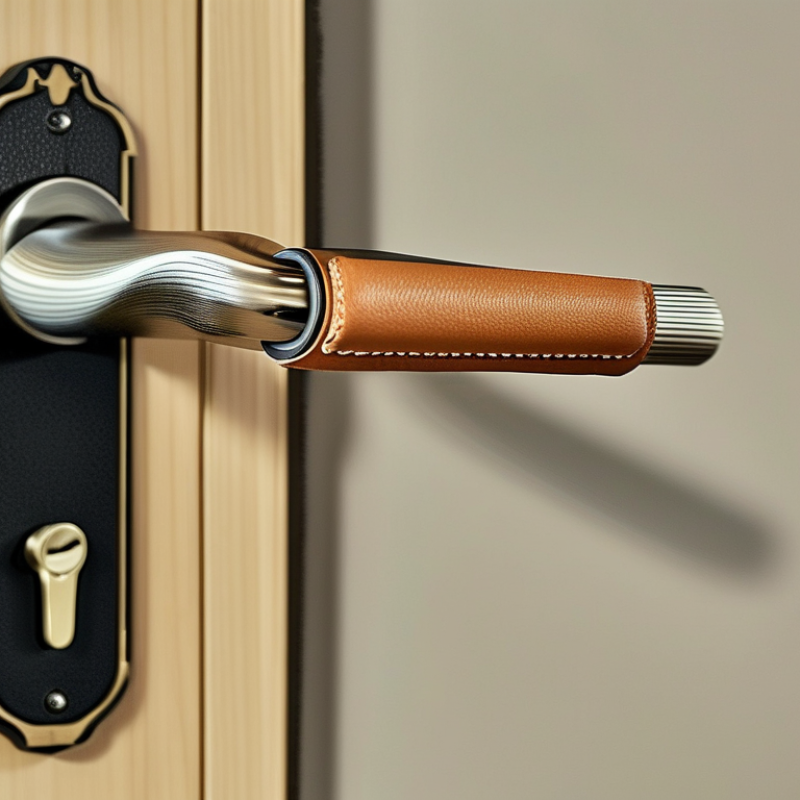
| Material Selection and Construction |
| Surface Material | Polyurethane leather, commonly called PU leather | PU resin coating laminated onto a textile or microfiber backing | Provides a uniform appearance, consistent color, and a broad range of surface textures. |
| Backing Fabric | Textile reinforcement layer | Commonly polyester, cotton-blend, or microfiber fabric | Supports dimensional stability and helps the covering conform to curved handle profiles. |
| Typical Covering Thickness | PU leather covering used for handle wrapping | Approximately 0.8–1.5 mm, depending on design and construction | Balances flexibility, tactile comfort, durability, and ease of forming around the handle. |
| Core Material | Handle substrate beneath the PU covering | Common options include stainless steel, aluminum alloy, zinc alloy, or engineered plastic | Allows buyers to select a suitable combination of strength, weight, corrosion resistance, and cost. |
| How PU Leather Door Handles Are Made |
| 1. PU Formulation | Preparation of the polyurethane coating | PU resin is blended with pigments, additives, and performance modifiers | Controls softness, color, gloss, abrasion resistance, and surface feel. |
| 2. Base Fabric Preparation | Cleaning, drying, and tension control of the backing fabric | Fabric is inspected for contamination, uneven tension, and visible defects | Reduces wrinkles, delamination, and inconsistent thickness during coating. |
| 3. Coating and Lamination | Application of PU layers onto the backing | One or more coating layers are applied and bonded to the textile backing | Creates the leather-like surface while maintaining flexibility for wrapping and forming. |
| 4. Embossing and Surface Finishing | Creation of grain, matte, smooth, or textured finishes | Embossing depth and surface gloss are adjusted according to the product specification | Supports different architectural styles and helps maintain a consistent visual appearance across batches. |
| 5. Cutting | Cutting PU leather panels or strips to size | Cut dimensions are matched to the handle length, diameter, seam position, and end treatment | Accurate cutting minimizes material waste and improves fit around the handle core. |
| 6. Handle Core Preparation | Machining, polishing, drilling, and cleaning of the core | Mounting holes and connection points are produced according to the installation design | Ensures compatibility with doors, screws, backplates, and specified hardware systems. |
| 7. Wrapping and Bonding | PU leather is formed around the handle core | Industrial adhesive, controlled pressure, and accurate seam alignment are used | Provides a secure covering with a smooth grip and reduced risk of lifting at the edges. |
| 8. Curing and Trimming | Adhesive curing followed by edge trimming | Typical curing time is approximately 24–72 hours, depending on adhesive and process conditions | Allows the covering to stabilize before final inspection and packaging. |
| 9. Final Inspection | Visual, dimensional, and functional checks | Inspection commonly covers color, wrinkles, seam alignment, adhesion, dimensions, and mounting performance | Helps maintain consistency for international projects and repeat orders. |
| Typical Quality and Performance Indicators |
| Abrasion Resistance | Resistance to repeated rubbing during daily use | Many commercial specifications target approximately 20,000–50,000 abrasion cycles, depending on the test method and product class | Important for hotels, offices, apartments, healthcare facilities, and other high-touch environments. |
| Color Fastness | Resistance to color transfer and fading | Commercial interior specifications commonly require grade 4 or better under the applicable testing method | Helps preserve a consistent appearance under frequent handling and routine cleaning. |
| Hydrolysis Resistance | Resistance to deterioration caused by heat and humidity | Performance is formulation-dependent; accelerated screening may use elevated temperature and high relative humidity | Relevant for humid climates, coastal regions, bathrooms, and poorly ventilated interior spaces. |
| Surface Cleaning | Routine care of the PU leather surface | Usually cleaned with a soft cloth and mild, non-abrasive soap solution | Supports simple maintenance without specialized leather treatment products. |
| Dimensional Consistency | Control of handle length, diameter, hole position, and covering fit | Final tolerances should be agreed in the technical drawing or purchase specification | Reduces installation problems and supports interchangeability across project quantities. |
| Why PU Leather Is Attractive to Global Buyers |
| Design Flexibility | Choice of color, grain, gloss, softness, and stitching detail | Custom surface patterns and colors can be developed without changing the basic handle structure | Supports residential, hospitality, commercial, and interior-design applications. |
| Consistent Appearance | Controlled synthetic surface production | Less natural variation than many genuine leather surfaces | Makes it easier to coordinate large quantities across doors and project locations. |
| Weight and Handling | Lightweight flexible covering combined with a selected structural core | Overall product weight depends mainly on the core material and handle dimensions | Can simplify packing, transportation, and installation planning. |
| Supply Planning | Roll-based covering material and repeatable production process | Standardized materials can support repeat production when color and texture references are retained | Useful for phased construction projects and replacement orders. |
| Cost Position | Material and manufacturing cost compared with many genuine leather constructions | Often positioned as a cost-controlled decorative covering, subject to core material and customization | Provides a balance between premium appearance, tactile comfort, and project budget control. |