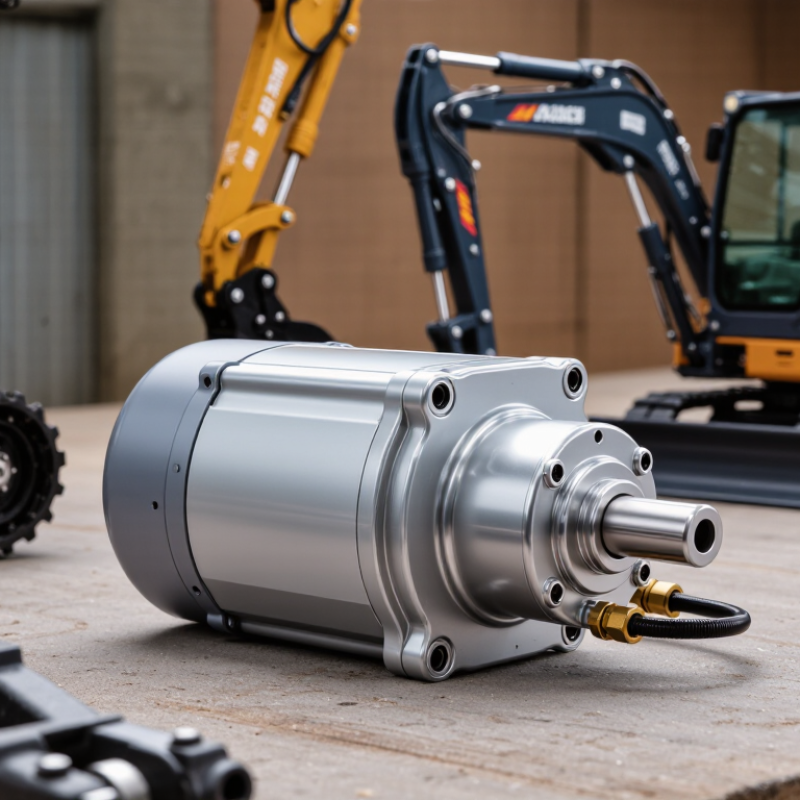
| Machine Operating Weight | Mini excavators, compact track loaders, small agricultural machines, and access equipment generally operate below 10,000 kg. | Choose a motor whose continuous and peak torque can move the fully loaded machine on the steepest intended surface. | Motor sizing based only on empty machine weight can cause poor gradeability, overheating, and premature wear. | Use the maximum operating weight, including attachments, payload, fuel, and accessories. |
| Required Tractive Force | Tractive force depends on machine weight, rolling resistance, slope, and acceleration requirements. | Calculate resistance forces first, then apply a design safety factor commonly between 1.2 and 1.5. | The motor must provide enough wheel or sprocket force without operating continuously at its pressure limit. | Check both flat-ground travel and the maximum working gradient. |
| Motor Displacement | Small travel motors commonly use fixed or two-speed displacement designs to balance torque and travel speed. | Select displacement according to required output torque, hydraulic flow, and final-drive ratio. | Larger displacement produces more torque at the same pressure but normally requires more hydraulic flow for the same speed. | Confirm that the selected displacement matches the available pump flow and reduction gearbox. |
| Output Torque | Compact-machine travel systems often require high starting torque for turning, climbing, and overcoming static resistance. | Compare continuous torque and peak or breakaway torque separately; do not use peak torque as the continuous rating. | Starting and obstacle-crossing loads can be considerably higher than steady travel loads. | Verify torque at the actual system pressure and the intended motor displacement. |
| Hydraulic Pressure | Many compact mobile hydraulic systems operate in the approximate range of 210–350 bar, depending on machine design. | Select a motor with continuous and intermittent pressure ratings above the machine’s real operating pressure. | Insufficient pressure capacity may result in leakage, seal damage, reduced service life, or motor failure. | Allow for pressure spikes during sudden stops, turning, slope travel, and obstacle impact. |
| Hydraulic Flow | Small travel circuits may provide roughly 20–100 L/min per motor, depending on pump capacity and machine size. | Match motor flow capacity to the pump’s continuous and maximum flow output. | Excessive flow can cause overspeed and heat generation; insufficient flow reduces travel speed. | Use the motor’s displacement and flow to estimate speed: motor speed is approximately flow divided by displacement. |
| Travel Speed | Compact machines commonly require a low-speed range for precise work and a higher-speed range for repositioning. | A two-speed motor is useful when the machine needs both high tractive effort and faster travel. | Low speed improves control and torque; high speed reduces transport and repositioning time. | Check maximum motor speed, gearbox ratio, sprocket diameter, and track or wheel circumference together. |
| Final-Drive Reduction | Hydraulic motors are normally connected to planetary reduction gearboxes in tracked or wheeled travel systems. | Use a reduction ratio that converts motor speed into the required wheel or sprocket speed while increasing output torque. | The gearbox determines the final balance between travel speed, tractive force, and mechanical durability. | Confirm allowable gearbox input speed, output torque, ratio, and mounting dimensions. |
| Brake Configuration | Mobile machines may need the drive to hold position when hydraulic pressure is removed. | Use a spring-applied, hydraulically released parking brake when a fail-safe holding function is required. | A mechanical brake helps prevent unintended movement during parking, loading, or hydraulic shutdown. | Check brake holding torque, release pressure, emergency-stop behavior, and maximum slope. |
| Machine Layout and Envelope | Compact equipment has limited space around the track frame, wheel hub, hoses, and structural members. | Select a compact motor with suitable flange, shaft, port orientation, and overall length. | A physically smaller motor can simplify installation and protect components from interference or impact. | Compare mounting bolt pattern, pilot diameter, shaft connection, port size, and hose bend radius. |
| Turning and Counter-Rotation | Tracked machines may operate one motor forward and the other in reverse during spot turns. | Select motors with matching displacement, speed characteristics, and pressure capability on both sides. | Balanced drive performance improves straight-line tracking, turning control, and maneuverability. | Test motor synchronization, leakage balance, and performance during counter-rotation. |
| Thermal Capacity | Continuous travel, high ambient temperature, restricted airflow, and frequent turning increase heat generation. | Choose a motor and circuit capable of dissipating heat at the expected duty cycle. | Excessive oil temperature lowers lubricant viscosity and accelerates seal and component wear. | Evaluate case-drain requirements, oil-cooling capacity, duty cycle, and allowable oil temperature. |
| Filtration and Cleanliness | Travel motors contain precision hydraulic surfaces that are sensitive to contaminated oil. | Use filtration and oil cleanliness levels recommended for the hydraulic components in the circuit. | Clean hydraulic oil reduces scoring, sticking valves, internal leakage, and premature failure. | Check return-line filtration, suction protection, flushing procedures, and contamination control. |
| Efficiency | Compact machines benefit from low energy loss because they often use small engines, batteries, or limited cooling capacity. | Compare volumetric and mechanical efficiency at the actual pressure, speed, and temperature range. | Higher efficiency provides more useful tractive force and reduces heat and fuel or battery consumption. | Review performance curves rather than relying only on nominal displacement or maximum pressure. |
| Service and Maintenance | Construction and agricultural equipment may operate in mud, dust, water, and abrasive environments. | Prefer a sealed, serviceable design with accessible ports, drain provisions, and replaceable wear components. | Simple inspection and maintenance can reduce downtime and extend the travel-drive life. | Confirm seal protection, drain routing, replacement-part availability, and inspection intervals. |