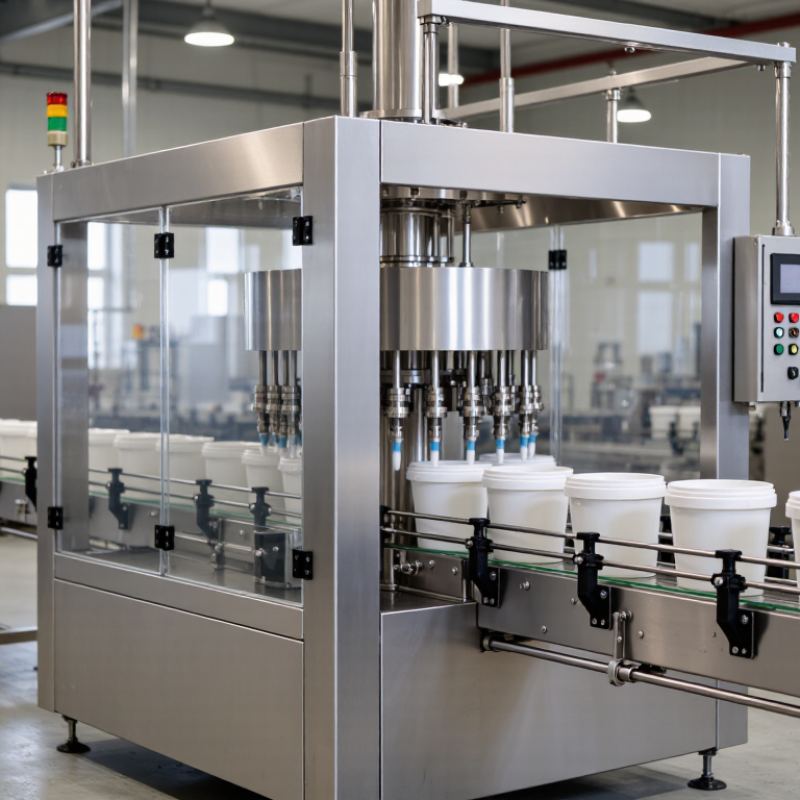
| What it is | An operator measures and transfers product into each bucket. | A dosing system fills the bucket after an operator positions it under the filling head. | An integrated line automatically feeds, fills, weighs, closes, and conveys buckets. |
| Typical products | Small batches of powders, granules, liquids, pastes, or viscous products. | Paint, coatings, adhesives, food ingredients, chemicals, detergents, and construction materials. | High-volume liquid, powder, granular, and semi-liquid products requiring repeatable production. |
| Common bucket sizes | Approximately 1–25 L, depending on operator handling and product weight. | Approximately 1–25 L; larger sizes may be possible with suitable equipment. | Approximately 5–30 L is common in industrial packaging; the actual range depends on the line design. |
| Typical output | About 10–60 buckets per hour. | About 60–300 buckets per hour. | About 200–1,200 buckets per hour, depending on product, fill volume, and machine configuration. |
| Filling accuracy | Often around ±1–3%, with variation caused by operator technique and product properties. | Commonly around ±0.5–1%, when correctly calibrated and matched to the product. | Commonly around ±0.1–0.5% for weight-based systems; actual accuracy depends on the load cell, product, and target weight. |
| Labor requirement | High; one or more operators usually handle measuring, filling, and movement. | Medium; an operator typically loads containers and starts or monitors each filling cycle. | Low per unit; operators mainly supervise the line, replenish materials, and perform quality checks. |
| Production consistency | Highly dependent on operator skill, fatigue, and working conditions. | More consistent because the dosing cycle and target quantity are controlled. | Highly consistent when the product feed, sensors, and control settings are stable. |
| Product waste | Usually higher because of overfilling, spillage, and manual transfer. | Usually lower because the filling quantity is controlled by a timer, flow meter, or weighing system. | Generally lowest when the machine uses accurate weighing, automatic shutoff, and optimized product feeding. |
| Best production scale | Product trials, custom orders, seasonal production, and very low-volume operations. | Small- to medium-scale production with several product or container changes. | Medium- to large-scale production with stable demand and repeatable packaging formats. |
| Changeover flexibility | Very high; changes can be made without machine adjustments. | High; many systems allow recipe, fill-volume, or nozzle adjustments. | Medium to high; changeover may require parameter updates, tooling changes, and cleaning. |
| Space requirement | Minimal. | Typically compact, often requiring approximately 1–3 m² of working space. | Larger footprint, commonly requiring approximately 5–20 m² for the filling and conveying section. |
| Operating principle | Manual volume or weight measurement. | Timed, volumetric, flow-meter, auger, piston, or weight-based dosing. | Automated container handling combined with volumetric or gravimetric dosing and programmed controls. |
| Main advantages | Lowest initial cost, simple operation, and maximum flexibility for irregular jobs. | Better accuracy and productivity without the full cost or complexity of a complete automated line. | High throughput, repeatable filling, reduced labor per bucket, and easier production monitoring. |
| Primary limitations | Slow output, inconsistent fill levels, and greater exposure to spills or ergonomic strain. | Still requires operator involvement and may not meet high-volume production targets. | Higher investment, greater maintenance requirements, and less economical for very small batches. |
| Why choose a bucket filling machine? | Suitable when flexibility is more important than speed or precision. | A practical choice for improving accuracy and output while retaining operator control. | A strong choice when production volume, filling consistency, labor efficiency, and waste reduction are priorities. |