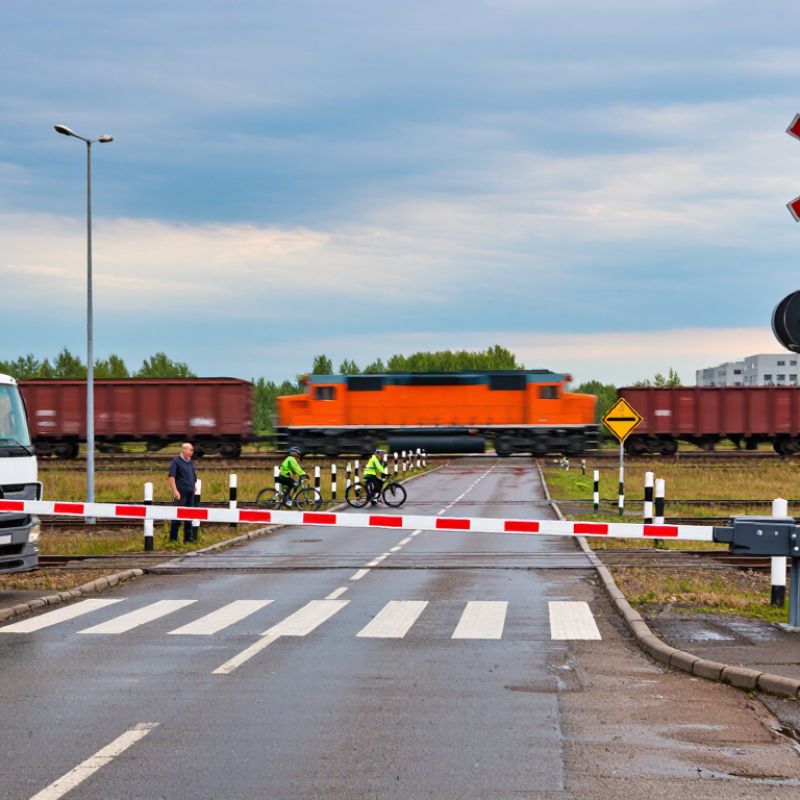
| Early awareness | Advance warning signs and pavement markings | A railway crossing is ahead and conditions may require a complete stop. | Reduce speed, scan both directions, and prepare to stop. | Gives drivers, cyclists, and pedestrians more time to make a safe decision. |
| Crossing identification | Crossbuck or railway-crossing sign | The roadway and railway intersect at this location. | Treat the crossing as a yield or stop-controlled hazard, according to local law. | Makes the crossing recognizable even when no train is visible. |
| Train approach alert | Alternating flashing red warning lights | A train is approaching, occupying the crossing, or the warning system is active. | Stop before the stop line or designated stopping point and remain stopped. | Provides a highly visible warning in daylight, darkness, and poor weather. |
| Audible warning | Bell, horn, or other audible alarm | A crossing warning is active, including when visual conditions are limited. | Stop and do not proceed until the warning ends and the crossing is clear. | Supports people who may not immediately see the lights, including distracted or visually impaired road users. |
| Physical protection | Lowering gates or barriers | The crossing must not be entered because a train is approaching or present. | Stop before the gate; never drive around, under, or through a lowered barrier. | Creates a strong physical and visual boundary against entering the track area. |
| Track clearance | Stop line and clear-zone markings | The safe stopping position is before the tracks and away from moving rail equipment. | Stop at the marked location and keep the crossing exit clear. | Reduces the risk of a vehicle being trapped on the tracks or struck by a train. |
| Visibility improvement | Reflective surfaces, lighting, and illuminated signs | The crossing and its warning equipment remain identifiable at night or in low visibility. | Slow down, keep headlights and windows clear, and check for trains. | Improves recognition when darkness, rain, fog, or glare reduces sight distance. |
| Decision reliability | Multiple coordinated warning methods | Visual, audible, and physical warnings reinforce the same stop instruction. | Obey the most restrictive warning and wait until it is safe and legal to proceed. | Reduces dependence on a single sense or a single piece of equipment. |
| Emergency response | Emergency notification instructions | A stopped vehicle, damaged equipment, or obstruction on the tracks requires immediate reporting. | Move away from the tracks when possible and contact the appropriate emergency service using the posted information. | Helps responders identify the exact crossing and address a dangerous obstruction quickly. |