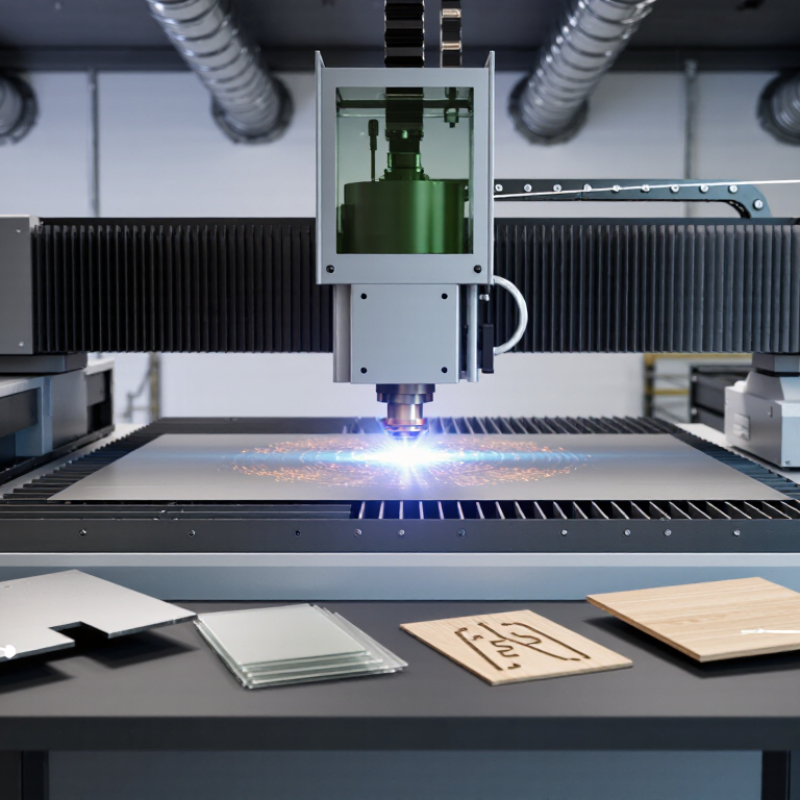
| Definition | An industrial laser cutter is a computer-controlled machine that uses a focused, high-energy laser beam to cut, engrave, or perforate materials. | It converts digital design files into precise physical components with limited mechanical contact and repeatable results. |
| Primary Cutting Process | The laser locally melts, vaporizes, or burns the material. An assist gas, such as oxygen, nitrogen, or compressed air, removes molten material from the cut zone. | This process produces narrow kerfs, clean profiles, and complex shapes without the physical cutting forces associated with many conventional tools. |
| Common Laser Sources | Fiber lasers are commonly used for metal sheet and plate cutting. CO2 lasers can process many nonmetallic materials and some metals. Solid-state and specialized laser sources serve specific production requirements. | The laser source is selected according to material type, thickness, reflectivity, required speed, and operating cost. |
| Typical Industrial Power Range | Approximately 1 kW to more than 20 kW for industrial metal-cutting systems. Lower-power systems are used for thin materials, marking, engraving, and nonmetallic work. | Higher power generally increases cutting capacity and productivity, but the appropriate level depends on material, thickness, gas selection, and process settings. |
| Typical Materials | Carbon steel, stainless steel, aluminum, copper, brass, galvanized sheet, plastics, wood, textiles, paper, and composite materials, depending on the laser type and machine configuration. | Material compatibility must be verified before processing. Some materials can release hazardous fumes or may be unsafe to cut with certain laser wavelengths. |
| Typical Metal Thickness Capability | Thin sheet metal can be cut from below 1 mm. Industrial systems may cut mild steel, stainless steel, or aluminum from several millimeters to several tens of millimeters, depending on laser power and process conditions. | Actual capacity varies with material grade, surface condition, focal configuration, assist gas, edge-quality requirements, and permissible production speed. |
| Typical Cutting Speed | From several hundred millimeters per minute to several meters per minute. Thin sheet materials can often be processed faster than thick plate. | Cutting speed affects throughput, heat input, edge quality, operating cost, and the risk of dross or incomplete penetration. |
| Positioning Accuracy | Many industrial systems provide positioning accuracy in the range of approximately ±0.01 mm to ±0.05 mm under specified operating conditions. | Accurate motion control supports tight part tolerances and consistent alignment between cutting operations. |
| Cut Kerf Width | Typically about 0.1 mm to 0.5 mm, depending on the laser type, nozzle, focal spot, material, and cutting parameters. | A narrow kerf reduces material waste and enables detailed contours, small holes, and closely nested parts. |
| Motion and Control System | Industrial machines commonly use computer numerical control, servo-driven axes, automatic height sensing, nesting software, and programmable process parameters. | Automation improves repeatability, reduces manual setup, and allows rapid production of different part geometries. |
| Work Area | Common sheet-processing tables range from approximately 1,500 × 3,000 mm to 2,000 × 6,000 mm, with larger formats available for specialized applications. | The work area determines the maximum sheet size, nesting efficiency, material-handling requirements, and floor-space needs. |
| Core Manufacturing Purpose | To cut accurate two-dimensional profiles, openings, slots, and internal features directly from digital drawings. | Industrial laser cutting is used to manufacture parts for machinery, transportation equipment, construction, electrical enclosures, appliances, and general fabrication. |
| Major Advantages | High precision, narrow kerf, low tool wear, fast design changes, reduced setup time, good repeatability, and the ability to create intricate geometries. | These benefits support flexible production, lower tooling requirements, and efficient processing of both prototypes and production batches. |
| Main Limitations | High initial investment, energy consumption, required ventilation, optical and mechanical maintenance, material reflectivity concerns, and reduced efficiency on very thick or unsuitable materials. | Production planning should consider machine capacity, safety controls, gas costs, maintenance schedules, and the total cost per part. |
| Safety Requirements | Industrial systems generally require enclosed beam paths, interlocked access panels, fume extraction, fire protection, trained operators, and procedures appropriate to the laser class and material. | Safety controls protect operators from laser radiation, hot metal, sparks, fumes, compressed gases, and high-voltage equipment. |
| Typical Output Quality | Well-configured machines can produce smooth, narrow cuts with limited burr or dross. Quality depends on material, thickness, focus, nozzle condition, power, speed, and assist-gas pressure. | Consistent process control can reduce or eliminate secondary deburring and finishing operations for many applications. |
| Best-Fit Applications | Precision sheet-metal fabrication, prototype development, short-run production, mass production, decorative panels, electrical cabinets, brackets, machine components, and customized parts. | The technology is especially valuable when designs change frequently or when complex profiles would require expensive dies or multiple machining operations. |
| Key Selection Factors | Material type, maximum thickness, sheet dimensions, required tolerance, production volume, cutting speed, automation level, assist-gas availability, software compatibility, and service requirements. | Evaluating these factors helps match the machine configuration to actual production needs rather than selecting solely by laser power. |
| Important Operating Note | Performance figures are typical industry ranges, not universal specifications. Actual results depend on machine design, material condition, process parameters, and operator practice. | A production trial and supplier-provided technical data should be used to confirm achievable thickness, tolerance, speed, and edge quality. |