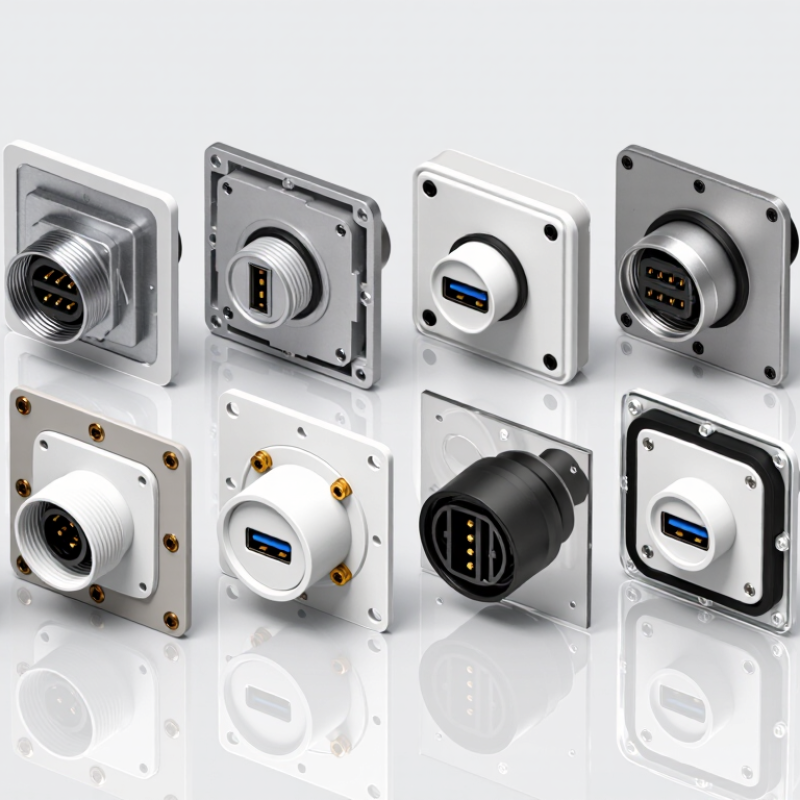
| 1 | USB 2.0 USB-C panel feedthrough | Up to 480 Mbps | Typically up to 15 W at 5 V/3 A, if the connector and cable are rated accordingly | IP-rated versions are available; confirm whether the rating applies when mated, capped, or both | Service ports, control panels, and low-bandwidth peripherals | Check whether the feedthrough carries all required USB-C pins and supports the intended charging mode |
| 2 | USB 2.0 high-current USB-C panel feedthrough | Up to 480 Mbps | Up to 25 W at 5 V/5 A only when the connector, source, and 5 A-rated cable support that current | Choose a gasketed or sealed design for exposed panels; protect the port when unmated | Low-speed equipment that needs higher 5 V charging current | Verify the connector’s current rating and cable requirements; data rate and power capability are separate specifications |
| 3 | USB 3.2 Gen 1 USB-C feedthrough | Up to 5 Gbps | USB Power Delivery can support up to 100 W (20 V/5 A) when the complete assembly is designed and rated for it | Sealed versions exist; high-speed performance depends on the quality of the complete panel assembly | Ruggedized data ports, cameras, and general-purpose equipment | Confirm both the stated data rate and any USB PD rating; neither should be inferred from the connector shape |
| 4 | USB 3.2 Gen 2 USB-C feedthrough | Up to 10 Gbps | Up to 100 W with a compatible USB PD implementation and appropriately rated cable and connector | Check whether sealing hardware affects the specified signal performance | External storage, machine vision, and faster peripheral connections | Look for a documented 10 Gbps rating for the assembled feedthrough, not just for the cable or device |
| 5 | USB 3.2 Gen 2x2 USB-C feedthrough | Up to 20 Gbps | Power depends on the assembly; USB PD can reach up to 100 W where all components support it | Use a manufacturer-tested sealed assembly, since signal integrity is more demanding at higher speeds | High-speed external storage and data-intensive portable equipment | Verify 20 Gbps support end to end; a USB-C receptacle alone does not establish this capability |
| 6 | USB4 20 Gbps USB-C feedthrough | Up to 20 Gbps | Power is determined by the product’s PD implementation; up to 100 W is possible in a suitably rated design | Confirm that the sealed connector and attached cable are qualified for the stated USB4 rate | Compact systems requiring USB4 connectivity through an enclosure | Check USB4 compatibility and the supported link rate in the assembly documentation |
| 7 | USB4 40 Gbps USB-C feedthrough | Up to 40 Gbps | USB PD may support up to 100 W; higher power requires a compliant EPR-capable design | High-speed sealing solutions require careful cable, gasket, and mounting design | High-performance docks, displays, and data-intensive systems | Confirm the 40 Gbps rating for the complete feedthrough path and check the required cable length |
| 8 | USB4 Version 2 USB-C feedthrough | Up to 80 Gbps; up to 120 Gbps in one direction for supported asymmetric operation | Up to 240 W is possible with USB PD EPR when the source, cable, and connector are all rated for it | Do not assume a generic sealed feedthrough supports USB4 Version 2; require explicit qualification | Specialized, next-generation high-bandwidth systems | Check the exact supported mode, cable requirements, and power rating in the product documentation |
| 9 | USB 2.0 bulkhead feedthrough with protective cap | Up to 480 Mbps | Usually intended for standard USB-C charging; confirm the specific current rating | A cap can help protect an unmated port; the stated ingress rating may differ between capped and mated states | Outdoor control boxes, field equipment, and ports exposed to dust or splashes | Read the IP-rating test conditions and follow instructions for cap installation and mating |
| 10 | USB 3.2 Gen 1 rugged sealed bulkhead assembly | Up to 5 Gbps when the complete assembly is rated for this speed | Up to 100 W USB PD is possible only if the connector, cable, and PD electronics are specifically rated | Some assemblies are specified to IP67 when correctly installed and mated; verify the exact conditions | Industrial enclosures, mobile equipment, and installations exposed to water or dust | Check panel thickness, cutout, gasket compression, mating state, and whether the ingress rating applies to the installed assembly |
| Comparison note: These are generic connector configuration classes, not specific product models. USB-C describes the connector form factor; actual data rate, charging power, and ingress protection depend on the complete connector assembly, cable, host, device, installation, and test conditions. USB PD power ratings are maximums for compatible systems, not guaranteed capabilities of every bulkhead connector. |