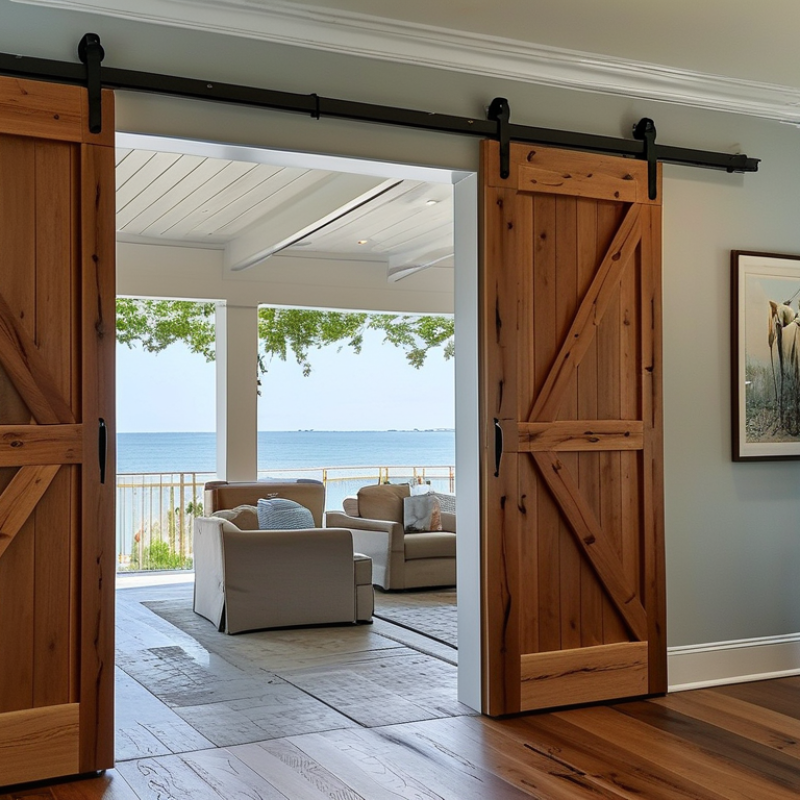
| Door Configuration | Two-panel barn door design with a central horizontal division and sliding hardware compatibility. | Suitable for bedrooms, bathrooms, studies, pantries, closets, and interior room dividers. |
| Available Materials | Solid softwood, engineered wood, MDF, or mixed wood construction, subject to the selected specification. | Material choices support different price points, weight requirements, finish expectations, and regional preferences. |
| Standard Door Sizes | Common single-door widths include approximately 610, 762, and 914 mm; common heights include approximately 1,981 and 2,032 mm. | Metric sizing supports international projects, while inch-equivalent sizing helps buyers serving North American markets. |
| Custom Dimensions | Custom width, height, thickness, panel proportion, and pre-drilled hardware positions can be requested. | Useful for renovation projects, non-standard openings, hospitality interiors, and private-label collections. |
| Panel and Edge Details | Options may include raised or flat panels, square or eased edges, decorative grooves, and concealed or visible joints. | Design flexibility allows the product to match modern, farmhouse, rustic, traditional, and transitional interiors. |
| Surface Finishes | Unfinished, clear-coated, stained, painted, distressed, and color-matched finishes are available depending on material. | Buyers can select ready-to-install finishes or request unfinished panels for local coating and customization. |
| Hardware Compatibility | Compatible hardware packages may include steel sliding rails, rollers, door stops, anti-jump discs, floor guides, and handles. | Complete hardware options simplify installation and reduce the need for separate sourcing. |
| Moisture Considerations | Interior-use construction; moisture-resistant materials and protective coatings should be specified for humid environments. | Important for buyers serving coastal, tropical, bathroom, or high-humidity applications. |
| Quality-Control Process | Recommended checkpoints include incoming material inspection, moisture-content checks, dimensional verification, sanding inspection, coating inspection, and final packaging review. | A documented inspection process helps reduce warping, surface defects, inconsistent color, and transit damage. |
| Applicable Quality References | Buyers may request production controls aligned with ISO 9001 principles, applicable ASTM or EN requirements, and project-specific inspection standards. | The exact standard should be confirmed according to the destination market, building code, and intended installation. |
| Sustainable Material Documentation | FSC-certified material, recycled-content documentation, or chain-of-custody records may be requested when available for the selected wood product. | Documentation supports green-building submissions, responsible-sourcing policies, and retailer compliance programs. |
| Sample and Approval Process | Pre-production samples can be used to approve dimensions, panel layout, color, surface texture, hardware placement, and packaging. | Sample approval reduces specification errors before bulk production and export shipment. |
| Packaging Method | Typical protection includes corner guards, foam or honeycomb padding, moisture-resistant wrapping, carton packing, and palletization for larger orders. | Packaging specifications can be adjusted for container loading, warehouse handling, and retail distribution. |
| Export Documentation | Commercial invoice, packing list, bill of lading or airway bill, certificate of origin, and material documents can be prepared when required. | Complete documentation supports customs clearance and importer record-keeping. |
| Shipping Modes | Sea freight is appropriate for commercial quantities; air freight or courier services may be used for samples and urgent small shipments. | Multiple transport options allow buyers to balance delivery speed, shipment volume, and logistics cost. |
| Trade Terms | Quotations may be structured under commonly used Incoterms such as EXW, FOB, CIF, or DDP, subject to destination and order conditions. | Clear Incoterms allocation defines freight, insurance, customs, and delivery responsibilities. |
| Order Flexibility | MOQ, mixed-model ordering, custom packaging, and private-label requirements should be confirmed before quotation. | Flexible ordering is beneficial for distributors testing new designs or managing multiple market segments. |
| Buyer Verification Checklist | Confirm material grade, moisture content, actual tolerances, finish samples, hardware load rating, test reports, packaging photos, and export references before purchase. | Independent verification helps ensure that the delivered product matches the approved specification and destination-market requirements. |