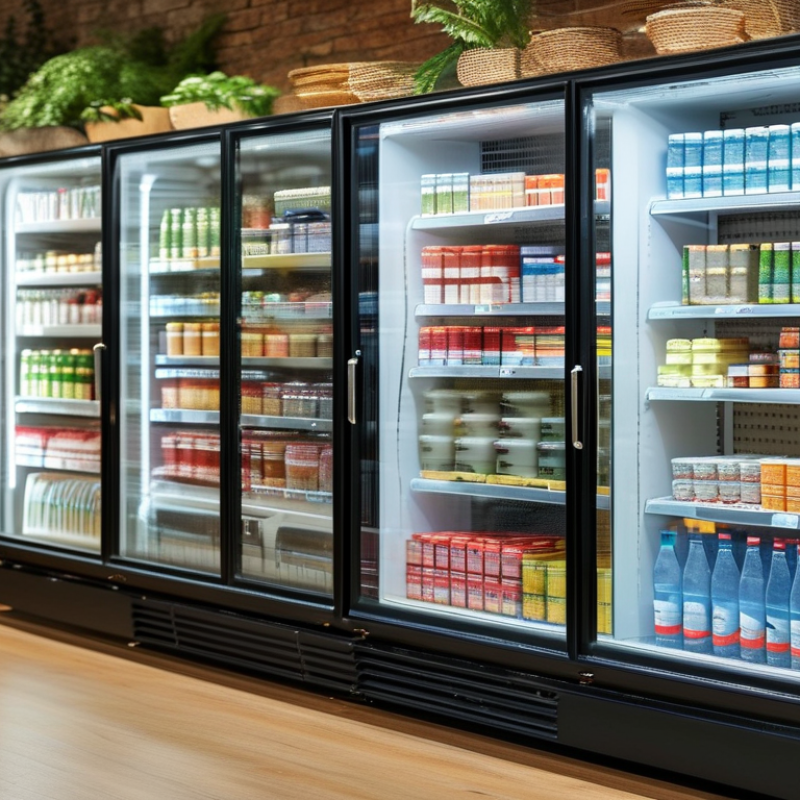
| Product Type | Glass-door upright merchandisers, under-counter units, countertop display coolers, or compact chest freezers | The correct cabinet format affects sales visibility, floor-space usage, loading capacity, and energy consumption. | Product catalogue, dimensional drawings, installation guide, and application photos |
| Net Storage Capacity | Approximately 80–700 litres for compact shop refrigeration, depending on cabinet format | Net capacity is more useful than external volume when comparing usable retail space. | Verified net-volume specification based on the applicable test standard |
| Chilled Operating Range | Common commercial display-cooling range: approximately 0°C to +10°C; many beverage units operate around +2°C to +8°C | Temperature suitability affects food safety, beverage quality, and compliance with local requirements. | Factory test report, temperature-control settings, and climate-class rating |
| Frozen Operating Range | Typically about −18°C to −24°C for compact commercial freezers | Stable low-temperature performance is essential for frozen-food quality and inventory protection. | Pull-down test, temperature-uniformity data, and rated ambient operating conditions |
| Refrigerant | Low-global-warming-potential refrigerants such as R290 are widely used in suitable small commercial systems; refrigerant choice must match local regulations and safety requirements | Refrigerant regulations vary by market, and flammable refrigerants require appropriate design, labeling, servicing, and installation controls. | Refrigerant type, charge quantity, safety classification, and compliance declaration |
| Energy Performance | Compare measured daily energy use in kWh/24 h under the same test conditions rather than relying only on nominal input power | Electricity cost is a major part of lifetime ownership cost for continuously operating refrigeration. | Energy test report, annual consumption estimate, rated power, and test ambient temperature |
| Climate-Class Capability | Select equipment rated for the intended store environment; common commercial classes include 25°C, 30°C, and 35°C test conditions | A cabinet designed for a mild indoor environment may lose performance in hot and humid retail locations. | Climate-class marking, laboratory report, and maximum ambient-temperature specification |
| Electrical Compatibility | Confirm voltage, frequency, plug type, phase, starting current, and protection requirements for each destination market | Electrical mismatch can cause safety risks, failed inspections, warranty disputes, or installation delays. | Electrical nameplate, wiring diagram, plug specification, and destination-market test report |
| Safety and Compliance | Supplier should provide valid conformity documentation for the destination market, including electrical safety, electromagnetic compatibility, and refrigerant-related requirements where applicable | Compliance documentation supports customs clearance, retail installation, insurance, and product-liability management. | Declaration of conformity, safety certificates, EMC reports, and technical construction file |
| Temperature Recovery | Request measured recovery time after door opening, product loading, or a defined power interruption | Fast, stable recovery helps protect products during busy trading periods. | Standardized recovery test with load quantity, ambient temperature, and test duration |
| Noise Level | Ask for an acoustic rating measured under defined conditions; compact commercial units commonly require special attention in small shops and hospitality areas | Lower operating noise improves customer comfort and is important where refrigeration is located near staff or seating areas. | Sound-pressure measurement, test distance, background-noise conditions, and operating mode |
| Door and Glass Design | Evaluate double glazing, anti-condensation performance, self-closing hardware, door durability, and replaceable seals | Door design influences energy loss, product visibility, condensation control, and maintenance cost. | Door-cycle test data, glass specification, gasket part numbers, and replacement procedure |
| Materials and Corrosion Protection | Use corrosion-resistant cabinet finishes, coated or stainless internal surfaces, and materials suitable for humid commercial environments | Material quality affects service life, hygiene, appearance, and suitability for coastal or high-humidity locations. | Material specifications, coating thickness, salt-spray data where relevant, and cleaning instructions |
| Minimum Order Quantity | Stock programs may allow small trial orders; customized production often requires a higher quantity agreed during quotation | MOQ affects inventory exposure, cash flow, product testing, and the feasibility of market entry. | Written MOQ by model, customization surcharge, packaging requirement, and sample-order terms |
| Production and Delivery Lead Time | Separate sample lead time, standard production lead time, peak-season lead time, and international transit time | A clear timeline supports store openings, promotional campaigns, and replenishment planning. | Quotation validity, production schedule, shipping terms, port of loading, and historical on-time delivery data |
| Warranty Coverage | Check separate coverage periods for the complete unit, compressor, control system, glass, and consumable parts | Different component warranties can materially change the buyer’s repair risk and total ownership cost. | Warranty policy, exclusions, claim procedure, labor coverage, and proof-of-purchase requirements |
| Spare-Parts Availability | Prioritize suppliers able to identify and supply controllers, fans, sensors, door seals, shelves, lighting, and refrigeration components | Long parts availability reduces downtime and prevents premature equipment replacement. | Parts catalogue, recommended spare-parts list, stock policy, and service-part pricing |
| After-Sales Support | Look for multilingual technical manuals, remote troubleshooting, service training, and defined response times | Responsive support is especially important when the buyer has no local refrigeration engineering team. | Support contact details, service-level agreement, troubleshooting flowchart, and training materials |
| Packaging and Export Readiness | Packaging should protect glass, corners, doors, shelves, and refrigeration components during multimodal transport | Effective export packaging reduces transit damage, claims, installation delays, and reverse-logistics costs. | Packaging specification, drop or vibration test data, package dimensions, gross weight, and loading plan |
| Total Cost of Ownership | Compare purchase price, freight, duties, installation, electricity, maintenance, spare parts, and expected service life | The lowest purchase price may not produce the lowest long-term operating cost. | Itemized quotation, energy data, maintenance schedule, parts pricing, and end-of-life provisions |