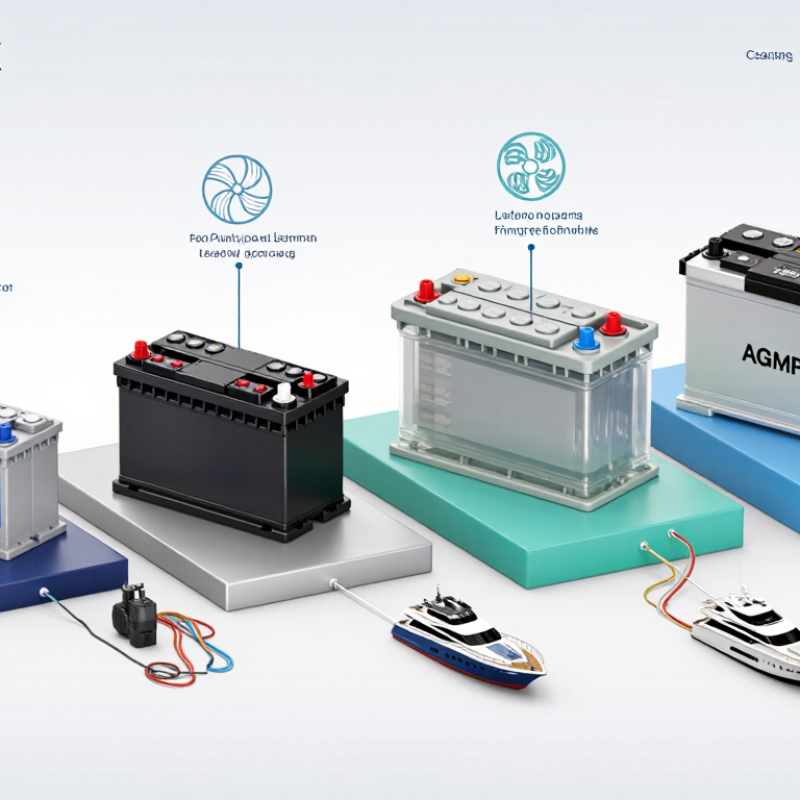
| Flooded Lead-Acid Deep-Cycle | Liquid electrolyte with lead plates | Up to about 50% | Approximately 300–700 cycles | Requires a staged lead-acid charging profile; periodic full charging is beneficial | Low initial cost, widely available, and relatively tolerant of occasional overcharging | Heavy, requires ventilation, may require electrolyte maintenance, and can release hydrogen gas while charging | Basic lighting, pumps, radios, and moderate auxiliary loads where weight and maintenance are acceptable |
| AGM Deep-Cycle | Absorbent glass mat sealed lead-acid | Up to about 50% | Approximately 400–1,000 cycles | Needs a regulated AGM-compatible charging profile; overcharging should be avoided | Sealed construction, low maintenance, good vibration resistance, and higher charge acceptance than many flooded batteries | Heavier than lithium batteries, sensitive to excessive voltage, and generally more expensive than flooded lead-acid | Chart plotters, sonar, navigation equipment, communications systems, and general house loads |
| Gel Deep-Cycle | Gelled electrolyte lead-acid | Up to about 50% | Approximately 500–1,200 cycles | Requires a lower-voltage gel-specific charging profile to prevent gas pockets and damage | Sealed, low maintenance, good resistance to vibration, and suitable for slower discharge applications | Charging is less forgiving, high charging currents can cause damage, and energy density is lower than lithium | Steady auxiliary loads, monitoring equipment, cabin electronics, and installations with limited ventilation |
| LiFePO4 Lithium Deep-Cycle | Lithium iron phosphate | Typically 80–100% | Approximately 2,000–5,000 cycles | Requires a lithium-compatible charger and a battery management system; charging below freezing may be restricted | Low weight, high usable capacity, stable voltage during discharge, fast charging, and long service life | Higher purchase price, requires compatible charging equipment, and must be protected against overcharge, over-discharge, and unsuitable temperatures | High-demand electronics, long-duration house loads, electric appliances, communications, and weight-sensitive vessels |
| Lithium-Titanate Deep-Cycle | Lithium-titanate cells | Often 80–100% | Approximately 5,000–15,000 cycles | Requires a compatible lithium charging system and battery management system | Very high cycle durability, excellent high-current performance, rapid charging capability, and strong low-temperature performance | Higher cost, lower energy density than many other lithium chemistries, and limited availability for recreational marine installations | Frequent cycling, high-power auxiliary systems, commercial marine equipment, and demanding duty cycles |
| Dual-Purpose Marine Battery | Lead-acid or lithium design combining starting and deep-cycle functions | Usually about 30–50% for lead-acid designs | Approximately 300–800 cycles, depending on chemistry and operating conditions | Must follow the charging requirements of the specific chemistry | Saves space by combining engine-starting capability with moderate auxiliary-load support | Usually delivers less starting power than a dedicated starter battery and less deep-cycle life than a dedicated house battery | Smaller boats with limited electrical loads, compact installations, or systems that need one general-purpose battery |