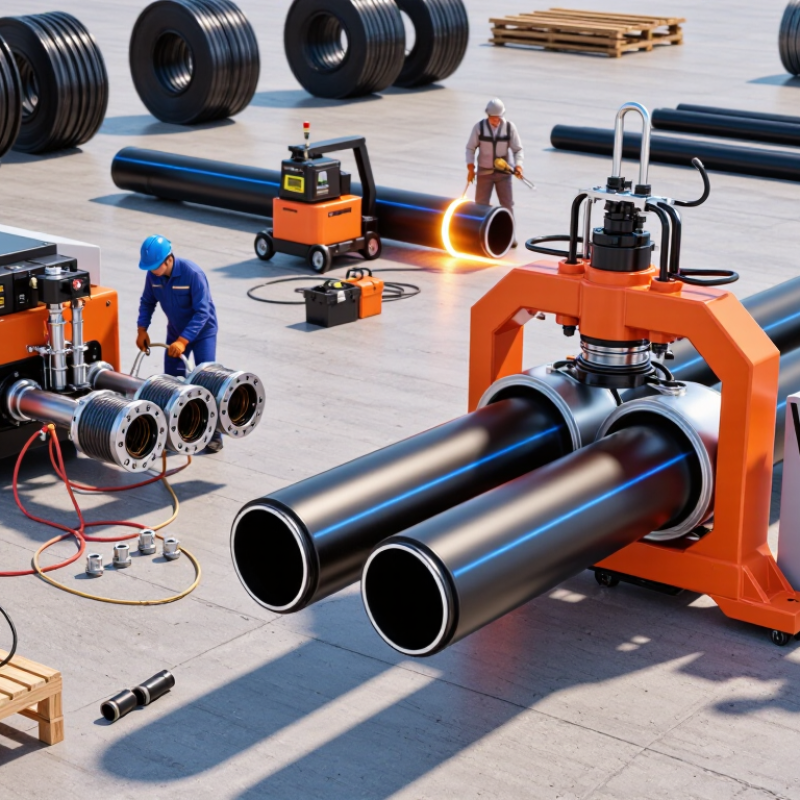
| Electrofusion control unit | Heats the embedded resistance wires in an electrofusion fitting to fuse it to a prepared pipe surface. | Commonly 20–630 mm fitting diameters; supported range depends on the unit and fitting system. | Typically powered by 110 or 230 V AC; many units read fitting data and regulate the weld cycle automatically. | Compact and job-site portable; heavier-duty units may require a trolley or vehicle transport. | Precise, compact connections, repairs, service connections, and locations with limited room for larger machines. |
| Butt fusion machine | Heats pipe ends with a plate and presses them together under controlled alignment and force. | Equipment is available for pipe diameters from around 40 mm to 1,600 mm and larger, depending on machine class. | Manual or hydraulic clamping; temperature-controlled heater plates are typical. | Small models can be carried; large-diameter machines are generally trailer- or excavator-supported. | Long, straight pipeline runs and larger-diameter pipe joints where there is space to align and clamp the pipe. |
| Socket fusion tool | Heats the pipe exterior and fitting interior on matching dies before the parts are joined. | Commonly used for small-diameter pipe, often about 20–125 mm; the tool and fitting system set the limit. | Electric heater with temperature control; dies are selected to match pipe and fitting size. | Lightweight and easy to use in confined spaces. | Small-bore plumbing, branch connections, and workshop or indoor installation work. |
| Extrusion welder | Feeds molten thermoplastic filler into a prepared joint while hot air or another heat source warms the surfaces. | Used for fabrication and repair of thick sections, fittings, tanks, and large pipe components; capacity varies by model. | Typically electrically heated; models vary in output rate, filler size, and temperature control. | Portable handheld models are available, though some are bulky for overhead or confined work. | Fabrication, repair patches, and joints that are unsuitable for standard butt fusion. |
| Hot-air welder | Directs heated air at the joint, often with a separate filler rod and a suitable welding nozzle. | Primarily for thin sheet, liners, and light fabrication rather than pressure-pipe butt joints. | Temperature and airflow are adjustable on many tools; settings must suit the material and application. | Handheld and highly portable. | Geomembranes, sheet fabrication, and small repair tasks where a hot-air process is appropriate. |
| Pipe scraper and alignment clamps | Prepares the pipe surface and holds pipe and fitting in alignment; these are supporting tools, not welding heat sources. | Tool sizes are selected to match the pipe diameter and joint configuration. | Usually manual; scraping depth, clean surfaces, and stable alignment are important for electrofusion preparation. | Generally compact and portable. | Essential preparation and restraint for repeatable electrofusion joints and many repair connections. |