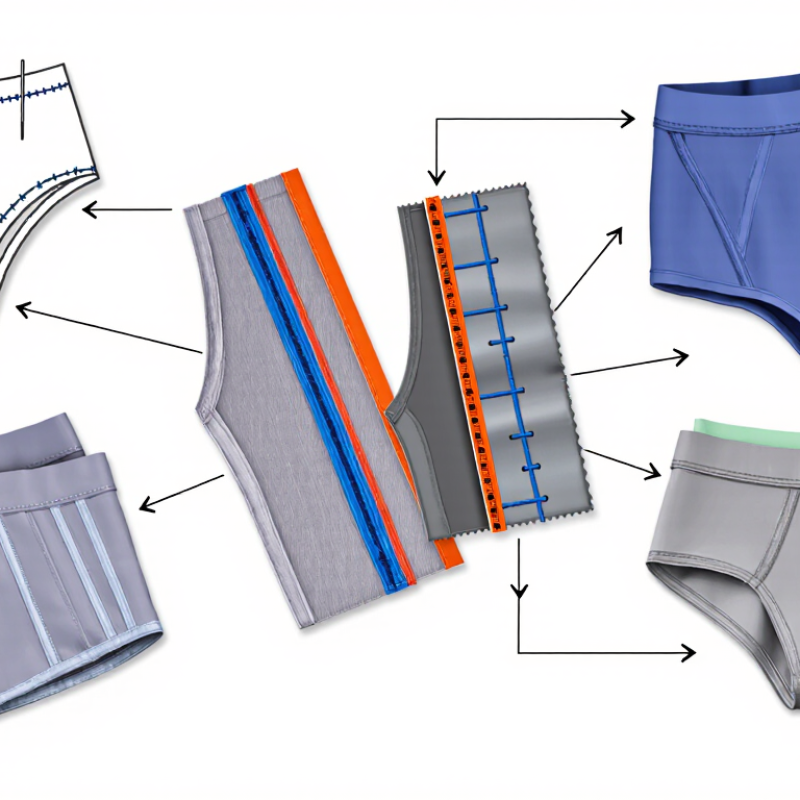
| Primary construction | A chainstitch combined with a three-thread overedge stitch | An overedge stitch that trims and encloses the fabric edge | An overlock stitch using needle and looper threads to secure the edge | Parallel needle rows with underside looper coverage for a flat seam appearance |
| Typical thread count | Five threads: two needle threads and three looper threads | Three threads | Four threads | Usually three, four, or five threads, depending on the stitch setup |
| Relevant stitch classification | Commonly identified as ISO 516, a five-thread safety stitch | Commonly based on ISO 504 overedge construction | Often based on ISO 514 four-thread overlock construction | Often associated with ISO 406 or ISO 407 coverstitch constructions |
| Seam security | High; the chainstitch provides a separate structural line and the overedge controls fraying | Moderate; suitable for edge finishing but less structurally secure than a safety seam | Good for general knit and woven garment assembly, with less redundancy than five-thread construction | Good stretch and coverage, but seam security depends on the specific stitch configuration |
| Seam appearance | Compact industrial seam with an overedge finish and a visible chainstitch line | Narrow edge finish with a visible looped thread structure | Neat enclosed edge with a slightly fuller thread profile | Broad, low-profile seam with parallel lines on the face side |
| Stretch performance | Good controlled stretch when stitch length and thread tension are correctly adjusted | Good for lightweight stretch fabrics, but seam extensibility varies with thread and settings | Good general elasticity for many knit fabrics | Very good stretch and recovery for hems, sportswear, and performance knits |
| Typical applications | Workwear, uniforms, protective apparel, durable knit garments, and high-use industrial clothing | Lightweight knits, lingerie components, edge finishing, and low-bulk garment sections | General garment assembly, knitwear, underwear, and casual apparel | Activewear hems, T-shirt hems, compression garments, and decorative flat seams |
| Fray control | Excellent because the overedge portion wraps and protects the cut edge | Excellent for edge containment | Very good for most cut knit and woven edges | Limited edge trimming and enclosure; usually used on prepared edges or folded hems |
| Durability under repeated wear | Very good when seam allowance, thread selection, and thread tension are properly controlled | Suitable for light-to-medium duty areas | Good for everyday apparel and medium-duty seams | Good for stretch zones, although needle thread breakage can occur if tension is excessive |
| Main advantage | Combines strong seam joining with reliable edge protection in one operation | Low thread consumption and a narrow, flexible finish | Balanced productivity, flexibility, and seam coverage | Flat appearance, high comfort, and excellent extensibility |
| Main limitation | Uses more thread and generally requires more machine setup and adjustment time | Does not provide the same independent chainstitch reinforcement as a five-thread safety seam | May not meet the strength requirements of high-stress industrial seams | Not a direct substitute for a safety seam when strong joining and edge trimming are both required |
| Best selection criterion | Choose when seam strength, fray resistance, and production durability are priorities | Choose when low bulk and edge finishing are more important than maximum seam strength | Choose for versatile everyday apparel construction | Choose when a flat, flexible, and visually clean seam is required |