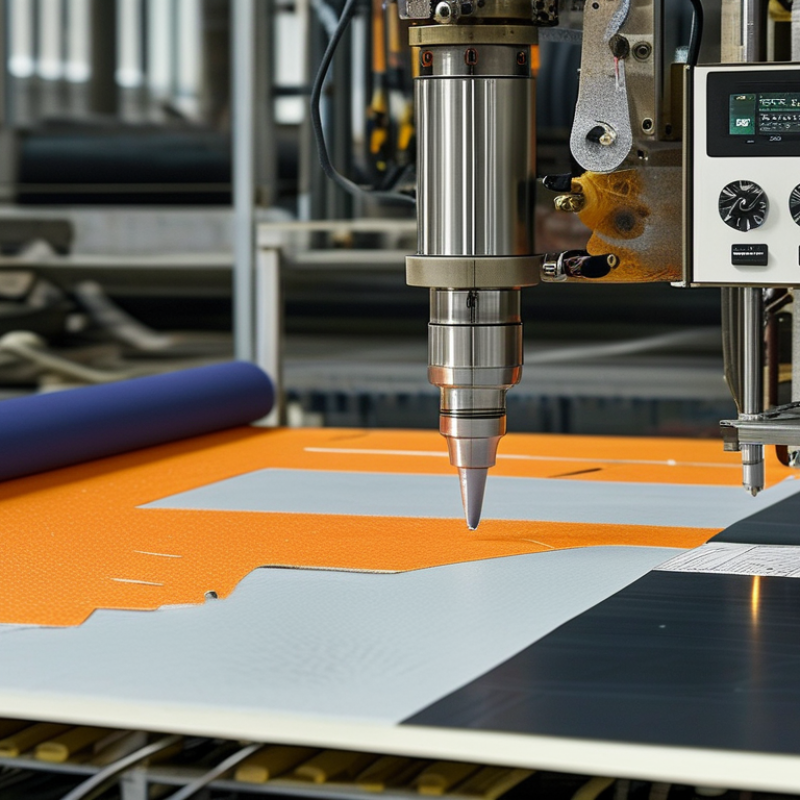
| Lamination Principle | Direct flame bonding without liquid adhesive | The flame briefly melts or activates the surface of thermoplastic foam, creating a tacky layer that bonds to fabric, film, or another compatible substrate under pressure. | Process description used in flexible polyurethane foam flame lamination. |
| Common Foam Material | Flexible polyurethane foam, generally open-cell foam | Polyurethane foam can form a receptive surface when exposed to controlled heat. The foam grade, density, cell structure, and surface condition strongly affect bonding quality. | Material suitability must be confirmed through a production trial and bond-strength testing. |
| Common Facing Materials | Knitted fabric, woven fabric, nonwoven, textile laminate, and selected films | The facing must tolerate short-term thermal exposure and make sufficient contact with the activated foam surface during nip rolling. | Compatibility depends on fiber type, coating, finish, melting point, and shrinkage behavior. |
| Fuel Options | Natural gas or liquefied petroleum gas such as propane | Fuel is mixed with air and delivered through a burner. Gas quality, pressure stability, burner design, and ventilation influence flame uniformity. | Fuel selection must comply with local gas-safety and installation requirements. |
| Theoretical Flame Temperature | Approximately 1,900–2,000°C for common hydrocarbon gases burning in air under ideal conditions | This is an ideal combustion value, not the actual temperature at the foam surface. Heat transfer is controlled by burner distance, exposure time, gas-air ratio, and line speed. | Actual operating conditions are normally established by process trials and thermal monitoring. |
| Typical Production Speed | Often configured from low single-digit speeds to several tens of metres per minute | Higher speed reduces heat exposure time, while lower speed increases the risk of foam damage. The correct setting depends on foam thickness, density, flame intensity, and facing material. | There is no universal speed; the machine specification and validated process window should be reviewed. |
| Flame Exposure Control | Controlled by burner height, gas flow, air flow, flame width, and web speed | Uniform exposure activates the foam surface without excessive shrinkage, scorching, smoke generation, or loss of elasticity. | A stable blue flame and consistent transverse coverage are common operational targets for gas burners. |
| Bonding Pressure | Applied through a nip roller or pressure roller after flame activation | Pressure brings the two surfaces into intimate contact while the foam surface remains tacky. Excessive pressure can compress the foam permanently or distort the textile. | Pressure is normally adjusted according to foam resilience, thickness, and laminate construction. |
| Adhesive Requirement | Normally no separate liquid or hot-melt adhesive is required | Removing adhesive can reduce adhesive handling, drying, curing, and volatile-organic-compound concerns. However, flame lamination is limited to materials with suitable thermal and chemical compatibility. | A trial is required where a barrier film, coating, or flame-retardant treatment is present. |
| Typical Applications | Automotive interior components, furniture upholstery, mattresses, garment padding, footwear materials, and acoustic products | Flame-laminated foam can provide cushioning, drape, thermal insulation, sound absorption, or surface comfort, depending on the laminate structure. | The final application may require additional requirements for odor, fogging, flammability, wash durability, or emissions. |
| Main Quality Indicators | Peel strength, bond uniformity, appearance, foam compression, scorch level, dimensional stability, and odor | These indicators reveal whether the flame energy and nip conditions are balanced across the full web width. | Testing methods should be selected according to the product specification and end-use sector. |
| Density Measurement | Reported in kilograms per cubic metre (kg/m³) | Foam density affects heat absorption, surface activation, compression response, and the amount of flame energy required. | ISO 845 is commonly used for the apparent density of cellular plastics and rubbers. |
| Flexible Foam Testing | Compression, tensile, tear, fatigue, and dimensional-stability tests may be required | Flame exposure can alter the surface and mechanical behavior of the foam, so the laminate should be tested rather than judged only by visual appearance. | ASTM D3574 is widely used for testing flexible cellular materials; applicable clauses depend on the product. |
| Ventilation and Exhaust | Required for combustion products, smoke, and heat generated during processing | Local exhaust helps control airborne contaminants and heat around the burner and bonding zone. The exhaust system must not disturb flame stability. | System design should follow applicable occupational-safety, fire-safety, and building regulations. |
| Safety Features to Review | Flame-failure detection, automatic gas shutoff, emergency stop, over-temperature protection, guarding, and exhaust interlock | These controls reduce the risk of unburned gas release, uncontrolled heating, operator exposure, and fire propagation. | The exact safety architecture should be checked against the machinery risk assessment and local regulations. |
| Energy and Material Efficiency | Potentially lower adhesive consumption and fewer adhesive-processing stages | Because bonding is created directly at the foam surface, the process can reduce adhesive storage and drying requirements. Energy use still depends on burner output, line speed, exhaust, and warm-up time. | Energy performance should be measured using actual gas consumption per square metre of finished laminate. |