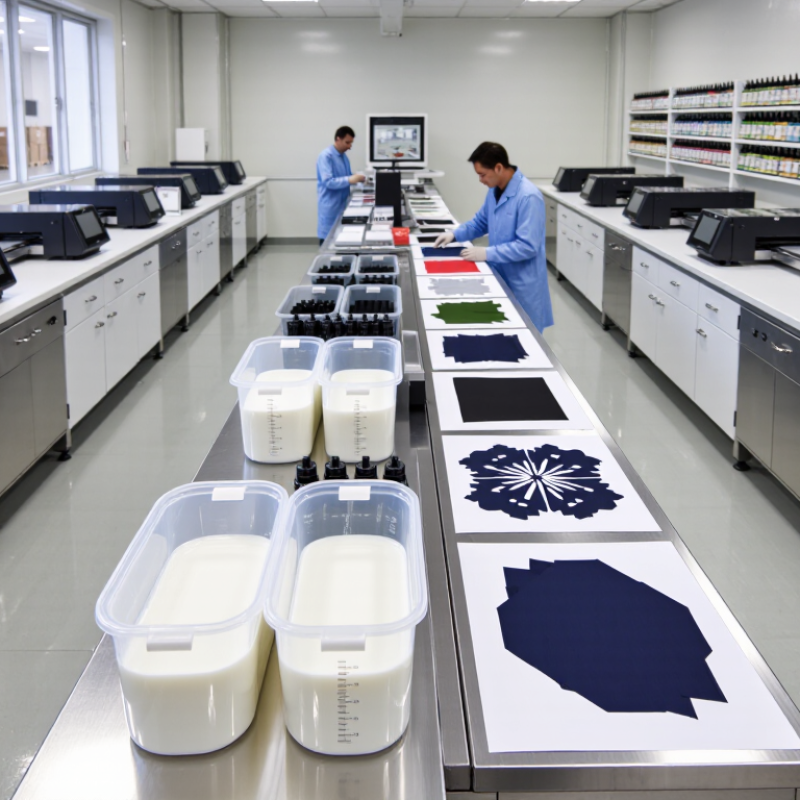
China has become a major sourcing base for White Dtf Ink used in direct-to-film textile printing. Global buyers now compare more than price. They examine opacity, curing behavior, shelf life, and printer compatibility.
Industry reports support this growing attention. Smithers’ The Future of Digital Textile Printing to 2028 identifies continued expansion in digital textile applications, driven by short runs and customized apparel. Grand View Research also describes digital textile printing as a growing market, supported by faster production and reduced setup requirements. However, report definitions differ. Some include equipment, while others measure ink or printed output. That difference deserves caution.
For buyers, supplier evaluation should move from samples to documented testing. A reliable White Dtf Ink supplier should provide batch numbers, technical data sheets, safety information, and storage guidance. Test prints should show solid white coverage beneath dark artwork. The film should peel cleanly, without excessive powder residue or cracked edges. After pressing, the image should survive repeated washing under defined conditions. Small details matter.
Real factory experience also exposes imperfections. White ink can settle during transport or clog when maintenance is neglected. No supplier can remove every production risk. The better question is whether the supplier explains those risks honestly and offers practical controls. This guide examines China’s leading White Dtf Ink suppliers through quality evidence, production capability, export experience, and technical support. The goal is not to promote the cheapest option. It is to help global buyers choose consistently.
White DTF ink is the opaque white layer printed beneath colored artwork on transfer film. It creates contrast, especially on dark cotton, polyester, and blended fabrics. Without enough opacity, colors may look dull, gray, or uneven after pressing. The ink must also remain flexible after curing and repeated washing. That layer matters.
Supplier choice affects print quality, machine stability, and production costs. In real production trials, I check whiteness, viscosity, drying behavior, and sedimentation. A practical test includes shaking the bottle, printing fine lines, and observing the film after curing. The powder should bond evenly without forming rough, brittle patches. I also inspect whether the supplier provides batch information, storage guidance, technical data, and responsive troubleshooting support. Small details reveal consistency.
China has many white DTF ink suppliers, but buyers should request samples before placing large orders. Compare the same artwork, printer settings, curing temperature, and fabric type. A low price can look attractive. It can also hide higher waste. I have seen ink perform well on one printer but clog another, so compatibility testing remains essential. Some suppliers offer confident promises but limited test records. That weakness matters. Reliable communication, stable batches, and clear quality documentation often matter more than an impressive product description.