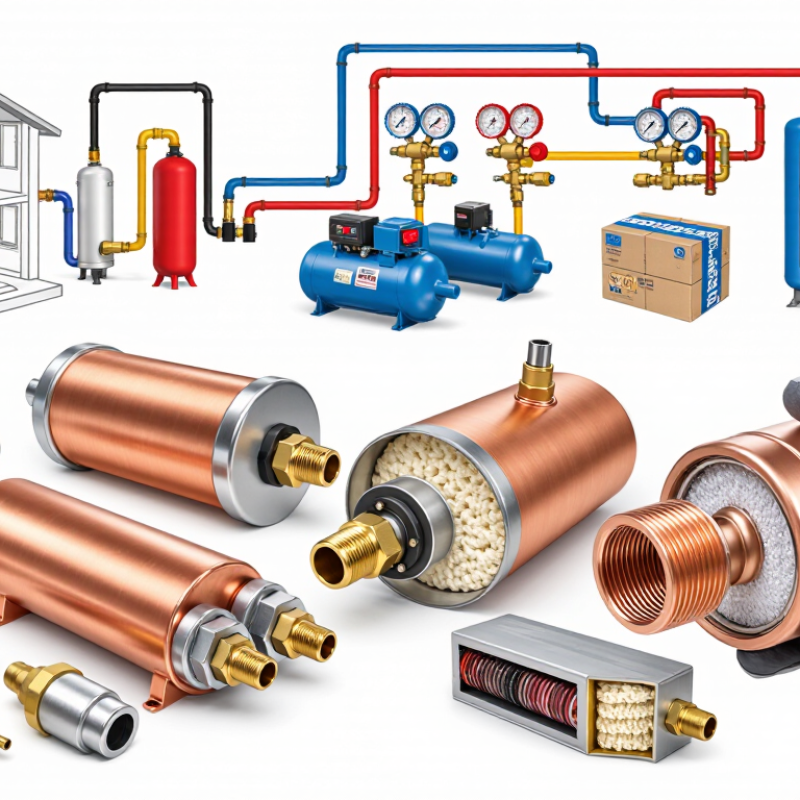
| Liquid-Line Filter Driers | Sealed steel shell with a desiccant core, inlet and outlet tubes, and internal filtration media | Removes moisture, acid, and solid contaminants from the liquid line | Split air conditioners, condensing units, heat pumps, refrigeration systems, and cold rooms | Copper sweat connections are common; several outside-diameter tube sizes are available | Compatibility must be confirmed for the refrigerant, oil type, working pressure, and operating temperature | Desiccant type, moisture capacity, pressure drop, shell material, and leak-test records |
| Bi-Flow Filter Driers | Bidirectional shell design with internal flow paths and filtration in both directions | Supports refrigerant flow reversal without requiring a separate drier for each direction | Reversible heat pumps and systems using a reversing valve | Straight-through and compact tube-end configurations are widely used | The complete assembly should be rated for the selected refrigerant and both flow directions | Bidirectional capacity, flow resistance, internal check-valve design, and pressure rating |
| Solid-Core Filter Driers | Molded or bonded desiccant core installed inside a sealed metal shell | High contaminant-holding capability and stable moisture adsorption | Commercial refrigeration, refrigerated display cases, chillers, and larger condensing systems | Flare, sweat, and other tube-end configurations may be specified for different installations | The desiccant formulation should be selected according to refrigerant and lubricant chemistry | Core strength, filtration rating, moisture capacity, acid-removal performance, and pressure drop |
| Molecular-Sieve Driers | Desiccant charge based mainly on synthetic molecular-sieve material | Strong water adsorption and effective protection against moisture-related corrosion | Residential air conditioning, heat pumps, refrigeration equipment, and sealed-system servicing | Common copper tube sizes can be selected for standard HVAC installation practices | Refrigerant and lubricant compatibility should be checked before use, especially in new low-GWP systems | Water capacity, particle retention, desiccant cleanliness, and sealed-packaging quality |
| Activated-Alumina or Mixed-Desiccant Driers | Combination desiccant charge designed to address moisture and acidic contaminants | Broader contaminant-control performance than a moisture-only design | Systems exposed to compressor burnout, lubricant degradation, or heavy contamination | Standard tube-end options are available for field replacement and OEM assembly | The formulation should be validated for the refrigerant, oil, and system operating conditions | Acid-removal ability, desiccant ratio, pressure drop, and post-burnout replacement guidance |
| High-Pressure HVAC Driers | Reinforced steel shell and brazed or welded tube connections for higher operating pressures | Suitable for modern high-pressure air-conditioning and heat-pump circuits when correctly rated | Equipment using higher-pressure refrigerants, including many R32 and R410A applications | Tube size and connection style depend on system capacity and installation design | Maximum allowable pressure and temperature must be verified against the equipment design | Burst pressure, design pressure, safety margin, corrosion resistance, and certified test procedures |
| OEM and Private-Label Driers | Customized shell dimensions, tube lengths, desiccant charge, labels, and packaging | Flexible adaptation to equipment drawings, replacement requirements, and export packaging | HVAC original equipment, replacement parts, distributor programs, and service kits | Customized tube diameters, lengths, orientation, and end forms may be requested | Technical approval is required for the target refrigerant, oil, pressure, and temperature range | Drawing control, sample approval, batch consistency, packaging quality, and traceability |