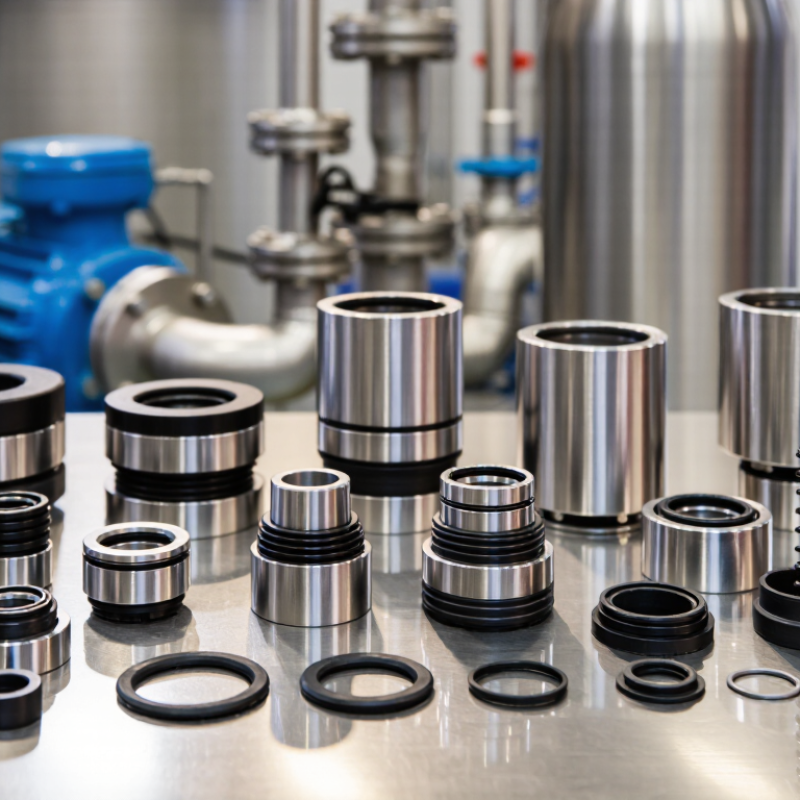
| Profile 01 — General-Process Specialist | Inside-mounted, single-spring, component seal | Carbon versus silicon carbide | EPDM or FKM | 316 stainless steel | Up to approximately 10 bar | Up to approximately 3,600 rpm | About −20°C to 180°C, depending on elastomer | Water transfer, HVAC circulation, light chemical service | Balanced cost, availability, and maintainability | Not ideal for highly abrasive slurries or severe dry running | Excellent for general-purpose pumps |
| Profile 02 — High-Temperature Specialist | Rotating multiple-spring, O-ring-mounted seal | Carbon versus reaction-bonded silicon carbide | Flexible graphite or high-temperature FKM | 316 stainless steel or nickel alloy | Up to approximately 25 bar | Up to approximately 3,600 rpm | About 200°C to 350°C, subject to design and medium | Thermal-oil pumps, hot water, heat-transfer systems | Strong thermal stability and reliable face loading | Requires careful installation and compatible secondary seals | Excellent for elevated-temperature service |
| Profile 03 — Abrasive-Service Specialist | Heavy-duty component seal with protected springs | Silicon carbide versus silicon carbide | EPDM, FKM, or polyurethane | 316 stainless steel or duplex stainless steel | Up to approximately 20 bar | Up to approximately 2,400 rpm | About −30°C to 180°C | Slurry pumps, wastewater, mineral processing | High resistance to abrasive wear and solids damage | Higher friction and heat generation than carbon-faced designs | Excellent for abrasive or particle-laden fluids |
| Profile 04 — Chemical-Compatibility Specialist | Stationary multi-spring component seal | Silicon carbide versus resin-impregnated carbon | FKM, FFKM, or PTFE-based sealing elements | Hastelloy-type alloy or 316 stainless steel | Up to approximately 30 bar | Up to approximately 3,600 rpm | About −40°C to 220°C, depending on materials | Acids, solvents, specialty chemicals, corrosive process fluids | Broad chemical resistance and stable leakage control | Material selection must be verified against the exact chemical mixture | Excellent for chemically demanding applications |
| Profile 05 — Food and Hygienic-Service Specialist | Sanitary component seal with cleanable geometry | Carbon versus silicon carbide or ceramic | FDA-compliant EPDM, FKM, or PTFE | 316L stainless steel | Up to approximately 16 bar | Up to approximately 3,000 rpm | About −20°C to 150°C | Food processing, beverage production, dairy, pharmaceutical utilities | Low dead space and compatibility with cleaning cycles | Not all elastomers are suitable for every sterilization or cleaning chemical | Excellent for hygienic pump systems |
| Profile 06 — High-Pressure Specialist | Balanced component seal with stationary springs | Silicon carbide versus tungsten carbide | FKM, FFKM, or PTFE | Duplex stainless steel or nickel alloy | Approximately 25–50 bar, depending on diameter and design | Up to approximately 3,600 rpm | About −30°C to 200°C | Boiler feedwater, high-pressure process pumps, hydrocarbon service | Improved pressure management and reduced face loading | More sensitive to shaft runout, alignment, and installation quality | Excellent for high-pressure rotating equipment |
| Profile 07 — Low-Emission Specialist | Balanced, stationary, multiple-spring seal with controlled leakage path | Silicon carbide versus carbon or silicon carbide | Graphite, FKM, or PTFE | 316 stainless steel or alloy steel with protective coating | Up to approximately 25 bar | Up to approximately 4,500 rpm | About −40°C to 200°C | Hydrocarbon pumps, volatile solvents, emission-sensitive processes | Low fugitive-emission potential when correctly installed and operated | Performance depends strongly on flush quality and equipment condition | Excellent where leakage control is a priority |
| Profile 08 — Slurry and Wastewater Specialist | Unbalanced heavy-duty seal with spring protection | Silicon carbide versus silicon carbide | EPDM or polyurethane | 316 stainless steel or duplex stainless steel | Up to approximately 16 bar | Up to approximately 1,800 rpm | About −20°C to 140°C | Municipal wastewater, sewage, paper stock, sludge handling | Good tolerance of suspended solids and intermittent operation | Lower speed and pressure capability than many clean-fluid designs | Excellent for wastewater and slurry pumps |
| Profile 09 — Low-Temperature Specialist | Component seal with low-temperature elastomer package | Carbon versus silicon carbide | Low-temperature FKM, EPDM, or PTFE | 316 stainless steel or nickel alloy | Up to approximately 20 bar | Up to approximately 3,600 rpm | About −60°C to 150°C, subject to material selection | Refrigeration auxiliaries, cryogenic support systems, cold-process fluids | Reliable elasticity and face contact at reduced temperatures | Thermal contraction and lubricant viscosity must be considered during startup | Excellent for cold-service equipment |
| Profile 10 — Custom-Engineering Specialist | Application-specific balanced component seal | Selected from carbon, silicon carbide, tungsten carbide, or ceramic | Selected from EPDM, FKM, FFKM, PTFE, or graphite | 316 stainless steel, duplex stainless steel, or nickel alloy | Approximately 10–50 bar, depending on engineered configuration | Up to approximately 5,000 rpm, depending on diameter | About −60°C to 350°C, subject to the complete material set | Non-standard pumps, difficult fluids, retrofit and special-duty equipment | Best flexibility for unusual operating conditions | Longer engineering lead time and higher qualification requirements | Excellent for custom or highly specialized applications |