Top 10 Construction Materials for Global Buyers

For global buyers, selecting construction materials is not simply a price comparison. It is a decision about safety, service life, logistics, and project performance. A concrete block, steel beam, or insulation panel may look suitable in a sample room. Its behavior can change under coastal humidity, freezing temperatures, heavy rainfall, or intense sunlight.

This guide examines ten widely used construction materials across international projects. It considers strength, durability, installation requirements, maintenance needs, and transport risks. Buyers can compare structural steel, concrete, timber, bricks, glass, insulation, roofing products, flooring, pipes, and finishing materials with clearer criteria. Product certifications and laboratory test reports deserve careful attention. So does the supplier’s production history, quality-control process, and ability to provide consistent batches. A low quotation may hide higher costs for breakage, delays, replacements, or specialized labor.

Details matter.

A shipment arriving with wet timber, scratched panels, or poorly protected cement can disrupt an entire schedule. Reliable sourcing therefore requires more than reviewing a catalog. It involves checking technical data, requesting samples, confirming packaging, and discussing local building requirements with qualified professionals. International standards can support comparison, but regional codes still require verification. No material performs perfectly in every environment. That limitation is easy to overlook. By weighing technical evidence against real site conditions, global buyers can make more defensible decisions and reduce avoidable procurement problems.

Top 10 Construction Materials for Global Buyers

Construction Material Selection Criteria for Global Buyers

Top 10 Construction Materials for Global Buyers

Construction material selection should begin with project conditions, not catalogue popularity. Cement, steel, timber, glass, insulation, roofing, brick, aluminum, gypsum, and aggregates each suit different environments. Check compressive strength, corrosion resistance, fire performance, thermal efficiency, and expected service life. Coastal projects need stronger protection against salt exposure. Cold regions require insulation that remains stable through repeated freezing. Local building codes also matter. A material may perform well in one country and fail approval in another. From site reviews, I have learned that delivery records can be as important as technical sheets. However, past experience is not always transferable.

Tips: Request test reports from independent laboratories. Verify production dates and storage conditions. Compare total landed cost, including freight, duties, installation, waste, and maintenance. Ask suppliers about batch consistency and replacement procedures. Small samples help, but they cannot reveal every site risk.

Reliable buyers also examine supplier capacity, quality-control systems, environmental declarations, and traceable documentation. Confirm dimensions before shipment. A minor tolerance issue can delay an entire installation crew. Use recognized testing methods where possible, and require clear warranty terms. Do not select only by the lowest quotation. That approach often overlooks breakage, rework, and energy costs. I once underestimated seasonal port delays; the material was suitable, but the schedule was not. A better review should include climate data, transportation routes, worker skills, and future repair access. Some decisions remain uncertain, and that uncertainty should be recorded rather than hidden.

Structural Materials: Concrete, Steel, and Engineered Wood

Top 10 Construction Materials for Global Buyers

Structural Materials: Concrete, Steel, and Engineered Wood

Concrete, steel, and engineered wood form the backbone of many modern structures. Each material performs differently under load, moisture, heat, and transport conditions. Concrete offers strong compressive performance and useful fire resistance. Buyers should check its strength grade, curing records, aggregate quality, and delivery temperature. A poorly cured slab may look acceptable but crack months later. Local climate matters greatly.

Steel provides high strength with relatively small sections, helping reduce structural weight. Global buyers should request mill certificates, coating specifications, weldability data, and dimensional tolerances. Coastal projects need stronger corrosion protection than dry inland sites. Storage is also important. Steel left on wet ground can develop surface rust before installation. That detail is easy to overlook.

Engineered wood can reduce weight and simplify installation. It also creates a warmer interior appearance. Buyers must verify moisture content, adhesive performance, fire design, and load calculations. Transportation exposure can change its condition. Covered packaging helps, but it is not a complete solution. No material is perfect. An experienced project team should compare lifecycle cost, not only purchase price. I have seen cheaper materials create higher expenses through delays, repairs, and extra labor. Independent testing and a clear inspection plan improve confidence, though they cannot replace careful site supervision. A material choice can still be wrong when drawings, climate data, or workmanship receive too little attention.

Building Envelope Materials: Brick, Glass, and Insulation

Top 10 Construction Materials for Global Buyers

Building Envelope Materials: Brick, Glass, and Insulation

For global buyers, building envelope materials affect comfort, energy use, and service life. The right combination controls heat, moisture, daylight, and outdoor noise.

Brick remains popular because it handles weather, impact, and fire exposure well. During site inspections, I have seen small cracks around window openings. These defects often become expensive leaks. Buyers should check compressive strength, water absorption, frost resistance, and dimensional consistency. Local climate matters. A brick suitable for a dry region may fail in repeated freeze-thaw conditions.

Glass needs more than a clear appearance. Specify solar heat gain, thermal transmittance, visible light, and safety performance. Low-emissivity coatings can reduce indoor heat loss. However, performance depends on frame design and installation quality. A beautiful glass wall can still create glare and overheating. Request independent test reports and confirm compliance with local building codes.

Insulation deserves equal attention. Mineral wool offers strong fire resistance and sound control. Foam boards can provide high thermal performance with limited thickness. Compare thermal values, moisture behavior, fire classification, and long-term stability. Ask for documentation covering production, testing, and transport conditions. A damaged board may look acceptable but perform poorly after installation. No material is perfect. I still question low prices when they hide unclear testing, weak packaging, or inconsistent specifications.

Top 10 Construction Materials for Global Buyers - Building Envelope Materials: Brick, Glass, and Insulation
Rank Material Primary Envelope Application Typical Thermal Conductivity
(W/m·K)
Typical Density
(kg/m³)
Fire Performance Water or Moisture Considerations Typical Service Life Key Global Buyer Considerations
1 Clay Brick Exterior masonry walls, cavity-wall façades, partitions, and rainscreen finishes 0.40–1.30 1,400–2,000 Non-combustible; generally maintains structural integrity at high temperatures Water absorption commonly ranges from approximately 6% to 20%; detailing and flashing are important 50–100+ years when properly manufactured and installed Check dimensional tolerances, freeze–thaw resistance, efflorescence control, compressive strength, and applicable masonry standards
2 Float Glass Windows, curtain walls, doors, façade infill panels, and interior daylighting areas About 1.0 Approximately 2,500 Non-combustible, but standard glass can crack or break under thermal shock or impact Essentially non-absorbent; edge protection and compatible sealants are required 30–50+ years depending on framing, seals, exposure, and maintenance Confirm thickness, optical quality, light transmission, solar factor, safety-glazing requirements, and local wind-load design
3 Mineral Wool Insulation External wall systems, ventilated façades, roofs, floors, and fire-rated cavity insulation 0.034–0.045 30–180 Generally non-combustible; suitable grades can withstand temperatures above 1,000°C Water-repellent grades are available, but prolonged wetting can reduce thermal performance 50+ years when kept dry and correctly installed Evaluate thermal resistance, density, facing, water-repellency, acoustic performance, compression resistance, and fire classification
4 Expanded Polystyrene (EPS) External thermal insulation systems, cavity walls, foundation insulation, and insulated panels 0.031–0.040 15–30 Combustible polymer; fire behavior depends on formulation, thickness, protection, and system design Low water absorption compared with many porous materials, but exposed edges require protection 50+ years when protected from ultraviolet exposure, solvents, and excessive heat Check fire classification, declared thermal conductivity, dimensional stability, bead structure, density, and compatibility with adhesives
5 Extruded Polystyrene (XPS) Below-grade walls, foundations, inverted roofs, floor slabs, and high-moisture insulation zones 0.029–0.036 25–45 Combustible polymer; must be protected and used according to the tested wall or roof assembly Very low water absorption and good resistance to freeze–thaw cycling 50+ years in protected applications Review compressive strength, long-term water absorption, edge profile, dimensional stability, and resistance to soil or chemical exposure
6 Laminated Safety Glass Overhead glazing, balustrades, skylights, façades, and areas requiring retained fragments after breakage About 1.0 Approximately 2,500 Non-combustible; interlayers retain broken fragments but are not equivalent to fire-rated glass unless tested Glass is non-absorbent; edge sealing is important for long-term interlayer durability 25–50+ years, depending on interlayer, edge conditions, ultraviolet exposure, and installation quality Specify interlayer type, impact class, thickness, acoustic rating, ultraviolet exposure, and safety requirements for the destination market
7 Low-Emissivity Coated Glass Energy-efficient windows, curtain walls, and insulated glazing units About 1.0 for the glass itself; overall window performance depends on the complete glazing unit Approximately 2,500 Non-combustible glass; coating durability depends on whether it is protected inside an insulating glass unit Non-absorbent; insulating-glass edge seals must control moisture ingress and condensation 20–40+ years for properly fabricated and installed units Compare U-value, solar heat-gain coefficient, visible transmittance, coating position, color, seal durability, and spacer technology
8 Autoclaved Aerated Concrete (AAC) Lightweight external wall blocks, panels, infill walls, and thermal masonry systems 0.09–0.20 300–700 Non-combustible; can provide substantial fire resistance when thickness and joints are properly designed Porous and capable of absorbing water; requires render, coating, cladding, and properly detailed joints 50–100 years with adequate weather protection Confirm density class, compressive strength, dimensional accuracy, reinforcement protection, lifting requirements, and installation methods
9 Calcium Silicate Brick Load-bearing and non-load-bearing masonry, façade walls, acoustic partitions, and fire-rated construction 0.60–1.00 1,600–2,000 Non-combustible; commonly used where fire resistance and acoustic mass are priorities Moderate to high moisture sensitivity may occur during storage and construction; weatherproof detailing is required 50–100+ years when protected from persistent moisture Check compressive strength, frost resistance, suction rate, dimensional tolerances, mortar compatibility, and local masonry-code compliance
10 Cellular Glass Insulation Flat roofs, below-grade walls, floors, cold-storage areas, and moisture-sensitive thermal bridges 0.038–0.055 100–180 Non-combustible and resistant to flame spread; performance depends on the complete assembly Closed-cell, non-absorbent, and resistant to water vapor; useful in damp or below-grade applications 50–100+ years with suitable mechanical protection Evaluate compressive strength, vapor resistance, dimensional stability, adhesive compatibility, surface finish, and transport protection

Finishing Materials: Tile, Flooring, Paint, and Gypsum Board

Top 10 Construction Materials for Global Buyers: Finishing Materials

Finishing materials shape how a building feels, performs, and ages. Ceramic tile remains practical for wet areas, kitchens, and high-traffic corridors. The Global Ceramic Tiles Market Report projects steady growth through 2029, supported by urban construction and renovation demand. Buyers should check water absorption, slip resistance, shade variation, and carton strength. A beautiful sample means little if corners arrive chipped. Tile waste can also rise when room dimensions do not match available sizes.

Flooring decisions require more than appearance. The 2023 Global Status Report for Buildings and Construction states that buildings produced 37% of global energy and process-related emissions in 2022. Durable flooring can reduce replacement frequency, but only when installation conditions are suitable. Concrete moisture, subfloor flatness, and temperature affect performance. I have seen low-cost flooring fail because moisture testing was skipped. That mistake was avoidable.

Paint selection should include coverage, drying time, cleanability, and volatile organic compound levels. Request technical data sheets and safety documentation before purchase. Gypsum board needs equal care. The U.S. Geological Survey reported global gypsum production at approximately 150 million metric tons in 2023. Standard boards suit dry interiors, while moisture-resistant or fire-rated boards require verified testing. Delivery protection matters. Bent edges create extra labor and visible joints. Buyers should compare full installed cost, not only the factory price. That calculation is easy to overlook.

Global Purchasing Factors: Quality, Cost, Standards, and Logistics

Top 10 Construction Materials for Global Buyers

Global buyers compare steel, cement, aggregates, concrete, timber, glass, aluminum, insulation, gypsum, and pipes. Quality remains the first filter, but quality means more than a polished sample. Buyers should verify test certificates, batch traceability, moisture levels, dimensional tolerance, and factory inspection records. ISO 9001 certification can support process control, but it never replaces product testing.

Cost calculations must include packaging, duties, insurance, inland transport, storage, and possible rework. A low-priced steel shipment may become expensive after corrosion protection and port delays. The UNCTAD Review of Maritime Transport reports that ships carry over 80% of global merchandise trade by volume. Logistics planning therefore matters as much as the purchase price. The World Bank’s Logistics Performance Index 2023 evaluates customs, infrastructure, shipment reliability, tracking, and delivery timeliness. These factors can expose hidden supplier risk. Yet paperwork still fails.

Standards require careful matching. Steel may need ASTM, EN, or national grades, while insulation requires fire, thermal, and environmental performance data. Cement also deserves scrutiny. The International Energy Agency estimates cement production creates about 7% of global carbon dioxide emissions, making lower-carbon options increasingly relevant. Buyers should request recent laboratory reports, not outdated brochures. My practical reflection is simple: suppliers can meet specifications on paper, while site conditions reveal weaknesses.

Tips: Compare landed cost, not unit price. Ask for a pre-shipment inspection. Check container loading photos. Confirm replacement terms before payment. Keep one approved sample for site comparison.

Top 10 Construction Materials for Global Buyers

Global Purchasing Factors: Quality, Cost, Standards, and Logistics

The chart uses an indicative 1–10 procurement benchmark based on commonly specified performance requirements, price competitiveness, international standards maturity, supply availability, transport efficiency, and handling complexity. Scores vary by grade, region, project specification, and order volume.

Find the Right Repair Product for Your Project

Need to find the most appropriate product for the needs of your project? We can help because we have over 70 years of experience servicing the industry with every kind of project, from Do-it-yourself projects to large skyscrapers. Package Pavement has the experience, the knowledge and the products to help every project succeed.

Quikrete Repair Products
Legend
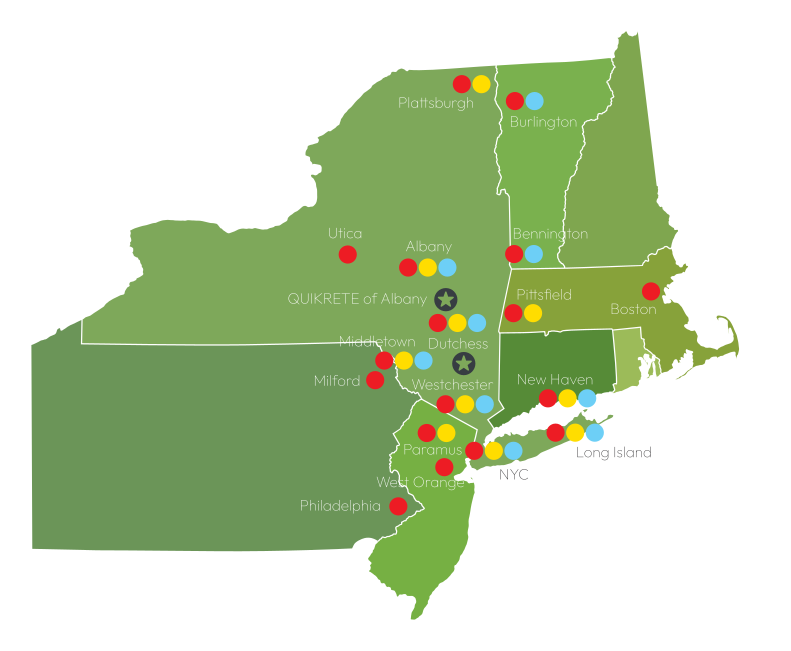
Package Pavement has two convenient locations in Stormville, NY (Dutchess County) and Ravena, NY (Greene County) to serve the Northeastern Region with bagged concrete, blacktop, mortar, and repair products. This map gives a general idea of where we service and the product lines we offer.
Package Pavement Products
Quikrete Products
Spec Mix Products
map

Our Brands Websites