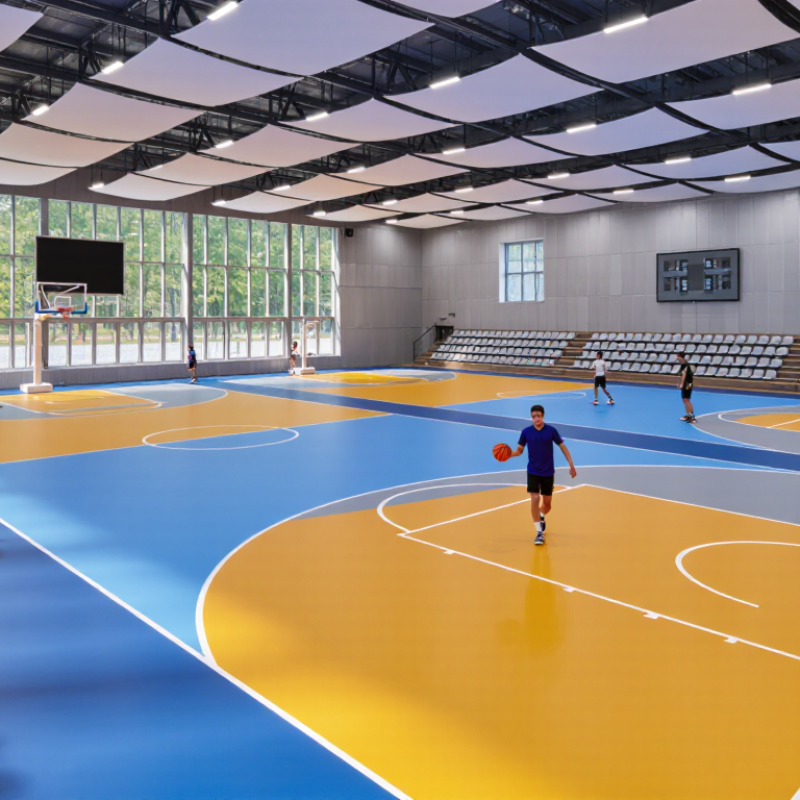
| 1 | Match the floor to the sport and venue | Confirm whether the system is intended for indoor or outdoor use, the sport played, athlete traffic, footwear type, rolling loads, and expected operating hours. | EN 14904 for indoor sports-area surfaces; EN 14877 for synthetic surfaces used in outdoor sports facilities; ASTM F2772 for indoor sports floor systems. | Technical data sheet, intended-use statement, system construction drawings, and test reports for the complete floor assembly. | A floor designed for the wrong sport may provide unsuitable grip, ball response, durability, or athlete protection. |
| 2 | Check shock absorption and vertical deformation | Review impact attenuation, area indentation, and vertical deformation values for the full installed system rather than for the top layer alone. | EN 14904 specifies performance requirements for indoor sports surfaces; ASTM F2772 includes performance classifications for indoor sports floor systems. | Independent laboratory report showing test conditions, specimen build-up, measured values, and applicable classification. | Correct shock absorption can help reduce repetitive loading while excessive deformation may affect stability and playability. |
| 3 | Verify slip resistance and sports performance | Ask for results under dry and, where relevant, contaminated or wet conditions. Also assess ball rebound, rolling behavior, and surface uniformity. | EN 14904 includes friction and sports-performance requirements; ASTM F2772 covers relevant performance characteristics for indoor systems. | Slip-resistance report, ball-rebound results, surface-uniformity data, and a physical sample or approved mock-up. | Balanced traction supports controlled movement without creating excessive sticking or inconsistent ball response. |
| 4 | Confirm fire-safety classification | Check the classification required by the destination country and building code, including the complete floor build-up, adhesive, underlay, and coating. | EN 13501-1 classifies reaction to fire for construction products and building elements in European markets; local codes may require additional tests. | Valid fire-test report or classification report identifying the tested product composition and installation method. | Fire performance affects approvals, occupant safety, insurance, and the ability to use the floor in public facilities. |
| 5 | Review emissions and indoor-air quality | Evaluate emissions from flooring, coatings, adhesives, and underlays, especially for enclosed gyms, schools, training centers, and healthcare facilities. | EN 717-1 for formaldehyde emission from wood-based panels; ISO 16000 series for indoor-air and emission measurements. Local VOC limits may also apply. | Recent laboratory emission report, safety data sheets, VOC statement, and documentation for every component in the system. | Lower emissions support healthier indoor environments and help meet green-building or public-project requirements. |
| 6 | Check installation, subfloor, and moisture requirements | Confirm permitted subfloor flatness, moisture limits, temperature, humidity, expansion joints, drainage, curing time, and approved adhesive or fixing method. | Use the applicable national installation code and the floor-system manufacturer’s documented installation specification; test methods vary by substrate and system. | Method statement, subfloor inspection checklist, moisture-test procedure, maintenance manual, and installer training or qualification records. | Many failures, including bubbling, open joints, and loss of adhesion, result from unsuitable substrate conditions or incorrect installation. |
| 7 | Validate durability, maintenance, and documentation | Assess wear resistance, indentation recovery, resistance to cleaning chemicals, repairability, spare-part availability, warranty terms, and expected service conditions. | Relevant abrasion, indentation, chemical-resistance, and dimensional-stability methods should be stated clearly in the test documentation; requirements depend on flooring type and market. | Maintenance schedule, cleaning-chemical compatibility chart, warranty, batch traceability, product data sheet, and after-sales service procedure. | Transparent lifecycle information helps control total cost, preserve safety performance, and support future repairs or replacement. |