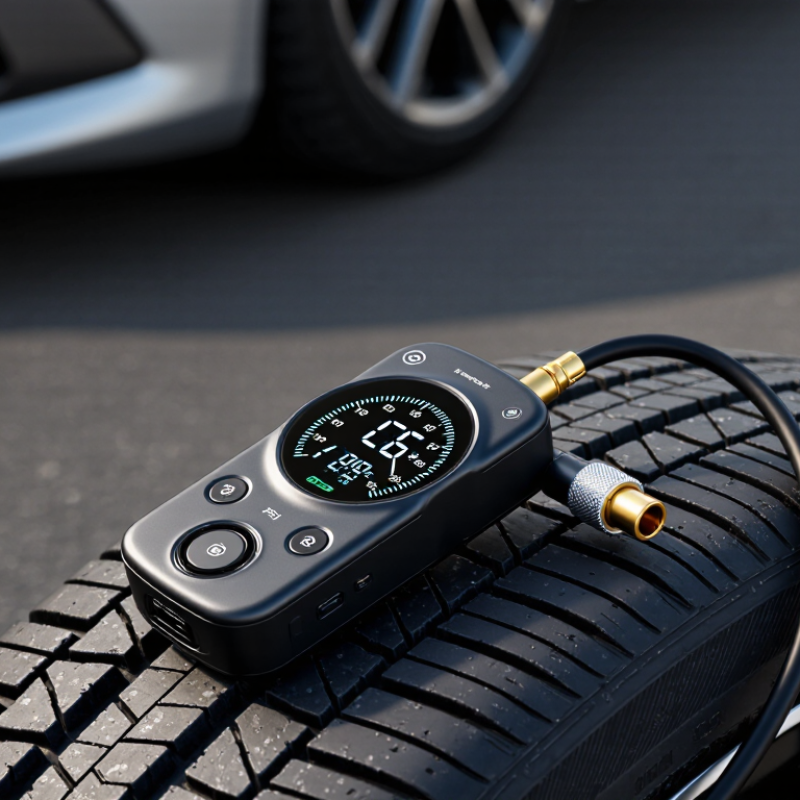
| Smart air pressure gauge | Digital pressure-measuring instrument | Uses an electronic pressure sensor, signal conditioning, a display, and often a microcontroller to calculate and show pressure. | Some models also record readings, switch units, transmit data, or provide high/low-pressure alerts. |
| Common sensing principle | Piezoresistive sensing | Pressure deflects a diaphragm and changes the resistance of strain-sensitive elements connected in a Wheatstone bridge. | The electrical output is converted into a pressure value by calibration data and digital processing. |
| Other sensor technologies | Capacitive, resonant, piezoelectric, or MEMS-based | Different technologies detect diaphragm displacement, frequency change, charge generation, or microscopic mechanical movement. | The suitable technology depends on pressure range, temperature, response speed, cost, and required stability. |
| Absolute pressure | Referenced to a near-vacuum | Absolute pressure includes atmospheric pressure and is expressed as pressure above an ideal vacuum. | Used when atmospheric changes must not affect the reference, such as in scientific and vacuum applications. |
| Gauge pressure | Referenced to local atmospheric pressure | Gauge pressure shows how much a system is above or below the surrounding atmosphere. | Most general-purpose air and tire gauges display gauge pressure unless marked otherwise. |
| Differential pressure | Pressure at port A minus pressure at port B | Measures the difference between two pressure points rather than pressure relative to a vacuum or atmosphere. | Useful for airflow, filter monitoring, ventilation systems, and flow measurement. |
| SI pressure unit | Pascal (Pa) | One pascal equals one newton per square metre: 1 Pa = 1 N/m². | Kilopascals (kPa) are commonly used because one kPa equals 1,000 Pa. |
| Bar standard | 1 bar = 100 kPa = 100,000 Pa | The bar is a metric pressure unit defined as exactly 100,000 pascals. | This is a convenient engineering conversion and is not exactly equal to standard atmospheric pressure. |
| Standard atmosphere | 1 atm = 101.325 kPa = 1.01325 bar | Standard atmospheric pressure is a defined reference based on average sea-level conditions. | Actual local atmospheric pressure varies with altitude and weather. |
| Pressure conversion | 1 psi ≈ 6.89476 kPa | Pounds per square inch is a customary pressure unit frequently used for tires and compressed-air equipment. | A gauge should clearly label the selected unit to prevent conversion errors. |
| Typical display units | kPa, bar, psi, and sometimes MPa | The same measured pressure can be displayed in different units using mathematical conversion. | Changing the display unit does not change the actual pressure. |
| Accuracy specification | Often stated as ±% of full scale | An accuracy of ±1% full scale on a 100 kPa range may permit an error of up to ±1 kPa. | Accuracy is not the same as resolution; a display with many digits is not automatically more accurate. |
| Resolution | Smallest displayed increment | For example, a 0.1 kPa resolution means the display changes in increments of 0.1 kPa. | Resolution describes readability, while accuracy describes closeness to the true value. |
| Repeatability | Consistency under repeated measurements | A repeatable gauge produces similar readings when the same pressure is applied under the same conditions. | High repeatability does not remove a consistent calibration offset. |
| Temperature effect | Sensor output may drift with temperature | Diaphragm materials and electronic components can respond differently as temperature changes. | Temperature compensation and allowing the gauge to stabilize can improve measurement quality. |
| Sampling and filtering | Periodic readings with digital averaging | The controller samples the sensor and may average or filter values to reduce vibration and short pressure spikes. | Heavy filtering produces a steadier display but can slow response to rapid pressure changes. |
| Zeroing function | Sets the current reference to zero | The gauge subtracts a measured offset from later readings, commonly for gauge-pressure measurement. | Zero only under the correct reference condition and do not zero a pressurized system unintentionally. |
| Data and alert features | Memory, peak hold, alarms, and wireless transfer | A smart gauge can store readings, identify maximum or minimum pressure, and notify users when limits are exceeded. | Connectivity features improve monitoring but do not replace correct calibration or safe pressure practices. |
| Basic measurement sequence | Pressure → diaphragm movement → electrical signal → calibrated digital value | The sensor converts mechanical pressure into an electrical response, which is digitized and processed for display. | Correct port connection, sealing, range selection, and calibration are essential for dependable results. |