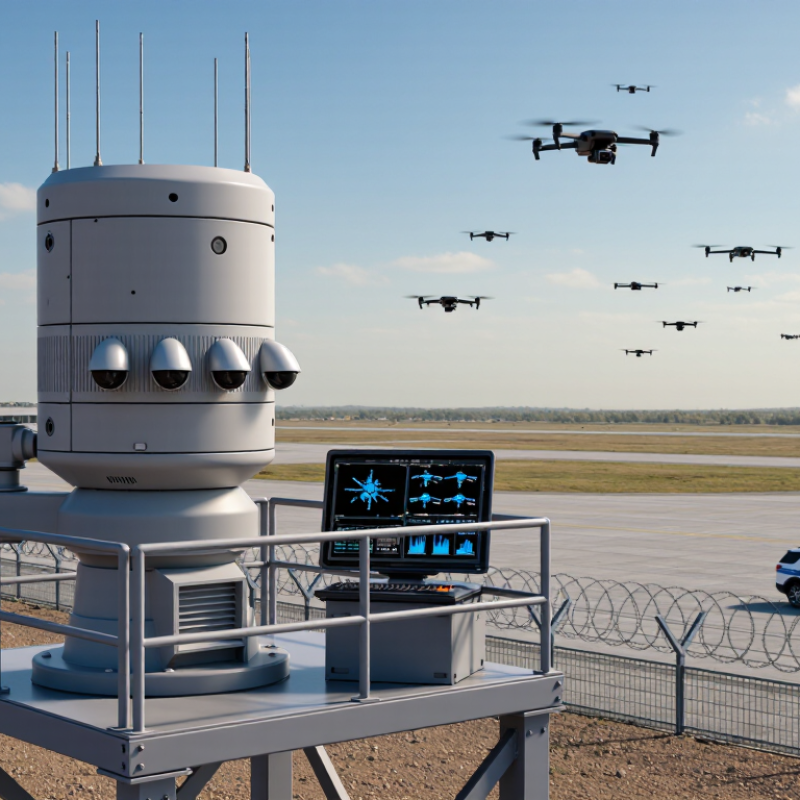
| Basic definition | Police drone detector | A detection system used to identify, locate, track, or help classify unmanned aircraft near a protected area. | Alerts, estimated location, track history, direction of travel, and sometimes an assessment of the aircraft type. | Detection does not automatically prove who is operating the drone, whether it is dangerous, or whether an interception is lawful. |
| Radio-frequency detection | RF monitoring | Receivers scan for radio transmissions between an aircraft, controller, telemetry unit, or data link. Direction-finding antennas can estimate the signal’s bearing. | Possible presence of a control link, signal direction, transmission characteristics, and in some systems an estimated pilot or aircraft position. | Autonomous flights, encrypted links, frequency hopping, low-power signals, terrain, buildings, and radio interference can reduce detection or identification performance. |
| Radar detection | Short-range radar | Transmits radio waves and analyzes reflected energy to estimate an object’s range, bearing, altitude, and movement. | Continuous tracks and movement data, including objects that are not actively transmitting radio signals. | Small drones can have a limited radar signature. Birds, trees, rain, structures, ground clutter, and nearby moving objects may create false alarms. |
| Optical detection | Visible-light cameras | Cameras observe the sky and use image processing or human review to confirm a visual target. | Visual confirmation, approximate appearance, movement, and supporting evidence for an alert. | Performance depends on daylight, visibility, contrast, camera coverage, target size, and operator or software accuracy. |
| Thermal detection | Infrared cameras | Detects differences in infrared radiation and can help locate a drone or its propulsion system in low-light conditions. | Additional confirmation at night or in poor visible-light conditions. | Small aircraft may have weak thermal contrast. Weather, distance, atmospheric conditions, and background temperature affect results. |
| Acoustic detection | Microphone arrays | Multiple microphones analyze characteristic propeller and motor sounds and estimate the direction of arrival. | Audible-drone alerts and approximate bearing, especially when visual observation is difficult. | Wind, traffic, machinery, buildings, vegetation, distance, and quiet or modified aircraft can reduce accuracy. |
| Remote identification | Broadcast identification data | Where required and available, the aircraft broadcasts information such as an identifier and location data that compatible receivers can read. | A supporting link between a detected aircraft and transmitted identification or position information. | Availability and technical requirements vary by jurisdiction. Missing, inaccurate, spoofed, or unavailable broadcasts cannot be treated as conclusive proof. |
| Sensor fusion | Multi-sensor correlation | Software combines RF, radar, optical, thermal, acoustic, and identification data to compare tracks and reduce duplicate or isolated alerts. | A more complete operating picture and a confidence level for each track. | Incorrect sensor calibration, poor time synchronization, incomplete coverage, and algorithmic errors can still produce false positives or missed detections. |
| Detection range | Operational coverage | Range depends on sensor type, antenna height, terrain, frequency, target size, weather, line of sight, and local interference. | A site-specific coverage area rather than one universal detection distance. | Published maximum ranges are not guaranteed field performance. Low-altitude drones can be hidden by terrain and buildings. |
| Tracking and response | Alert management | The system generates an alert, displays the track, records relevant data, and may support visual verification and incident coordination. | Faster awareness, evidence preservation, and better coordination between authorized personnel. | A detector generally observes and reports; it does not automatically disable, seize, jam, or destroy an aircraft. |
| Privacy and data protection | Collection of signals and imagery | Cameras, microphones, and RF receivers may collect information about people, vehicles, communications, or nearby properties. | Operational awareness and incident documentation when collection is necessary and properly controlled. | Agencies may need a lawful purpose, access controls, retention limits, audit procedures, and safeguards against unnecessary collection. |
| Radio-frequency law | Spectrum compliance | Passive monitoring may be treated differently from transmitting, interfering with, or attempting to decode communications. | Legal operation depends on the receiver, frequencies, data collected, and applicable communications rules. | Jamming and unauthorized interference are restricted or prohibited in many jurisdictions, including for public-safety users unless specifically authorized. |
| Evidence and accountability | Logging and validation | System time, alerts, sensor outputs, operator actions, and maintenance records can be logged for review. | A traceable record that supports investigations, incident review, and performance testing. | Automated classifications should be independently verified before enforcement action. Logs must be protected from unauthorized alteration or disclosure. |
| Legal authority for intervention | Counter-drone actions | Actions such as interception, disruption, seizure, or disabling an aircraft require separate legal authority and operational rules. | A detector can inform a response decision but does not itself grant authority to take action. | Rules differ by country and agency. Potential issues include aviation safety, communications law, privacy, property rights, criminal procedure, and civil liability. |