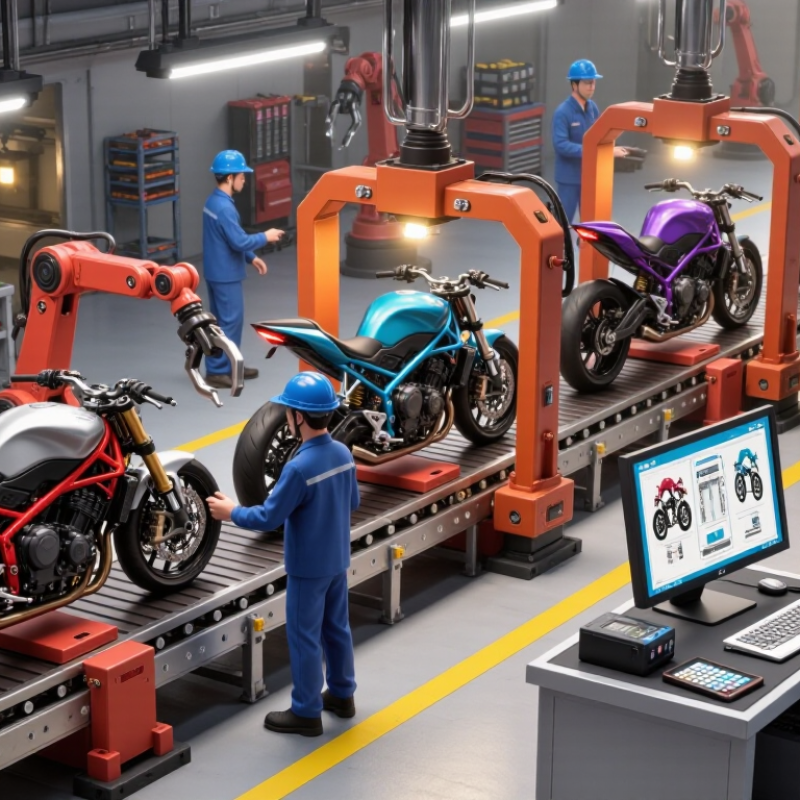
| 1. Parts Kitting | Small parts and assemblies are grouped according to the build sequence. | Fasteners, brackets, wiring sections, controls, hoses, and trim components. | Parts are delivered in labeled bins, carts, or sequenced kits beside the line. | Reduces walking, searching, and incorrect-part risks. | Part number, quantity, revision level, and barcode or electronic traceability. |
| 2. Frame Preparation | The frame is inspected, positioned in a fixture, and prepared for component installation. | Welded or cast frame, steering components, brackets, bearings, and mounting hardware. | The frame travels on a conveyor or guided carrier that maintains its orientation. | Fixtures hold mounting points in repeatable positions during assembly. | Frame identification, weld condition, dimensional alignment, and bearing fit. |
| 3. Engine Installation | The engine is lifted into the frame and secured with specified mounting hardware. | Completed engine, mounting bolts, spacers, isolators, and support fixtures. | An overhead hoist, lift table, or guided manipulator transfers the engine to the frame. | Engine installation is sequenced before many systems that connect to the power unit. | Mounting orientation, bolt presence, tightening angle or torque, and clearance. |
| 4. Front-End Assembly | The steering head, fork assembly, handlebars, front wheel, and controls are installed. | Forks, steering stem, handlebar, brake components, wheel, tire, and control cables. | Components arrive on carts or racks and are fitted directly to the framed motorcycle. | The front end is aligned to support later brake, cable, and electrical routing work. | Steering movement, wheel runout, axle installation, brake routing, and fastener torque. |
| 5. Rear Chassis Assembly | The swingarm, rear suspension, rear wheel, chain or belt drive, and related guards are fitted. | Swingarm, shock absorber, rear wheel, drive components, brake parts, and spacers. | Parts are supplied in sequence from dedicated racks near the assembly station. | Suspension and drive components must be installed without restricting movement. | Wheel alignment, drive tension, suspension travel, brake operation, and torque verification. |
| 6. Electrical and Fuel Systems | Wiring harnesses, battery connections, sensors, lighting, fuel lines, and control modules are connected. | Harnesses, connectors, battery, sensors, lamps, fuel tank, hoses, and protective sleeves. | Harnesses are routed through fixed clips and guides while the motorcycle remains on its carrier. | Routing protects wires from heat, sharp edges, vibration, and moving parts. | Connector seating, polarity, continuity, leak prevention, and harness clearance. |
| 7. Exhaust and Body Components | The exhaust system, seat, fenders, side panels, tank covers, and other exterior parts are installed. | Exhaust sections, heat shields, seat, plastic or metal panels, fasteners, and seals. | Large parts are delivered on protective carts or racks to prevent surface damage. | Appearance-sensitive operations are performed with protective covers and controlled handling. | Panel gaps, surface condition, exhaust clearance, heat-shield security, and seat locking. |
| 8. Fluids and Adjustments | Required fluids are added and operating controls are adjusted to specification. | Engine oil, coolant where applicable, brake fluid, fuel, lubricants, and adjustment tools. | Metered filling equipment and portable service tools are positioned at the station. | Dispensing equipment helps control quantity and reduce contamination or spillage. | Fluid quantity, visible leaks, brake feel, throttle return, clutch operation, and control free play. |
| 9. End-of-Line Testing | The completed motorcycle undergoes functional, electrical, safety, and appearance checks. | Diagnostic equipment, brake testers, roller or dynamometer equipment where required, and inspection forms. | Motorcycles leave the assembly conveyor for a controlled test area or inspection lane. | Defects are recorded electronically or on standardized inspection documents for correction. | Starting, charging, lighting, instrument operation, brake performance, emissions compliance where applicable, and fastener audit. |
| 10. Final Release and Packing | Approved motorcycles receive final documentation, protection, and shipment preparation. | Inspection records, protective materials, shipping supports, labels, and owner documentation. | Motorcycles move to a holding area, shipping crate, or transport staging lane. | Traceability links the finished vehicle to its build record and inspection results. | Vehicle identification, damage inspection, accessory completeness, packaging security, and release authorization. |