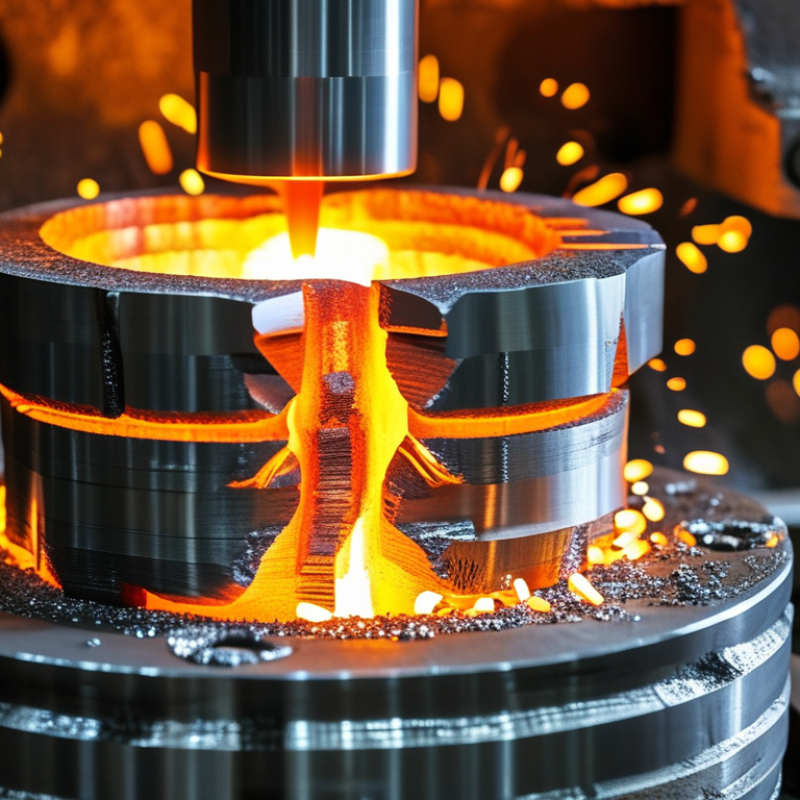
| Hot Forging | Above the material’s recrystallization temperature; commonly about 900–1,250 °C for steels, depending on grade and process. | Carbon steel, alloy steel, stainless steel, aluminum alloys, titanium alloys, and nickel-based alloys. | Crankshafts, connecting rods, gears, pressure-containing parts, heavy machinery components, and structural fittings. | High material deformability; suitable for large reductions and complex shapes; refined grain flow; reduced risk of work hardening during forming. | Requires heating equipment; oxidation and scale may occur; dimensional accuracy and surface finish are generally lower than in cold forging. |
| Warm Forging | Between room temperature and the recrystallization range; often about 600–900 °C for steels. | Carbon steels, alloy steels, stainless steels, and selected nonferrous alloys. | Automotive and industrial shafts, flanges, hubs, yokes, and medium-complexity precision parts. | Lower forming loads than cold forging; better dimensional accuracy than hot forging; less scale formation; improved surface quality. | Temperature control is critical; tooling can be more demanding; the workable temperature range depends strongly on the alloy. |
| Cold Forging | Near room temperature, normally without bulk heating of the workpiece. | Low-carbon steel, stainless steel, aluminum, copper, brass, and selected titanium alloys. | Fasteners, rivets, pins, bolts, automotive fittings, electrical terminals, and small precision components. | Excellent material utilization; high production rates; good dimensional repeatability; smooth surface finish; increased strength from work hardening. | High forming forces; limited shape complexity and reduction per operation; tooling costs can be high; residual stresses may require relief treatment. |
| Open-Die Forging | Usually hot forging temperatures appropriate to the alloy; steels are commonly forged in the approximate range of 900–1,250 °C. | Large steel forgings, stainless steel, nickel alloys, titanium alloys, and aluminum alloys. | Large shafts, discs, rings, pressure-vessel components, turbine parts, and heavy industrial equipment. | Suitable for very large parts; flexible tooling; strong directional grain flow; economical for low-to-medium production volumes. | Lower dimensional precision than closed-die forging; machining allowance is often required; complex shapes may need multiple operations. |
| Closed-Die Forging | Commonly performed hot or warm; steel operations often use approximately 900–1,250 °C, depending on alloy and die design. | Carbon and alloy steels, aluminum alloys, titanium alloys, and nickel-based alloys. | Automotive steering and suspension parts, aircraft fittings, gears, levers, brackets, and high-strength machinery components. | Good repeatability; near-net-shape production; efficient grain flow; reduced machining and material waste at suitable production volumes. | High die and tooling cost; flash may require trimming; design size and geometry are restricted by equipment and die-filling limits. |
| Impression-Die Forging | Most commonly hot forging, with temperature selected according to the alloy and required deformation. | Steel, aluminum alloys, titanium alloys, and nickel-based alloys. | Aircraft structural hardware, engine components, vehicle parts, and industrial power-transmission components. | Produces repeatable shapes with controlled grain flow; suitable for medium-to-high production quantities; good mechanical performance. | Requires carefully designed dies and preforms; flash trimming may be necessary; initial tooling investment is significant. |
| Seamless Ring Rolling | Usually hot or warm, depending on alloy; steel rings are frequently processed at elevated forging temperatures. | Carbon and alloy steels, stainless steels, titanium alloys, aluminum alloys, and nickel-based alloys. | Bearings, flanges, gears, wind-turbine components, aerospace rings, pressure vessels, and industrial seals. | Efficient production of large seamless rings; circumferential grain flow; reduced material waste compared with machining from solid stock. | Requires specialized rolling equipment; ring geometry is constrained by process parameters; additional heat treatment and machining may be required. |
| Roll Forging | Typically hot or warm, depending on the material and required cross-section reduction. | Carbon steel, alloy steel, stainless steel, aluminum alloys, and titanium alloys. | Axles, leaf-spring ends, connecting rods, tapered bars, and elongated preforms for die forging. | High productivity; efficient preform production; favorable grain flow; lower material waste than cutting from bar stock. | Best suited to elongated or gradually changing sections; equipment and roll tooling require specialized design. |
| Upset Forging | Cold, warm, or hot, depending on the material, part size, and required deformation. | Carbon steel, alloy steel, stainless steel, aluminum, copper, brass, and nickel alloys. | Bolts, fasteners, headed pins, valves, rivets, and components with enlarged ends or localized thick sections. | Efficient for increasing cross-sectional area; high production rates; strong fiber continuity; excellent material utilization. | Length-to-diameter ratios are limited by buckling risk; multiple stages may be needed for large deformations; tooling loads can be high. |
| Precision Forging | Usually warm or hot, with carefully controlled temperature and lubrication. | Aluminum alloys, titanium alloys, steels, and nickel-based alloys. | Gears, aircraft fittings, automotive drivetrain parts, and components requiring minimal machining. | Near-net-shape capability; reduced machining time and scrap; good dimensional consistency when process control is strong. | Strict requirements for die accuracy, material volume, lubrication, and process control; tooling costs are relatively high. |