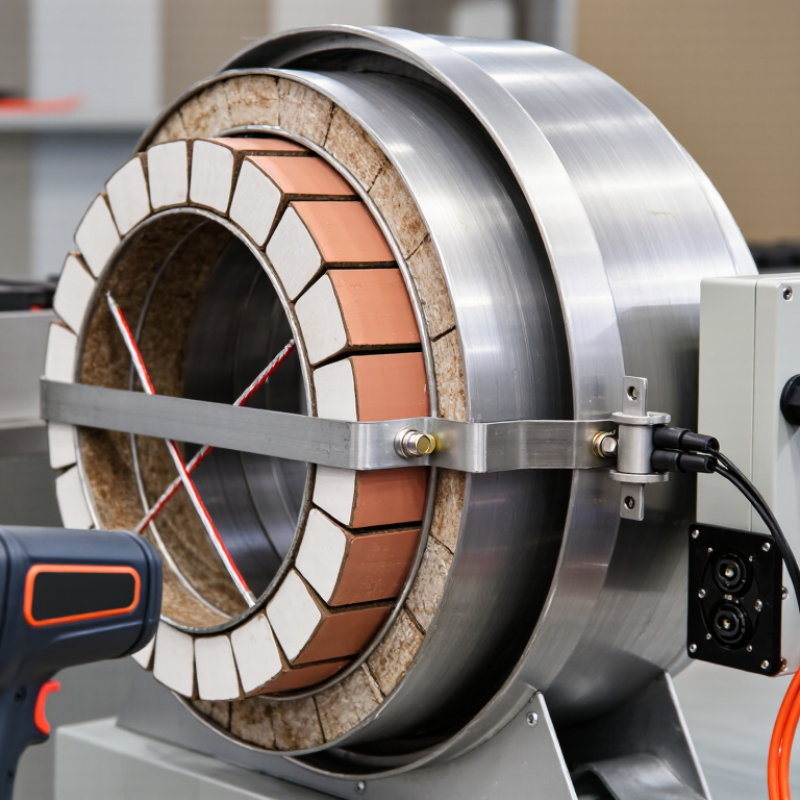
| Operating Temperature | Up to approximately 300 °C | Standard ceramic insulated band heater with suitable electrical insulation | Provides efficient barrel heating for many low-to-medium temperature processes. | Confirm the heater's maximum sheath, insulation, and terminal temperature ratings. |
| High-Temperature Operation | Approximately 300–600 °C, depending on the process | High-temperature ceramic band heater with heat-resistant leads and terminals | Ceramic insulation can support higher operating temperatures than many conventional insulated designs. | Check the manufacturer's declared continuous operating temperature; do not use the short-term limit as a continuous rating. |
| Heated Cylinder Diameter | Small, medium, or large cylindrical barrel | Custom-diameter heater or segmented heater design | Correct diameter improves contact, reduces air gaps, and helps maintain uniform heat transfer. | Measure the actual barrel circumference or outside diameter after allowing for surface condition and tolerances. |
| Heater Width | Narrow heating zone or extended axial coverage | Single-width band for localized heating; multiple bands for long barrels | Separate zones allow better temperature distribution and easier maintenance. | Match each heater width to the required heating zone and avoid overlapping unless specifically permitted. |
| Voltage and Power | Available supply voltage and required heat-up rate | Heater selected by voltage, wattage, watt density, and circuit capacity | Incorrect electrical sizing can cause slow heating, excessive surface temperature, or circuit overload. | Use the relationship Current (A) = Power (W) ÷ Voltage (V) and verify the circuit, wiring, and switching capacity. |
| Watt Density | Heat-sensitive material or standard metal processing | Lower watt density for sensitive materials; higher watt density only when process conditions allow | Watt density affects surface temperature, heat-up speed, and the risk of material degradation. | Calculate watts per heated surface area and compare it with the process material's allowable temperature. |
| Temperature Sensor | Closed-loop temperature regulation | Thermocouple or RTD installed close to the actual control point | Sensor location has a direct effect on measurement accuracy and process stability. | Match the sensor type to the controller input and protect it from direct heater radiation where necessary. |
| Temperature Controller | Stable process temperature with limited overshoot | PID controller with adjustable proportional, integral, and derivative parameters | PID control can improve stability compared with simple on/off control, especially during changing loads. | Select a controller with the correct sensor input, output type, alarm functions, and supply voltage. |
| Control Output | Frequent switching and accurate power modulation | Solid-state relay or power controller, correctly rated for the heater load | Electronic switching reduces mechanical contact wear during frequent temperature corrections. | Provide a properly rated heat sink, overcurrent protection, and adequate cabinet ventilation. |
| Installation Fit | Fast replacement or limited-access installation | Hinged, split, or clamp-style band with accessible terminals | A service-friendly design can reduce downtime during installation and replacement. | Confirm hinge position, clamp direction, terminal clearance, and the available installation space. |
| Clamping and Contact | Efficient heat transfer to a clean cylindrical surface | Adjustable clamping hardware with close-fitting band geometry | Poor contact or loose bands create hot spots, slow heat transfer, and premature heater failure. | Clean the barrel, remove burrs, tighten evenly, and follow the specified installation clearance. |
| Thermal Insulation | Reduced heat loss and lower external surface temperature | External thermal insulation rated for the operating temperature | Insulation can improve energy efficiency and protect nearby components and operators. | Ensure insulation does not cover terminals, restrict ventilation, or exceed its own temperature rating. |
| Electrical Protection | Industrial equipment with continuous operation | Grounding, overcurrent protection, correctly rated leads, and suitable terminal covers | Protection reduces the risk of electric shock, short circuits, and equipment damage. | Follow applicable electrical codes and verify protective-earth continuity before energizing. |
| Maintenance Access | Frequent inspection or high-utilization production | Replaceable leads, accessible fasteners, and clearly labeled heating zones | Accessible components simplify testing, troubleshooting, and planned replacement. | Allow sufficient clearance for tightening, electrical testing, and safe heater removal. |
| Final Verification | Before commissioning the heating system | Documented inspection and controlled heat-up test | A pre-start check helps identify wiring, fit, sensor, and temperature-control problems early. | Verify resistance, insulation condition, grounding, sensor response, clamp tightness, and controller operation. |