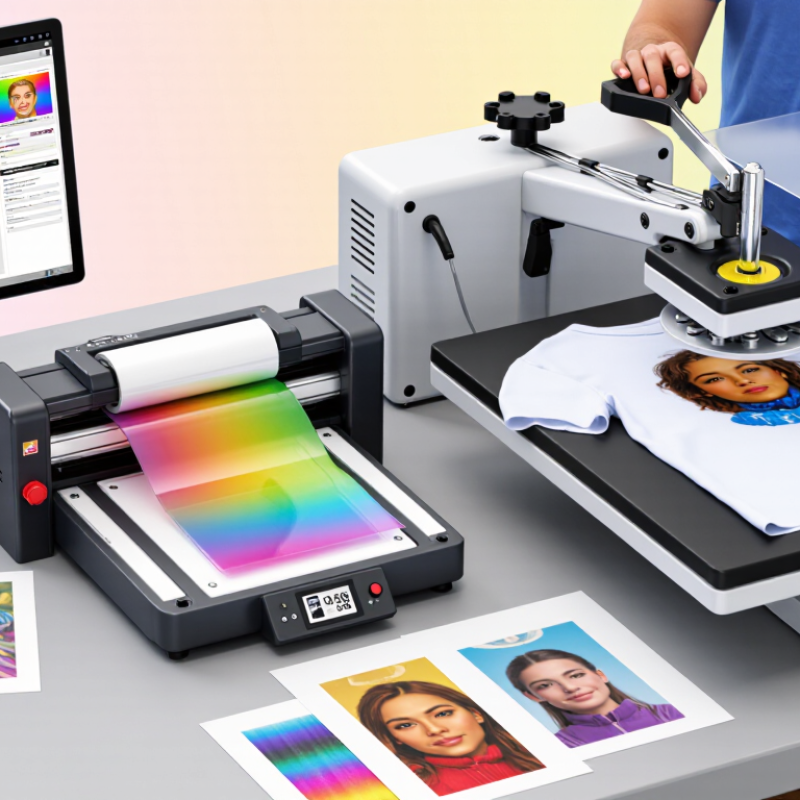
| Transfer Sheet Type | A specially coated film used to carry a printed design before it is applied to fabric. | Usually supplied as individual sheets or continuous roll film. | Provides a temporary surface that holds the printed image and releases it during heat pressing. |
| Base Film | The main transparent or semi-transparent layer of the sheet. | Commonly made from polyethylene terephthalate, also known as PET film. | Provides dimensional stability and allows the design to be handled before application. |
| Film Thickness | The thickness of the PET carrier film. | Often about 75–100 micrometres, although the exact value depends on the sheet construction. | Affects flexibility, handling, heat transfer behavior, and release performance. |
| Surface Coating | A treatment applied to the film surface to control ink adhesion and powder bonding. | Typically a receptive coating designed for water-based pigment inks and hot-melt adhesive powder. | Helps the ink remain in place and supports even attachment of the adhesive layer. |
| Printed Ink Layer | The image printed onto the coated side of the transfer sheet. | Usually includes CMYK color inks and may include white ink as an underbase. | Creates the visible artwork. White ink helps colors remain opaque on dark or colored garments. |
| White Ink Underbase | A layer of white ink positioned behind the colored image. | Used selectively or fully, depending on the garment color and the desired opacity. | Improves color brightness and reduces the influence of the textile color on the printed design. |
| Hot-Melt Adhesive Powder | Fine thermoplastic powder applied to the wet printed ink. | Commonly made from polyurethane-based or similar thermoplastic adhesive materials. | Forms the bonding layer that attaches the printed design to the textile when heated. |
| Powder Curing | The controlled heating stage that melts and levels the adhesive powder. | Often performed at approximately 120–160°C, depending on the powder and equipment. | Creates a continuous adhesive film without applying the transfer directly to the garment. |
| Printing Method | The process used to place the image onto the transfer sheet. | Typically digital inkjet printing with water-based pigment inks. | Allows detailed, full-color artwork without cutting the design from solid-color material. |
| Transfer Surface | The coated side of the sheet that receives the ink. | Usually identified by a smoother or specially treated printable surface. | Correct orientation is essential for proper ink adhesion and image release. |
| Heat-Press Application | The stage in which the cured transfer is bonded to a garment. | Many systems use approximately 140–170°C for about 10–20 seconds, but settings vary. | Heat and pressure activate the adhesive so it bonds with the textile fibers. |
| Peel Method | The way the PET film is removed after pressing. | May be hot peel, warm peel, or cold peel, depending on the film and adhesive system. | Controls when the carrier film can be separated without lifting or distorting the design. |
| Compatible Fabrics | Textiles that can accept the adhesive and tolerate the required heat and pressure. | Commonly cotton, polyester, cotton-polyester blends, and some treated synthetic fabrics. | Enables application across a broad range of garments, subject to fabric testing. |
| Final Transfer Structure | The layered construction remaining on the garment after the carrier film is removed. | Textile surface, thermoplastic adhesive layer, white and colored ink layers, and any protective finish. | Produces a durable, flexible printed graphic integrated with the garment surface. |
| Key Quality Factors | Conditions that influence the appearance and durability of the finished transfer. | Film coating, ink coverage, powder distribution, curing, press temperature, pressure, and dwell time. | Proper control helps prevent peeling, cracking, uneven texture, poor opacity, and incomplete adhesion. |