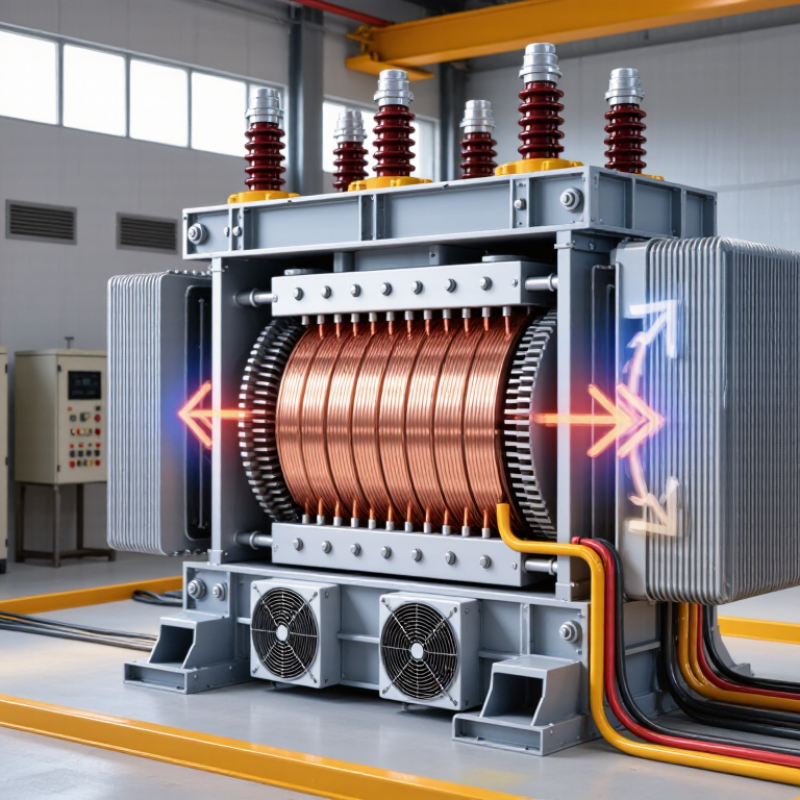
| Definition and Operating Principle |
| Construction | Transformer type | A stationary transformer in which the windings are insulated and cooled by air rather than immersed in liquid. | Eliminates the need for mineral oil or other liquid insulation and reduces liquid-leakage risk. |
| Energy transfer | Electromagnetic induction | Alternating current in the primary winding creates a changing magnetic flux in the core, inducing voltage in the secondary winding. | Provides voltage conversion without a direct electrical connection between the primary and secondary circuits. |
| Frequency | System frequency | Commonly designed for 50 Hz or 60 Hz power systems. | The transformer frequency rating must match the intended electrical system. |
| Core material | Magnetic core | Typically laminated electrical steel with insulation between laminations. | Laminations reduce eddy-current losses and help improve efficiency. |
| Cooling method | Heat removal | Natural air cooling is commonly designated AN; forced-air cooling is commonly designated AF. | Fans can increase heat dissipation and may allow higher short-term or continuous loading when permitted by the design. |
| Typical Technical Characteristics |
| Power rating | Apparent power | Available from approximately 1 kVA to several MVA, depending on the design and application. | Small units serve control or auxiliary loads; larger units supply commercial, industrial, and infrastructure systems. |
| Primary voltage | Input voltage | Low-voltage and medium-voltage designs are available; many distribution designs operate at primary voltages up to about 36 kV. | The voltage rating must be selected according to the utility or facility distribution system. |
| Secondary voltage | Output voltage | Common low-voltage outputs include approximately 208 V, 240 V, 380 V, 400 V, 415 V, and 480 V, depending on the electrical system. | Provides the voltage required by lighting, receptacles, motors, HVAC equipment, and other loads. |
| Phase configuration | Electrical arrangement | Single-phase and three-phase configurations are available. | Three-phase units are widely used for commercial and industrial distribution; single-phase units support smaller or specialized loads. |
| Insulation system | Thermal class | Common insulation thermal classes include Class F, rated at 155°C, and Class H, rated at 180°C. | Thermal class indicates the maximum temperature capability of the insulation system, not a recommended operating temperature for every component. |
| Efficiency | Energy performance | Typically about 95% to 99.5%, depending on rating, voltage, load level, design, and efficiency requirements. | Efficiency is generally highest near the load range for which the transformer was designed. |
| Sound level | Audible noise | Often approximately 40 to 70 dB(A), depending on size, core design, enclosure, loading, and cooling fans. | Acoustic requirements should be checked when the transformer is installed near offices, residences, hospitals, or other noise-sensitive areas. |
| Tap adjustment | Voltage regulation | Many units include de-energized tap links, commonly in steps around ±2.5% or ±5%, subject to the design. | Tap settings help compensate for supply-voltage variation, but they must be changed only when the transformer is de-energized unless a specialized system permits otherwise. |
| Common Applications |
| Commercial buildings | Facility distribution | Office buildingsRetail facilitiesHotelsSchools | Suitable for indoor electrical rooms where low fire risk and limited maintenance are important. |
| Industrial facilities | Plant power systems | FactoriesProcess plantsWorkshopsWarehouses | Supplies motors, drives, automation equipment, lighting, and other plant loads. |
| Infrastructure | Critical and public facilities | HospitalsData centersAirportsTransit systems | Used where indoor installation, operational continuity, and reduced liquid-fire exposure are valuable. |
| Renewable energy | Power conversion systems | Solar installationsWind systemsBattery energy storage | Can provide voltage matching between power-conversion equipment and the facility or grid connection. |
| Special environments | Indoor or restricted locations | Underground facilitiesMarine environmentsHigh-rise buildings | Application suitability depends on enclosure rating, humidity, salt exposure, altitude, ventilation, and local electrical codes. |
| Benefits |
| Fire safety | Reduced liquid-fire exposure | Contains no liquid insulation that can leak or support a liquid-fueled fire. | Often preferred for indoor installations and locations with strict fire-safety requirements; the transformer still contains energized electrical components and combustible solid materials may be present. |
| Environmental profile | Leakage prevention | No routine handling of mineral oil is required. | Reduces the risk of soil or water contamination caused by transformer-liquid leakage. |
| Maintenance | Routine servicing | Generally requires inspection, cleaning, connection checks, temperature review, and ventilation checks rather than liquid testing. | Maintenance can be simpler, although electrical testing and safety procedures remain essential. |
| Installation flexibility | Location options | Can often be installed indoors when adequate ventilation, clearances, enclosure protection, and code compliance are provided. | May reduce the need for a separate outdoor transformer vault or liquid-containment system. |
| Overload response | Short-term loading | Some designs can tolerate limited short-duration overloads, provided temperature limits are not exceeded. | Actual overload capability must follow the manufacturer’s thermal data and protection settings. |
| Operating Limitations and Design Considerations |
| Heat dissipation | Thermal management | Air cooling is less effective than liquid cooling for comparable physical volume and rating. | Dry type transformers may require more space, larger ventilation openings, or forced-air fans as power ratings increase. |
| Overloading | Temperature limitation | Continuous overloading can accelerate insulation aging and reduce service life. | Load current, ambient temperature, harmonics, and cooling status should be monitored against the design limits. |
| Ambient conditions | Temperature and humidity | High ambient temperature, condensation, dust, corrosive gases, and high humidity can reduce cooling and insulation performance. | Special coatings, heaters, filtered ventilation, or a suitable enclosure may be required in harsh environments. |
| Altitude | Air-density effect | Air density decreases at high altitude, reducing natural and forced-air cooling effectiveness. | Ratings may require derating or special design above the altitude specified by the applicable standard or project specification. |
| Harmonic loads | Nonlinear-current heating | Variable-frequency drives, switched-mode power supplies, and other nonlinear loads can increase winding and core losses. | A transformer with an appropriate harmonic-duty or K-factor rating may be necessary. |
| Dust accumulation | Insulation and cooling | Dust on windings and ventilation paths can reduce insulation performance and restrict airflow. | Regular inspection and cleaning are important, especially in industrial or construction environments. |
| Physical size and weight | Space requirement | For the same power rating, a dry type transformer may be larger or heavier than a comparable liquid-immersed unit. | Structural loading, access routes, lifting equipment, working clearances, and ventilation space should be considered during design. |
| Initial cost | Project economics | Purchase cost can be higher for some ratings and performance requirements. | Total cost should include fire protection, containment, ventilation, maintenance, energy losses, and installation requirements. |
| Safety and Maintenance Practices |
| Electrical isolation | Safe access | De-energize, isolate, lock out, and verify absence of voltage before inspection or maintenance. | Only qualified personnel should work on or near the transformer in accordance with applicable safety regulations. |
| Inspection interval | Maintenance planning | Inspection frequency depends on operating hours, environment, loading, contamination, and criticality. | Routine checks should include ventilation, terminals, grounding, enclosure condition, unusual noise, odor, and temperature indicators. |
| Testing | Condition assessment | Possible tests include insulation resistance, winding resistance, turns ratio, and protective-device verification. | Testing should be performed using procedures suitable for the transformer design and the applicable electrical standard. |
| Protection | Fault and overload control | Protection may include primary and secondary overcurrent devices, temperature sensors, alarms, trip functions, and surge protection. | Protection settings must coordinate with system fault levels, inrush current, transformer rating, and downstream equipment. |