How to Choose a Stainless Steel Pipe Manufacturer?

Choosing a Stainless Steel Pipe Manufacturer affects more than the purchase price. It shapes reliability, maintenance, and the risk of costly delays. The global stainless steel industry produced 58.4 million tonnes in 2023, up 4.6% from 2022, according to worldstainless’ 2023 production data. That scale offers buyers many options. It does not make every supplier equally capable.

Start with the pipe’s service conditions: fluid, temperature, pressure, and exposure to corrosive substances. Then check whether the proposed grade and dimensions suit the application. ASTM A312/A312M, for example, covers specified seamless, welded, and heavily cold-worked austenitic stainless steel pipe. Materials expert J. R. Davis’s ASM Specialty Handbook: Stainless Steels emphasizes how corrosion performance depends on alloy and environment. A fair paraphrase of that guidance is: “Choose the alloy for the service conditions, not the sales label.” Ask for traceable material test reports, documented inspection procedures, and clear answers about tolerances and delivery.

Small details matter. A checklist helps, but it can create false confidence. A certificate alone cannot show how consistently a factory controls production or handles a nonconformance. Ask to review a sample document package, clarify inspection and acceptance criteria, and confirm how changes are approved. Compare suppliers on technical fit, quality evidence, communication, and lifecycle cost—not price alone. The right Stainless Steel Pipe Manufacturer should welcome specific questions and support its claims with records. If an answer sounds polished but lacks evidence, pause and verify.

How to Choose a Stainless Steel Pipe Manufacturer?

Define Your Pipe Requirements and Intended Application

Choosing a stainless steel pipe manufacturer should begin with the job, not a catalog. Define where the pipe will operate, what it will carry, and how it will be installed. In a food-processing line, record fluid temperature, cleaning chemicals, pressure, flow rate, and hygiene requirements. Outdoor supports may face rain, salt air, and repeated temperature changes. Small details matter. Also measure the required outside diameter, wall thickness, length, tolerances, and connection method. A minor dimensional error can delay assembly or create costly rework.

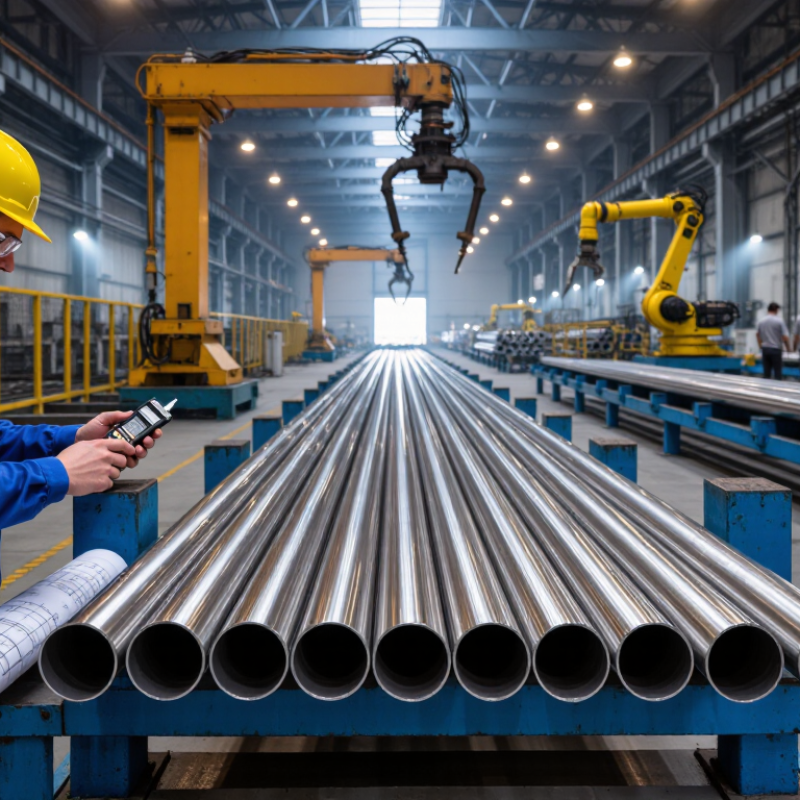
The stainless steel grade must match the environment. Chloride exposure may require better resistance than a dry indoor application. Acidic fluids, high heat, and abrasive particles can change the selection entirely. Ask for material certificates, heat numbers, test results, and inspection records. These documents support traceability and show whether the manufacturer controls its process. Confirm welding procedures, surface finish, straightness, and non-destructive testing when the application demands them. Do not rely on polished appearance alone.

Share the same detailed specification with several manufacturers. A capable supplier should ask practical questions instead of simply quoting a price. Their questions often reveal technical understanding. I have seen projects specify pressure and diameter but overlook cleaning methods and support spacing. That omission caused trouble later. A specification can look complete and still be weak. Leave room to review assumptions with an engineer, especially when temperatures or corrosive conditions vary. No requirement is perfect. Choose a manufacturer that explains limits clearly, provides verifiable records, and can produce pipes consistently for the intended service.

Verify Material Grades and Manufacturing Capabilities

A reliable stainless steel pipe manufacturer should prove material grade, not merely print it on a quotation. Request the heat number, chemical analysis, mechanical test results, and a traceable EN 10204 3.1 certificate. Compare chromium, nickel, molybdenum, carbon, and nitrogen values with the specified grade. A polished certificate is not proof by itself.

ASTM A312/A312M covers seamless and welded austenitic stainless steel pipe for demanding service. Ask whether the factory performs solution annealing, weld inspection, hydrostatic testing, and dimensional checks under the applicable edition. For welded pipe, review the welding procedure, operator qualifications, and non-destructive testing records. Tiny details matter. A missing heat number can break traceability.

Capacity also requires evidence. World Stainless reported approximately 58.4 million tonnes of global stainless steel production in 2023, showing a large and competitive supply base. Volume alone proves little. Request recent production samples, mill certificates, calibration records, and inspection reports from independent laboratories. Verify pipe sizes, wall-thickness tolerances, surface finishes, and maximum batch capacity. Visit the facility if possible. Some manufacturers can meet one specification but struggle with low-volume, tight-tolerance orders. That limitation should be stated clearly, even when it weakens the sales pitch.

Review Quality Systems, Certifications, and Testing Practices

Choosing a stainless steel pipe manufacturer requires more than checking a polished website. Review its quality system, certifications, and testing records. The ISO Survey 2022 reported more than 1.2 million ISO 9001 certificates worldwide. Yet certification alone proves little. Ask whether the certificate covers the actual production site and relevant pipe processes.

A reliable manufacturer should link every pipe bundle to a heat number, material test certificate, and inspection record. Check whether laboratories use calibrated equipment. Useful controls include positive material identification, chemical analysis, dimensional checks, hydrostatic testing, and ultrasonic examination. ASTM and ASME requirements can define suitable methods, but the supplier must show completed reports, not empty templates. Look for test pressure, holding time, acceptance criteria, and inspector authorization. Small details matter.

Production data also deserves scrutiny. World Stainless reported global crude stainless steel production of about 58.4 million tonnes in 2023. At that scale, process consistency becomes critical. Ask how the factory controls welding parameters, solution annealing, surface finish, and traceability after cutting.

A factory tour can reveal more than a certificate. Observe storage racks, rejected-material zones, and instrument labels. A missing calibration sticker is a warning. Not always decisive, but worth questioning.

Some buyers overvalue third-party certificates. That is an understandable mistake. Request recent nonconformance records and corrective-action evidence, when commercially available. A manufacturer willing to discuss failures may be more reliable than one claiming perfect results. Test the system before trusting the pipe.

Assess Customization, Lead Times, and Technical Support

Choosing a stainless steel pipe manufacturer requires more than comparing prices. Customization often reveals real manufacturing ability. Ask whether the supplier can control outside diameter, wall thickness, length, surface finish, and end preparation. Small changes affect tooling, welding, polishing, and inspection. Request a sample drawing before approval. It should show tolerances, material grade, weld requirements, and test points. Good engineers explain trade-offs clearly. A thinner wall may reduce weight, but it can increase denting risk. I have seen projects specify a perfect finish without defining acceptable marks. That mistake creates arguments later. Write acceptance criteria early. Keep them measurable.

Lead time should be divided into practical stages. Confirm raw material availability, tooling preparation, sample production, inspection, bulk manufacturing, and dispatch. A promise of ten days may exclude testing or transport. Ask for a production schedule with named checkpoints. Check how the manufacturer handles changes after drawing approval. A small revision can restart production. Build a modest buffer. It is not wasteful. It protects installation dates. Also ask whether capacity is reserved during your planned window. Production claims can sound confident, yet remain vague.

Technical support matters when the pipe enters a real system. The supplier should review pressure, temperature, corrosion exposure, joining method, and installation conditions. Request material certificates, dimensional reports, hydrostatic or non-destructive test records, and traceability details when applicable. Support should continue after delivery. Clear responses during a fit-up problem can prevent expensive rework. Test their communication with one detailed question. Measure response quality, not just speed. Sometimes the best answer is, “We need more data.” That honesty is useful. Still, do not rely on promises alone. Record decisions, verify samples, and inspect critical batches independently.
Compare Total Costs and Select a Reliable Manufacturer

How to Choose a Stainless Steel Pipe Manufacturer?

A low quotation can look persuasive. It can also be wrong. Compare the complete purchasing cost, not only the price per meter. Include material grade, wall-thickness tolerance, cutting, surface treatment, packaging, freight, inspection, and taxes. A cheaper pipe may create higher costs when welding requires extra preparation or rejected pieces delay installation.

Ask each manufacturer for a detailed, comparable quotation. Check whether the price includes mill test certificates, dimensional reports, and corrosion-related testing where necessary. Request sample documents before placing a large order. Review heat numbers, batch traceability, and inspection procedures. These details show whether quality control exists beyond attractive sales language.

Reliability needs evidence. Examine production capacity, delivery records, equipment maintenance, and responses to technical questions. A factory visit or independent inspection can reveal storage problems, mixed materials, or unclear labeling. I have seen projects lose time because pipes arrived without usable certificates. The original price looked excellent. The overall result was not.

Set clear acceptance standards in the purchase contract. Specify grade, outside diameter, thickness, length, finish, quantity, testing, packaging, and remedies for nonconforming goods. Discuss lead times realistically, including production and transport buffers. Do not ignore communication quality. Slow answers before an order may become serious delays afterward. A reliable manufacturer may not offer the lowest quote, but transparent costs and repeatable quality usually protect the project budget better.

Find the Right Repair Product for Your Project

Need to find the most appropriate product for the needs of your project? We can help because we have over 70 years of experience servicing the industry with every kind of project, from Do-it-yourself projects to large skyscrapers. Package Pavement has the experience, the knowledge and the products to help every project succeed.

Quikrete Repair Products
Legend
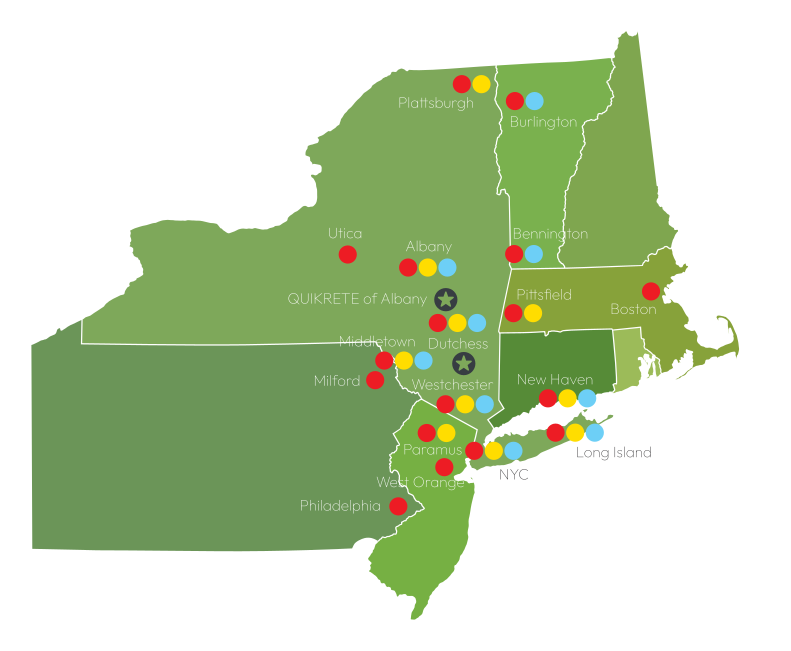
Package Pavement has two convenient locations in Stormville, NY (Dutchess County) and Ravena, NY (Greene County) to serve the Northeastern Region with bagged concrete, blacktop, mortar, and repair products. This map gives a general idea of where we service and the product lines we offer.
Package Pavement Products
Quikrete Products
Spec Mix Products
map

Our Brands Websites