| Compatibility | Number of authorized users | Provide one personal lock position for every employee exposed to the hazardous energy. | Count the people who may work under the group lockout and confirm that the box has enough external lock holes or hasp capacity. | OSHA 29 CFR 1910.147 |
| Compatibility | Energy-control hardware capacity | The box should hold the required equipment, such as individual locks, tags, hasps, valve covers, breaker lockouts, and written procedures. | List the devices needed for the most complex isolation task and compare their combined size with the internal usable space. | OSHA 29 CFR 1910.147; ANSI/ASSP Z244.1 |
| Compatibility | Mounting and portability | Choose a portable box for changing work locations, or a wall-mounted cabinet when the lockout station is fixed and used frequently. | Check mounting holes, surface strength, access clearance, handle design, and the total loaded weight before installation. | Manufacturer installation instructions; site risk assessment |
| Security | Personal lock retention | Each authorized employee should be able to apply and remove a uniquely identified personal lock. The box must not allow accidental bypass of an applied lock. | Apply all available lock positions, close the box, and confirm that the contents cannot be removed until the applicable personal locks are removed. | OSHA 29 CFR 1910.147(d)(4) and (f)(3) |
| Security | Tamper resistance | Use a rigid metal or impact-resistant nonmetallic enclosure with protected hinges, a durable latch, and visible evidence of unauthorized opening. | Inspect hinge pins, latch alignment, lock-hole diameter, enclosure rigidity, and resistance to ordinary hand tools used during routine access. | Site security requirements; ANSI/ASSP Z244.1 |
| Security | Environmental protection | For outdoor or washdown locations, select corrosion-resistant construction and a cover seal suitable for the actual exposure. For indoor dry areas, standard powder-coated steel or durable polymer may be sufficient. | Confirm material, corrosion protection, temperature range, water-ingress rating where specified, and compatibility with chemicals used at the site. | ISO 14118; site environmental assessment |
| Regulatory Features | Energy-control procedure identification | Provide a clearly visible area for the machine name, isolation procedure number, authorized employees, and emergency contact information. | Check that labels remain legible after cleaning and that the procedure can be located without opening the box. | OSHA 29 CFR 1910.147(c)(4) and (c)(7) |
| Regulatory Features | Warning labels and tags | Use durable labels with clear wording such as “Do Not Operate,” employee identification, and the purpose of the lockout. | Confirm that labels are permanent, readable, resistant to the working environment, and consistent with the site’s written program. | OSHA 29 CFR 1910.147(c)(5) |
| Regulatory Features | Group lockout control | The system should support a primary authorized employee or designated coordinator who verifies isolation, while each worker controls their own personal lock. | Review the written group-lockout procedure and confirm that no employee must rely solely on another person’s lock for protection. | OSHA 29 CFR 1910.147(f)(3) |
| Regulatory Features | Training and inspection support | Include a document sleeve, checklist holder, or clearly assigned storage location for inspection records and employee training information. | Confirm that authorized, affected, and other employees receive role-appropriate training and that periodic inspections are documented. | OSHA 29 CFR 1910.147(c)(7) and (c)(6) |
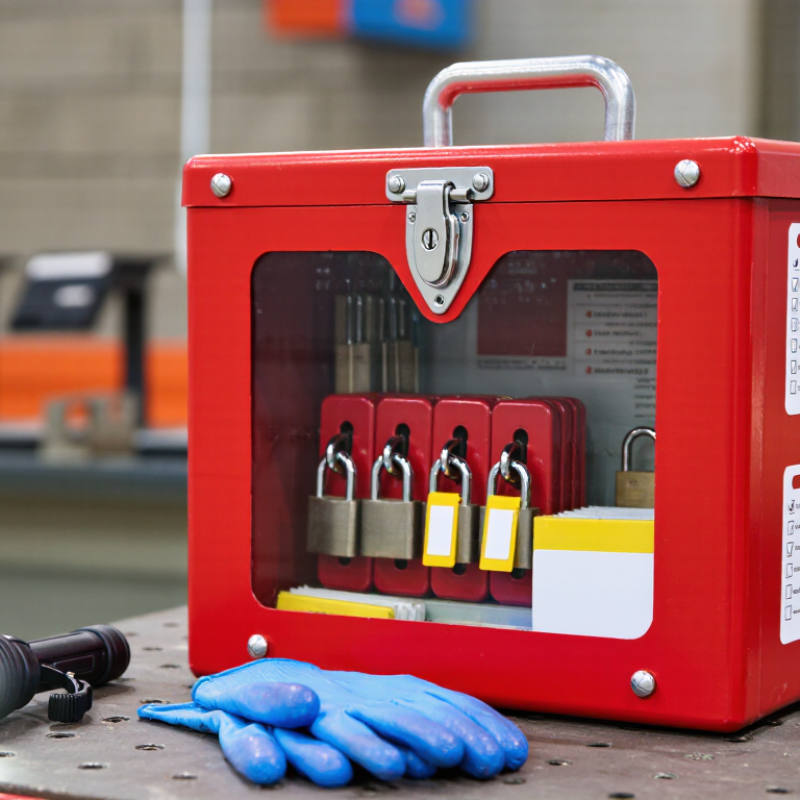
| Usability | Visibility and access | A transparent or windowed cover can improve visual confirmation of contents, while a solid cover may provide better protection from light and contamination. | Check visibility under normal lighting, glove compatibility, opening direction, and whether the box can be accessed without contacting nearby hazards. | Human-factors review; site risk assessment |
| Usability | Identification and key control | Use individually keyed or uniquely identifiable personal locks. Keep spare keys controlled and establish a documented process for exceptional lock removal. | Confirm that lock numbers or names can be recorded and that the site has a written procedure for removing an absent employee’s lock. | OSHA 29 CFR 1910.147(e)(3) and (f)(3) |