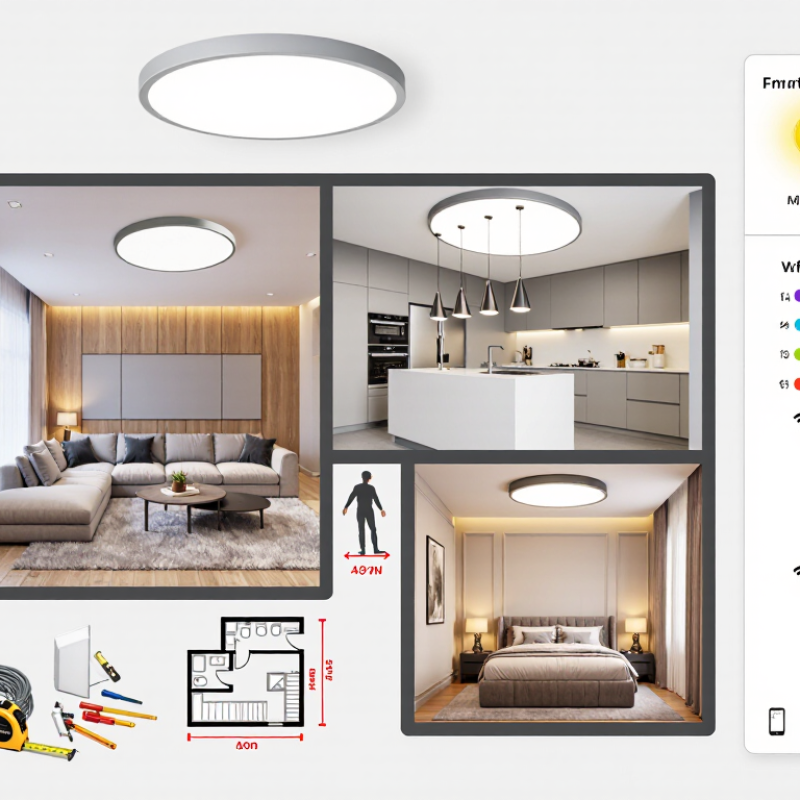
| Typical Design | Low-profile fixture mounted close to the ceiling | Short stem or decorative gap between the ceiling and shade | Thin, flat light-emitting surface with an even glow | One or more shades suspended from a cord, rod, or stem | Several adjustable light heads mounted on a ceiling rail or bar |
| Best For | Bedrooms, hallways, kitchens, and rooms with low ceilings | Living rooms, bedrooms, and entryways with average ceiling height | Home offices, utility rooms, kitchens, and modern interiors | Dining areas, kitchen islands, bedrooms, and statement lighting | Art walls, kitchens, work areas, and rooms needing directional light |
| Typical Ceiling Clearance | Usually about 10–20 cm below the ceiling | Usually about 20–45 cm below the ceiling | Usually about 3–8 cm below the ceiling | Commonly 30–150 cm below the ceiling; adjustable models may extend further | Usually about 15–35 cm below the ceiling, depending on the track and heads |
| Common Fixture Diameter or Length | Approximately 25–60 cm in diameter | Approximately 30–60 cm in diameter | Approximately 30–120 cm in length or width | Approximately 15–50 cm per shade; multi-light designs are wider | Approximately 60–150 cm rail length |
| Typical Brightness Range | About 1,000–3,500 lumens | About 1,200–4,000 lumens | About 1,500–5,000 lumens | About 600–3,000 lumens, depending on the number of lights | About 1,000–4,000 lumens, depending on the number of heads |
| Recommended Room Size | Small to medium rooms, approximately 6–20 m² | Small to medium rooms, approximately 8–22 m² | Medium to large rooms, approximately 10–30 m² | Small to medium zones, approximately 6–18 m² | Small to large rooms, approximately 8–25 m² |
| Light Distribution | Wide, general illumination; some models produce a small amount of ceiling shadow | Wide illumination with more decorative downward and upward light options | Very even, broad illumination with low visible shadowing | Focused or downward illumination; distribution depends on the shade | Directional illumination with adjustable beams and accent-lighting capability |
| Color Temperature | Commonly 2,700–6,500 K; tunable models cover warm to cool white | Commonly 2,700–6,500 K; some models offer separate up-light and down-light control | Commonly 3,000–6,500 K; tunable white is widely available | Commonly 2,700–5,000 K; warm white is often preferred for dining and relaxation | Commonly 2,700–6,500 K; adjustable heads may support different settings |
| Dimming Capability | Usually available through an app, remote control, or compatible wall control | Usually available; verify dimming compatibility with the existing wiring | Commonly available, especially on tunable-white models | Available on many models, but the bulbs or integrated driver must support dimming | Commonly available, with individual or grouped control on some models |
| Color Effects | Optional; many models provide white light only | Optional; decorative models may include colored accent light | Less common; usually focused on white-light adjustment | Optional; depends on the light source and shade design | Optional; often more useful for accent or decorative lighting |
| Smart Control Options | App, voice assistant, remote control, schedules, scenes, and sometimes occupancy automation | App, voice assistant, remote control, schedules, scenes, and sometimes occupancy automation | App, voice assistant, schedules, scenes, and energy monitoring on selected models | App, voice assistant, schedules, scenes, and group control when supported | App, voice assistant, schedules, scenes, and zone-based control on selected models |
| Wireless Connection | May use Wi-Fi, Bluetooth, or a dedicated low-power smart-home protocol | May use Wi-Fi, Bluetooth, or a dedicated low-power smart-home protocol | May use Wi-Fi, Bluetooth, or a dedicated low-power smart-home protocol | May use Wi-Fi, Bluetooth, or a dedicated low-power smart-home protocol | May use Wi-Fi, Bluetooth, or a dedicated low-power smart-home protocol |
| Installation Difficulty | Moderate; requires ceiling mounting and electrical connections | Moderate; decorative hardware may require additional assembly | Moderate to high; secure mounting is important because the panel is often larger | Moderate to high; suspension height and ceiling support must be planned carefully | Moderate to high; the rail must be securely mounted and accurately aligned |
| Maintenance | Low; integrated LED models normally require fixture replacement if the light engine fails | Low to moderate; shades and decorative surfaces may need regular dusting | Low; the flat surface is easy to wipe, but replacement can require removing the panel | Moderate; exposed shades and cords may collect dust and require careful cleaning | Moderate; multiple heads and rails require more frequent dusting |
| Energy Efficiency | High when using LED technology; dimming can reduce energy use | High when using LED technology; efficiency depends on the light output selected | High; broad illumination can reduce the need for multiple fixtures | High with LED light sources, although decorative designs may provide less light per fixture size | High with LED light sources; directional control can reduce unnecessary illumination |
| Key Advantages | Space-saving, versatile, easy to coordinate with most interiors, and suitable for low ceilings | More decorative than a flush mount while remaining relatively compact | Uniform light, slim profile, and strong suitability for task-oriented rooms | Strong visual impact, flexible hanging height, and effective zone lighting | Adjustable direction, useful accent lighting, and flexible coverage of multiple areas |
| Potential Limitations | Some models have limited repairability and may not provide decorative visual interest | Requires more vertical space and may cast more visible shadows than a panel | Can look utilitarian and may need careful ceiling support or a compatible mounting frame | Can obstruct views, collect dust, or be unsuitable for very low ceilings | More visible hardware and potentially more complex installation than a single fixture |
| Important Buying Checks | Measure ceiling junction-box position, verify lumen output, check dimming method, and confirm app compatibility | Check total drop height, shade clearance, mounting support, and whether upward light is included | Check panel dimensions, driver access, color-rendering quality, and mounting compatibility | Check hanging height, ceiling load capacity, shade size, cord adjustment, and dimmer compatibility | Check rail length, beam angle, head adjustment range, ceiling support, and control of individual zones |
| Best Overall Choice When | You want a practical smart ceiling light that fits most rooms and ceiling heights | You want smart functionality with a more traditional or decorative appearance | You prioritize evenly distributed light for work, cooking, or larger rooms | You want the light fixture to serve as a prominent design feature | You need to direct light toward several specific areas or objects |