| Primary application | Agricultural pesticide spraying, fertilizer spraying, water transfer, and selected industrial liquid applications | Confirm compatibility with the actual liquid concentration, temperature, pressure, and operating cycle | ISO 1401 for rubber agricultural spray hoses; application-specific fluid compatibility requirements |
| Nominal inside diameter | 6, 8, 10, 13, 16, 19, and 25 mm common reference sizes | Measure inside diameter at multiple points and check ovality before shipment | ISO 4671 measurement principles; approved product drawing and tolerance schedule |
| Nominal outside diameter | Determined by inner diameter, wall thickness, and reinforcement construction; record the approved drawing value for every size | Digital caliper measurement at minimum three positions per sampled length | ISO 4671 and the agreed manufacturing drawing |
| Working pressure | Typical reference range: 20–50 bar, depending on construction, nominal diameter, and application | Hydrostatic pressure test at the specified rated pressure; do not exceed the approved hose rating | ISO 1402 hydrostatic testing; ISO 1401 or the agreed product specification |
| Proof pressure | Set by the applicable standard or customer specification; commonly higher than the rated working pressure | Hold the specified proof pressure for the required dwell time and inspect for leakage, blistering, or permanent deformation | ISO 1402 and the approved inspection plan |
| Burst pressure | Must meet the minimum burst-pressure ratio required by the applicable standard and approved design | Destructive burst test on representative samples from production batches | ISO 1402; ISO 1401 where applicable |
| Temperature range | Typical reference range: approximately −30°C to +60°C for general spray-hose compounds; verify the compound-specific rating | Low- and high-temperature flexibility, pressure retention, and visual inspection after conditioning | Manufacturer compound data, ISO 4672, and application-specific requirements |
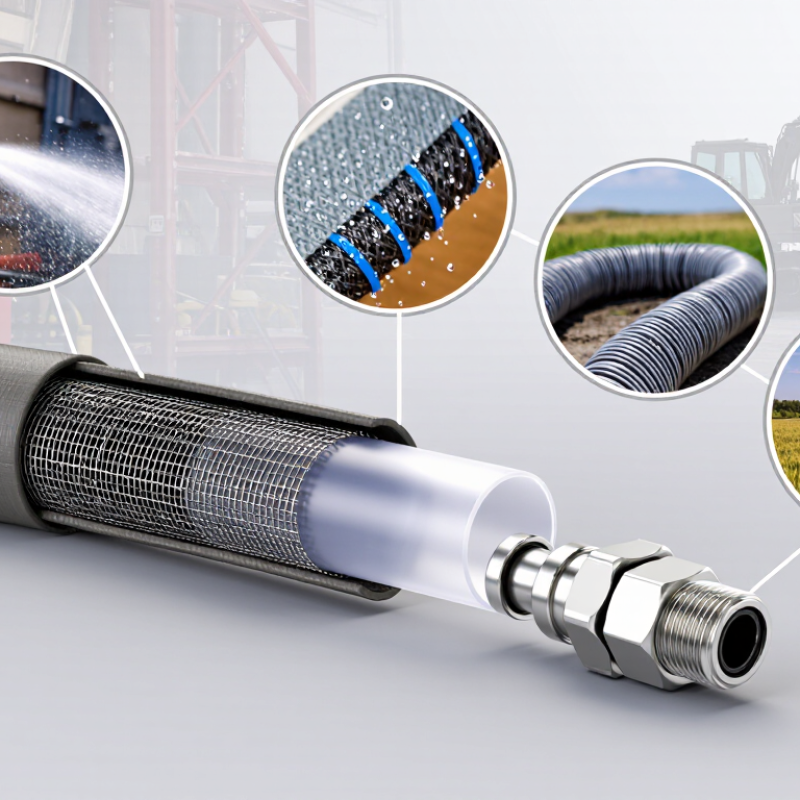
| Reinforcement construction | Textile braid or spiral reinforcement selected according to pressure, flexibility, bend radius, and abrasion requirements | Cross-section inspection for uniform reinforcement coverage, wire or textile placement, and bonding | Approved construction drawing and production control plan |
| Minimum bend radius | Typically specified as a multiple of the outside diameter; the exact value depends on hose size and reinforcement design | Bend the hose to the approved minimum radius, then check kinking, cover damage, leakage, and pressure retention | ISO 10619 series and the approved product specification |
| Fluid compatibility | Suitable only for fluids listed in the technical data sheet; pesticide concentrates and solvents require separate compatibility confirmation | Immersion testing for volume change, hardness change, tensile-property retention, and appearance | ISO 1817 for rubber and thermoplastic hose fluid-resistance testing |
| Cover resistance | Cover should resist outdoor weathering, abrasion, and incidental contact with the specified spray medium | Abrasion, ozone, weathering, and visual-defect inspection according to the material and application | ISO 6945, ISO 7326, and relevant compound specifications |
| Tensile and elongation properties | Record compound-specific tensile strength and elongation limits on the material or product inspection report | Test samples from the tube and cover; compare results with the approved compound specification | ISO 37 for vulcanized or thermoplastic rubber |
| Adhesion between layers | No visible layer separation or progressive delamination under normal rated service conditions | Peel-force test between tube, reinforcement, and cover layers | ISO 8033 |
| Electrical properties | Electrical conductivity or non-conductivity must be declared when static-charge control is relevant | Electrical resistance test using the configuration required for the intended application | ISO 8031 and application-specific safety requirements |
| Marking and traceability | Mark with nominal size, working pressure, temperature range, production date or batch code, and applicable standard where required | Verify legibility, permanence, spacing, batch traceability, and matching packing-list information | ISO 1307 and customer or destination-market marking rules |
| Dimensional tolerance | Use the tolerance class stated in the approved drawing or applicable standard; dimensions must remain within the declared range | Sampling inspection of inside diameter, outside diameter, wall thickness, and length | ISO 4671 and ISO 1307 |
| Packaging for export | Protect hose ends from contamination, prevent excessive coil deformation, and use moisture-resistant outer packaging for sea freight | Pre-shipment packaging inspection, carton or pallet count verification, and container-loading record | Approved packing specification and destination-country logistics requirements |