| 1 | Computerized Jacquard Control | Electronic pattern control coordinates needles, yarn feeders, color changes and knitting sequences through programmable software. | Commonly supports multi-color patterns, programmable stitch structures and digital pattern storage. | Patterned crew socks, athletic socks, fashion socks and logo-style knitted designs. | Improves repeatability, shortens pattern-change time and reduces manual setup errors. |
| 2 | Electronic Needle Selection | Actuators select individual needles or groups of needles to create plain, tuck, miss and transfer structures. | Supports fine pattern control across different cylinder gauges and stitch designs. | Ribbed socks, mesh panels, terry structures, compression zones and decorative textures. | Enables complex constructions without frequent mechanical cam replacement. |
| 3 | Multi-Feeder Yarn Management | Multiple yarn feeders introduce body, plating, elastic, terry and reinforcement yarns at controlled knitting positions. | Feeder quantity varies by machine design, pattern complexity and sock construction. | Color-pattern socks, plated designs, cushioned sports socks and reinforced work socks. | Allows several yarn types to be integrated in one knitting cycle. |
| 4 | Automatic Toe-Closer Integration | The toe section is shaped and closed by an integrated transfer, linking or sewing mechanism after the sock tube is knitted. | Available as integrated or connected equipment depending on the machine configuration. | Seamless-toe casual socks, sports socks, children’s socks and comfort-focused products. | Reduces handling operations and improves consistency at the toe seam or closure. |
| 5 | Automatic Heel and Pocket Shaping | Needle selection and stitch-length control form reciprocated heel and toe pockets for anatomical fitting. | Supports standard, reinforced, anatomical and specialized heel constructions. | Athletic socks, hiking socks, work socks and shaped performance hosiery. | Improves fit while reducing manual intervention and fabric waste. |
| 6 | Servo Motor Drive System | Servo motors precisely regulate cylinder rotation, stitch movement and auxiliary mechanisms. | Variable-speed operation with programmable acceleration, deceleration and synchronization. | High-speed production of basic, patterned and performance socks. | Provides accurate motion control, lower mechanical shock and more stable quality. |
| 7 | Automatic Lubrication and Centralized Oiling | A metered lubrication system supplies oil to moving components at scheduled intervals. | Programmable or timed lubrication cycles, depending on machine architecture. | Continuous production lines requiring stable operation over extended shifts. | Reduces friction, wear, heat buildup and unplanned maintenance interruptions. |
| 8 | Digital Yarn-Tension Monitoring | Sensors and tension-control devices monitor yarn delivery and compensate for changes during knitting. | Tension settings are adjusted according to yarn type, stitch structure and fabric density. | Fine-gauge socks, plated products, elasticated cuffs and technical hosiery. | Helps minimize stripes, loose loops, needle lines and uneven fabric density. |
| 9 | Online Fault Detection | Sensors detect yarn breakage, missing stitches, abnormal movement, overload or other operating faults. | Automatic stop, alarm and error-code functions are common on computerized machines. | All automated sock production, especially multi-machine manufacturing lines. | Limits defective output and helps operators identify problems quickly. |
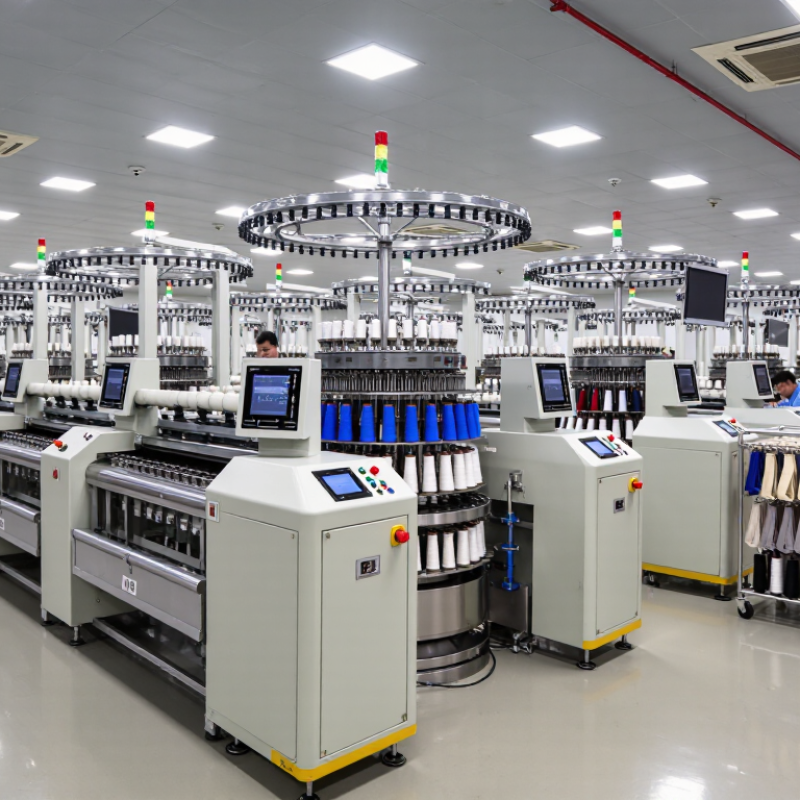
| 10 | HMI, Pattern Library and Production Data | A touchscreen interface stores programs, displays machine status and provides access to production parameters. | May include USB or network-based pattern transfer, parameter backup and production counters. | Short-run, customized, export-oriented and multi-style sock production. | Simplifies operator training, supports quick style changes and improves production traceability. |