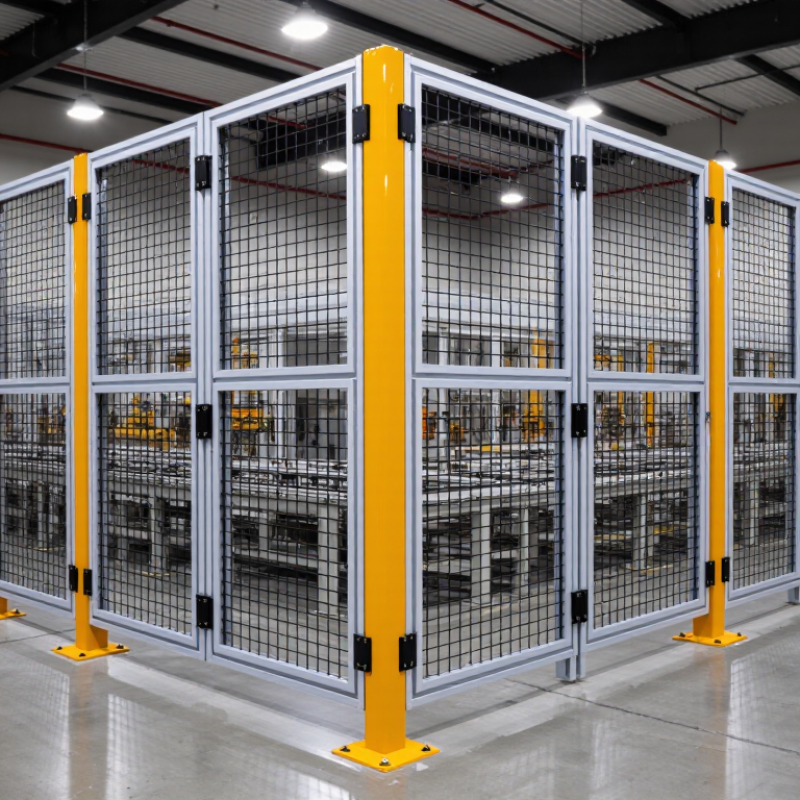
| Compliance with Safety Standards | Whether the fence system is designed as a machine guard and integrated with the machine risk assessment. | Check design alignment with ISO 14120 for guards and ISO 13857 for safety distances. | Declaration of conformity where applicable, technical file extracts, risk-assessment documents, and test records. | 20% | Pass only when documents match the supplied configuration and intended application. |
| Guarding and Access Control | Panel height, mesh or opening size, clearance from hazardous movement, door locations, and access routes. | Opening sizes and separation distances must be selected according to the hazard and the reach-distance tables in ISO 13857. | Layout drawings, opening-size schedule, clearance calculations, and photographs of a comparable installation. | 15% | Reject generic dimensions that are not supported by a machine-specific layout. |
| Interlocking and Safety Switch Compatibility | Mechanical door design, hinge direction, lock provisions, trapped-key options, and compatibility with safety switches. | Interlocking arrangements should be assessed with ISO 14119 and the machine control-system requirements. | Door hardware drawings, switch-mounting details, actuator alignment tolerances, and functional test procedure. | 15% | Confirm that opening a door initiates the required safety function and prevents unexpected restart. |
| Material and Corrosion Protection | Panel wire, frame, posts, brackets, fasteners, weld quality, surface treatment, and environmental suitability. | Common finishes include painted steel, powder-coated steel, and galvanized steel; hot-dip galvanizing can be specified with ISO 1461 where applicable. | Material certificates, coating specification, coating-thickness records, salt-spray results when required, and fastener grade information. | 10% | Select the finish according to humidity, chemicals, washdown conditions, and indoor or outdoor use. |
| Structural Performance | Resistance to normal impact, panel deflection, post stability, anchoring, and accidental contact during operation. | Performance should be verified for the foreseeable forces identified in the risk assessment; there is no universal load value for every machine guard. | Engineering calculations, finite-element analysis where appropriate, impact-test method, anchor details, and installation instructions. | 10% | Use application-specific evidence rather than accepting an unsupported impact rating. |
| Customization and Layout Accuracy | Ability to produce straight panels, corner sections, sliding or hinged gates, pass-throughs, and uneven-floor solutions. | The final layout should reflect the machine footprint, maintenance zones, emergency exits, utilities, and required safety distances. | Approved 2D or 3D drawings, bill of materials, revision history, tolerance schedule, and sample shop drawings. | 10% | Prioritize suppliers that use controlled drawings and obtain written approval before production. |
| Manufacturing Quality Control | Control of incoming materials, welding, dimensional accuracy, coating, assembly, packaging, and final inspection. | A documented quality system should provide traceability from purchase order and drawings through final inspection. | Quality manual, inspection and test plan, welding procedure records, nonconformance process, and pre-shipment inspection report. | 10% | Give preference to measurable inspection criteria instead of visual-only acceptance. |
| Installation and Maintainability | Assembly sequence, anchor access, replaceable panels, door adjustment, spare parts, and maintenance access. | The guard should remain effective after foreseeable maintenance activities and permit safe access to service areas. | Installation manual, torque specifications, anchor schedule, replacement-part list, and maintenance instructions. | 8% | Check installation time, adjustment method, and whether special tools are required. |
| Packaging and Export Readiness | Protection against corrosion, deformation, moisture, missing hardware, and identification errors during international transport. | Packaging should be suitable for the selected transport method, storage period, climate, and handling conditions. | Packing specification, carton or crate list, component labels, loading photographs, and damage-claim procedure. | 5% | Confirm that every package is traceable to the approved bill of materials. |
| Commercial and After-Sales Support | Quotation clarity, delivery schedule, warranty terms, technical communication, spare-part availability, and complaint response. | A quotation should clearly identify quantities, specifications, exclusions, delivery terms, inspection conditions, and warranty scope. | Detailed quotation, contract terms, warranty policy, communication records, and service escalation process. | 7% | Score based on documented commitments rather than verbal promises. |