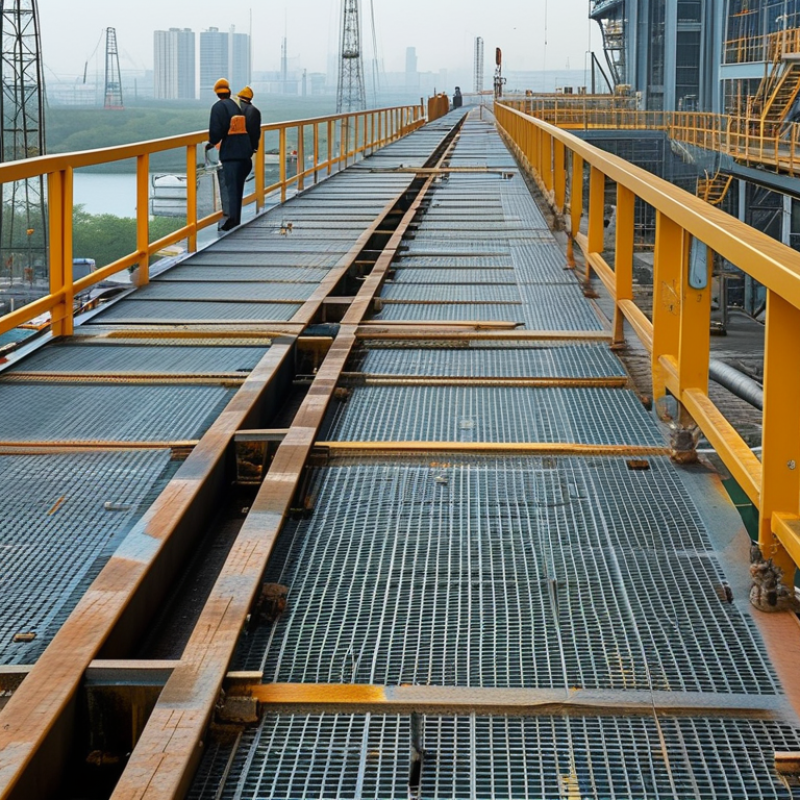
| Definition | A raised walkway or working platform made from load-bearing steel grating panels. | Provides safe access above equipment, floors, tanks, pipes, and process areas. |
| Primary Use | Personnel access, inspection, maintenance, operation, and emergency movement. | Allows workers to reach elevated or obstructed areas without walking on pipes or machinery. |
| Common Material | Carbon steel is common; stainless steel and aluminum may be selected for specific environments. | Material selection depends on load, corrosion exposure, temperature, hygiene, and project requirements. |
| Surface Protection | Hot-dip galvanizing is widely used for carbon-steel grating; painted or untreated surfaces are also possible. | Coatings help reduce corrosion and extend service life, especially in outdoor or humid locations. |
| Load-Bearing Structure | Bearing bars carry the main load, while cross bars connect and stabilize the panel. | Bearing-bar size, spacing, span, and support conditions determine the allowable load. |
| Open-Grating Design | Open spaces between bars allow light, air, water, snow, and small debris to pass through. | Improves drainage and ventilation while reducing standing water on the walking surface. |
| Slip Resistance | Plain surfaces are suitable for many areas; serrated bearing bars provide additional grip in wet or oily conditions. | The surface pattern should match the expected moisture, oil, footwear, and cleaning conditions. |
| Typical Locations | Factories, power facilities, water-treatment plants, warehouses, bridges, roofs, and industrial platforms. | Catwalks provide organized access in facilities where floor-level routes are limited or unsafe. |
| Safety Components | Handrails, midrails, toe boards, stairs, kick plates, gates, and suitable supports may be included. | These components help control falls, dropped objects, access points, and changes in elevation. |
| Drainage and Ventilation | The grating remains largely open rather than forming a continuous solid deck. | This can help prevent puddles and preserve airflow around equipment and elevated work areas. |
| Installation | Panels are supported by beams or frames and secured with clips, clamps, bolts, or other approved fasteners. | Proper support and fastening reduce movement, vibration, and panel displacement during use. |
| Maintenance Benefit | Modular panels can generally be removed or replaced individually when access or repairs are required. | Maintenance work can be simplified without replacing an entire platform. |
| Design Considerations | Span, uniform load, concentrated load, deflection, bar spacing, access openings, and environmental exposure. | A qualified designer should verify structural capacity and safety requirements for the intended installation. |
| Core Advantages | High strength-to-weight efficiency, airflow, drainage, visibility, modularity, and relatively low maintenance. | These features make steel grating suitable for durable industrial walkways and elevated service platforms. |