How to Buy Low Carbon Concrete for Global Projects?

Buying low carbon concrete for global projects requires more than choosing a greener product label. Cement production creates about 7% of global carbon dioxide emissions, according to the International Energy Agency’s Cement sector analysis. Concrete also consumes enormous quantities of raw materials, water, and transport energy. The purchasing decision therefore affects both project emissions and supply-chain resilience.

A reliable buyer should request a product-specific Environmental Product Declaration, verified under ISO 14025 and relevant EN 15804 requirements. The declaration should show global warming potential per cubic metre, not only per tonne of cement. Compare the same strength class, exposure condition, service life, and curing assumptions. Otherwise, the numbers can look impressive but remain misleading. Low carbon concrete may use supplementary cementitious materials, calcined clay, recycled aggregates, optimized mix designs, or lower-carbon binders. Availability varies sharply between ports, cities, and remote project sites.

The Global Cement and Concrete Association’s 2050 Roadmap identifies material efficiency, clinker reduction, novel cements, and carbon capture as major decarbonization pathways. The IEA also emphasizes efficiency, alternative fuels, and clinker substitution. These reports provide direction, not a universal purchasing formula. The market is not perfectly comparable. That weakness matters.

For international procurement, buyers should establish a project carbon baseline, confirm local standards, audit supplier data, and test trial batches before contract award. Ask where the cement was produced, how aggregates traveled, and whether renewable electricity supports batching. A lower reported footprint can still conceal transport emissions or weaker durability evidence. Good procurement connects verified carbon data with structural performance, delivery reliability, and long-term maintenance. The cheapest mix may not be the lowest-cost solution over its full life.

How to Buy Low Carbon Concrete for Global Projects?

Defining Low-Carbon Concrete and Its Global Project Benefits

How to Buy Low Carbon Concrete for Global Projects?

Low-carbon concrete is concrete designed to reduce embodied carbon, especially emissions from cement production. Its impact is commonly measured in kilograms of CO2e per cubic meter. Buyers should compare this figure with a verified baseline, not with vague environmental claims. A credible environmental product declaration can reveal materials, manufacturing data, and calculation boundaries.

Global projects need more than a low carbon number. The mix must meet local strength, durability, fire, curing, and construction requirements. Ask suppliers for test results under the project’s climate conditions. A mix suitable for a cool European site may behave differently in a humid coastal region. Check the cement replacement percentage, aggregate source, transport distance, and expected service life. These details affect real emissions.

Procurement teams can request several compliant mix designs before choosing one. Compare performance at 28 and 56 days, not only the purchase price. Also review delivery capacity, batch consistency, and backup supply. On busy sites, a delayed pour can create waste and costly rework. That risk is often ignored. Lower-carbon materials may also require longer curing, which can change the construction schedule. Data is not always complete, especially across developing supply chains. Buyers should record assumptions and update calculations when better information appears. A modest reduction with dependable quality may serve a global project better than an impressive claim with weak evidence.

Setting Carbon Performance Targets for Different Construction Needs

Buying low-carbon concrete for global projects starts with a measurable carbon target, not a vague request for “green concrete.” The International Energy Agency reported that cement production emitted about 2.5 gigatonnes of CO2 in 2022, nearly 7% of global emissions. This scale makes procurement decisions significant.

Set targets by construction need. For high-rise structural elements, specify a maximum of 300–400 kilograms of CO2e per cubic metre, subject to strength and durability requirements. For pavements and foundations, use project-specific limits, because cement content, exposure, and service life can change the result. Interior slabs may accept lower-carbon mixes with reduced early strength. They may need longer curing periods.

Ask suppliers for verified Environmental Product Declarations, using a consistent life-cycle boundary, such as cradle-to-gate. Compare the same strength class, exposure class, curing condition, and declared volume. The EN 15804 standard supports this type of comparison. The Global Cement and Concrete Association’s 2050 Roadmap also stresses clinker reduction, alternative fuels, efficiency, and carbon capture.

Do not reward a low number alone. A mix with high recycled content may perform poorly in wet, freezing conditions. Regional transport can also erase part of the claimed benefit. Trial batches, site records, and independent verification create stronger evidence. Some targets will be imperfect. That is acceptable, if the assumptions remain visible and are improved during design reviews.

How to Buy Low Carbon Concrete for Global Projects? - Setting Carbon Performance Targets for Different Construction Needs

Construction Need Typical Concrete Strength Recommended Carbon Target
(kg CO₂e/m³)
Indicative Reduction
vs. Regional Baseline
Suitable Applications Minimum Procurement Evidence
Standard low-carbon concrete 20–30 MPa 180–280 15–30% Low-rise buildings, pavements, ground slabs, non-critical foundations Mix design, cement or binder content, declared GWP, and batch-level delivery records
Structural building concrete 30–50 MPa 220–350 20–35% Columns, beams, suspended slabs, cores, and general commercial structures Third-party verified environmental product declaration or equivalent LCA data
High-performance structural concrete 50–80 MPa 180–300 30–50% High-rise buildings, transfer structures, long-span floors, and heavily loaded elements Strength and durability test results, curing plan, service-life assumptions, and verified GWP per cubic metre
Infrastructure and marine concrete 35–60 MPa 200–330 20–40% Bridges, ports, seawalls, tunnels, retaining walls, and transport infrastructure Chloride and sulfate resistance data, permeability testing, exposure-class compliance, and verified LCA results
Precast and modular construction 40–70 MPa 170–280 25–45% Precast panels, beams, pipes, façade units, sleepers, and modular components Factory mix records, curing energy data, recycled-content information, dimensional quality records, and product LCA
Mass concrete and large foundations 25–45 MPa 140–240 30–50% Rafts, dams, heavy foundations, wind-turbine bases, and other high-volume pours Heat-of-hydration plan, temperature-control method, cement-replacement percentage, and pour-specific carbon declaration
Durability-critical concrete 40–70 MPa 220–360 15–35% Wastewater facilities, coastal assets, chemical environments, and long-life public infrastructure Design service life, exposure classification, permeability and diffusion testing, maintenance assumptions, and verified EPD data
Near-zero-carbon pilot concrete 20–50 MPa Below 150 50% or more Demonstration projects, low-risk components, innovation programs, and selected non-critical elements Independent LCA verification, full mix disclosure, durability validation, supply continuity plan, and project trial results
Data interpretation: Carbon values are indicative procurement ranges for cradle-to-gate concrete, expressed as kilograms of carbon dioxide equivalent per cubic metre. Actual targets should be calibrated against local cement content, aggregate sources, electricity mix, transport distance, strength class, exposure conditions, and the project-specific regional baseline. Carbon performance must not override structural safety, durability, code compliance, or required service life.

Comparing Mix Designs, Materials, Suppliers, and Environmental Declarations

How to Buy Low Carbon Concrete for Global Projects?

Comparing Mix Designs, Materials, Suppliers, and Environmental Declarations

Buying low carbon concrete begins with the required performance, not a single emissions number. Define strength, exposure class, curing conditions, placement method, and service life. A 40 MPa mix for a dry interior slab differs greatly from concrete used in tidal foundations. Small details matter.

Compare cement replacement options carefully. Slag, calcined clay, natural pozzolans, and recycled aggregates can reduce embodied carbon. However, availability, early strength, water demand, and local durability rules may change the result. A mix with less cement is not automatically better. Test cylinders at seven and twenty-eight days. Record temperature, slump, and curing conditions.

Supplier evaluation needs more than a low quotation. Ask for quarry locations, transport distances, batch controls, recycled content, and recent test reports. Request a product-specific Environmental Product Declaration, or EPD, with its declared unit, system boundary, life-cycle stages, and verification status. Compare documents using the same standards and regional assumptions. Generic EPDs can mislead procurement teams.

Stay skeptical.

Global projects often combine data from different regions, making direct comparisons difficult. Grid electricity, transport fuels, and allocation rules can alter results. I would also review replacement material security. A low-carbon design fails if an imported additive arrives late. Trial batches expose these weaknesses early. The strongest purchase decision balances measured emissions, technical reliability, supply resilience, and transparent documentation. No option is perfect. Recheck the assumptions.

How to Buy Low Carbon Concrete for Global Projects?

This comparison shows representative ready-mix design options using commonly available cement-reduction strategies. Replacing clinker with supplementary cementitious materials can reduce embodied carbon while maintaining typical structural concrete strength levels.

Planning benchmark only: values are representative global ranges synthesized from published concrete life-cycle studies and environmental product declaration datasets. Final procurement decisions should use project-specific, third-party verified EPDs, local material availability, required strength, durability class, and transport distance.

Checking Standards, Certifications, Transport Impacts, and Regional Availability

How to Buy Low Carbon Concrete for Global Projects?

Start by defining “low carbon” with measurable boundaries. Ask for a product-specific Environmental Product Declaration, or EPD. Check whether it follows ISO 14025 and EN 15804 or an equivalent regional framework. The declared unit matters. One cubic metre may not compare fairly with one cubic yard. Request the global warming potential in kilograms of CO₂e. Also review cement content, supplementary cementitious materials, curing methods, and strength performance. A certificate alone is not proof of a lower footprint.

Look beyond the document.

Transport can quickly change the result. Confirm the quarry, cement plant, batching station, and project site on a map. A mix with lower factory emissions may travel hundreds of kilometres farther. That benefit can shrink. Ask for delivery distances, vehicle types, load efficiency, and expected waiting time. Ready-mix concrete has a limited placing window, so regional batching capacity affects both emissions and quality. Trial batches should test slump, temperature, setting time, and early strength under local weather.

Regional availability needs careful checking. Some areas have reliable fly ash, slag, calcined clay, or recycled aggregate supplies. Others face seasonal shortages or strict material approvals. Review local concrete standards, public works specifications, and permitted replacement levels before procurement. In project reviews, I have seen strong EPD figures fail because the approved mix was unavailable locally. I would not treat one supplier’s estimate as certain. Recheck data before each major pour, especially when shipping routes, fuel prices, or regulations change.

Contracting, Ordering, and Verifying Low-Carbon Concrete on Site

How to Buy Low Carbon Concrete for Global Projects?

Buying low-carbon concrete starts with a clear performance brief, not a vague sustainability target. Define strength, exposure class, slump, curing conditions, delivery distance, and placement method. Request verified environmental product data for the exact mix, not a generic product family. The data should state system boundaries, cement content, recycled materials, transport assumptions, and declared carbon intensity. Require the supplier to explain regional calculation methods. They may not match.

Put these requirements into the contract. Set acceptable carbon limits alongside strength and durability requirements. Specify approval procedures for mix changes, substitute materials, delayed deliveries, and rejected loads. Order concrete using a rolling schedule that reflects actual site progress. A low-carbon mix can have different setting behavior. Allow time for trial batches and seasonal adjustments. Keep communication direct between the contractor, batching plant, designer, and testing laboratory. Small gaps create expensive surprises.

Verification continues at the gate and beside the pump. Check delivery tickets, batch times, mix codes, truck volumes, and measured slump. Record concrete temperature and weather conditions. Take strength specimens under controlled procedures. Compare laboratory results with site observations, including finishing time and early cracking. Independent testing strengthens credibility, especially across several countries. Digital records help, but paper backups still matter. That is not elegant, but it works. Some projects focus heavily on carbon figures and overlook curing quality. This weakens the result. Review the evidence weekly, question unexplained changes, and accept that the first mix may need revision.

Find the Right Repair Product for Your Project

Need to find the most appropriate product for the needs of your project? We can help because we have over 70 years of experience servicing the industry with every kind of project, from Do-it-yourself projects to large skyscrapers. Package Pavement has the experience, the knowledge and the products to help every project succeed.

Quikrete Repair Products
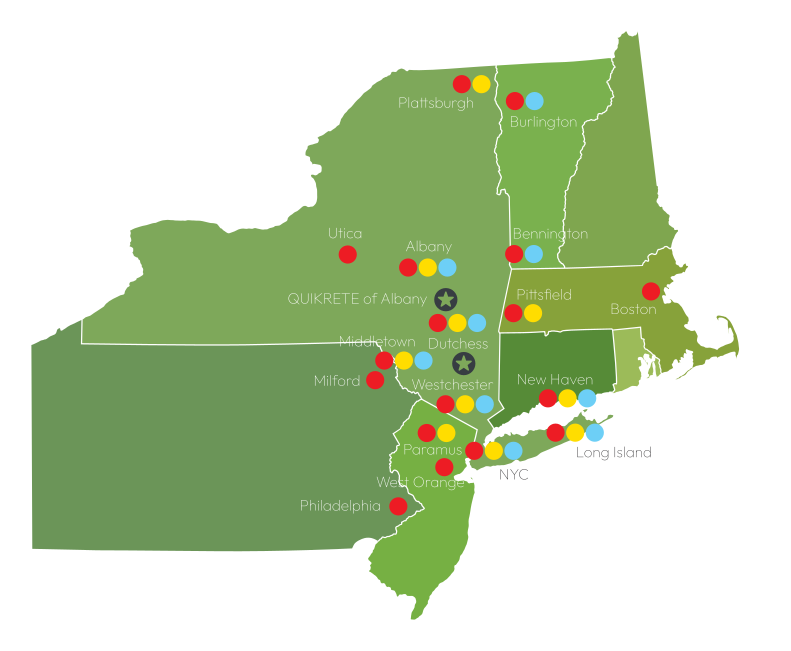
Legend
Package Pavement has two convenient locations in Stormville, NY (Dutchess County) and Ravena, NY (Greene County) to serve the Northeastern Region with bagged concrete, blacktop, mortar, and repair products. This map gives a general idea of where we service and the product lines we offer.
Package Pavement Products
Quikrete Products
Spec Mix Products
map

Our Brands Websites