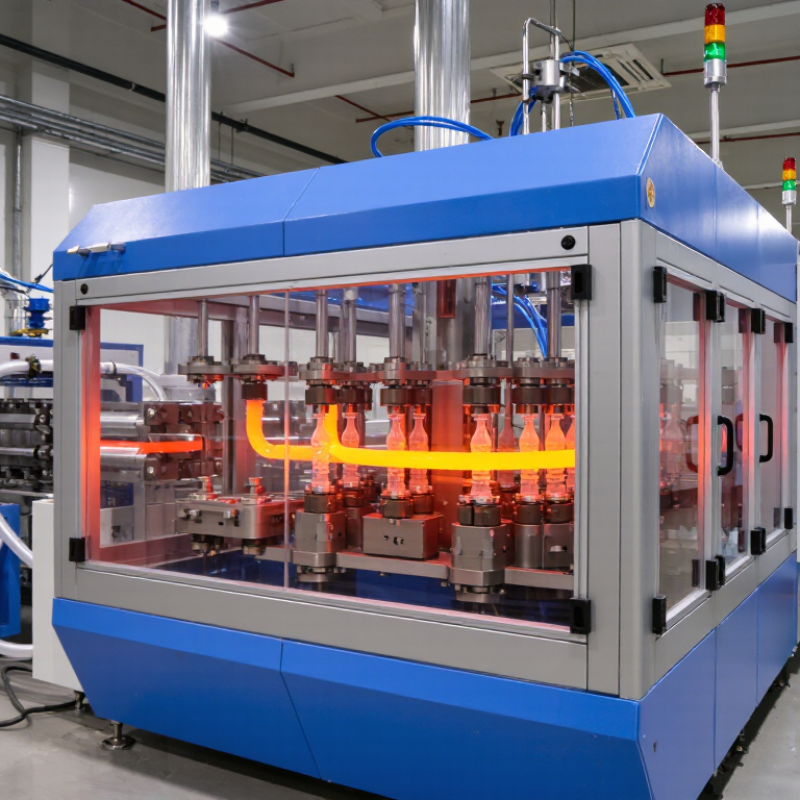
| Material Hopper | Stores and feeds plastic resin into the machine. | Pellets are held above the extrusion or injection unit and enter the conveying system through a controlled opening. | Plastic pellets such as PET, HDPE, PP, or other process-compatible resins. | The resin should be clean, correctly identified, and dried when the material requires moisture removal. |
| Extruder or Injection Unit | Melts and prepares the plastic for forming. | A screw conveys plastic through heated zones, or an injection barrel pushes molten plastic into a preform mold. | Barrel, screw, heater bands, thermocouples, and drive motor. | Temperature profile, screw speed, residence time, and melt pressure affect material quality and consistency. |
| Heating System | Softens the plastic preform or parison to the required forming temperature. | Heating elements transfer controlled radiant or conductive heat while temperature sensors monitor different zones. | Infrared lamps, ceramic heaters, reflectors, temperature sensors, and cooling fans. | Uniform heating is essential for balanced wall thickness and stable container dimensions. |
| Parison or Preform System | Creates the initial plastic shape that will be expanded into the final product. | An extrusion machine produces a hollow parison, while an injection stretch blow machine uses a molded preform. | Molten tube, PET preform, die head, injection mold, or preform transfer mechanism. | Length, temperature, weight distribution, and neck geometry influence the finished container. |
| Mold | Defines the external shape and surface details of the product. | The mold closes around the parison or preform and provides the cavity into which the plastic is expanded. | Usually aluminum or steel mold halves, cavity surfaces, vents, cooling channels, and clamping faces. | Mold alignment, venting, cooling efficiency, and cavity finish affect appearance and dimensional accuracy. |
| Clamping Unit | Closes, holds, and opens the mold during the forming cycle. | A hydraulic, pneumatic, or servo-driven mechanism applies sufficient force to keep the mold closed during blowing. | Clamping plates, guide columns, toggle or linear mechanism, hydraulic cylinders, or servo actuators. | Clamping force must be high enough to prevent flash but controlled to avoid unnecessary mold wear. |
| Blow Pin or Blow Nozzle | Introduces compressed air into the hot plastic. | The nozzle seals against the preform or parison opening and delivers air that expands the plastic against the mold wall. | Blow pin, sealing surface, air valve, nozzle holder, and neck-support components. | Correct sealing, nozzle alignment, and air timing help prevent leaks, deformation, and incomplete forming. |
| Compressed-Air System | Provides the air used to stretch and form the container. | Compressed air passes through filters, regulators, valves, and piping before entering the mold cavity. | Compressor, air receiver, filters, pressure regulator, valves, and high-pressure lines. | Air pressure, flow rate, cleanliness, and moisture control directly influence cycle stability and product quality. |
| Stretch Rod | Stretches the preform lengthwise in stretch blow molding. | The rod moves into the heated preform before or during air injection, improving molecular orientation and material distribution. | Servo or pneumatic actuator, guide system, rod tip, and position sensor. | Rod position, speed, stroke, and timing must match the preform temperature and container design. |
| Cooling Channels | Removes heat from the mold and stabilizes the formed product. | Temperature-controlled water or another cooling medium circulates through passages in the mold and related tooling. | Cooling passages, hoses, pump, heat exchanger, temperature controller, and flow sensors. | Balanced cooling reduces shrinkage variation, warpage, cycle time, and dimensional inconsistency. |
| Hydraulic or Servo Drive System | Supplies controlled movement and force to machine mechanisms. | Actuators operate the clamp, screw, injection system, stretch rod, or other moving parts according to programmed settings. | Servo motor, hydraulic pump, cylinders, valves, drive controller, and feedback sensors. | Accurate motion control improves repeatability, energy efficiency, and synchronization between machine stages. |
| Control System | Coordinates the complete molding cycle and monitors process conditions. | A programmable controller receives sensor signals and controls heating, movement, air valves, cooling, and safety interlocks. | PLC, touch-screen interface, temperature controllers, pressure sensors, position sensors, and alarms. | Recipes should be set consistently, and alarms or interlocks should not be bypassed during operation. |
| Trimming and Ejection System | Removes excess plastic and releases the finished product. | Cutters, pinch-off edges, or automated mechanisms separate flash and transfer the container to the discharge area. | Trim knives, pinch-off edges, grippers, ejector pins, conveyors, and collection chutes. | Clean trimming and gentle ejection help protect the neck, base, and sealing surfaces of the product. |
| Safety and Monitoring Devices | Protect operators and detect abnormal operating conditions. | Guard switches, emergency stops, pressure sensors, temperature alarms, and interlocks stop or prevent unsafe actions. | Safety doors, emergency-stop buttons, limit switches, pressure switches, and warning indicators. | Guards and safety controls should remain functional and be inspected according to the machine’s maintenance requirements. |