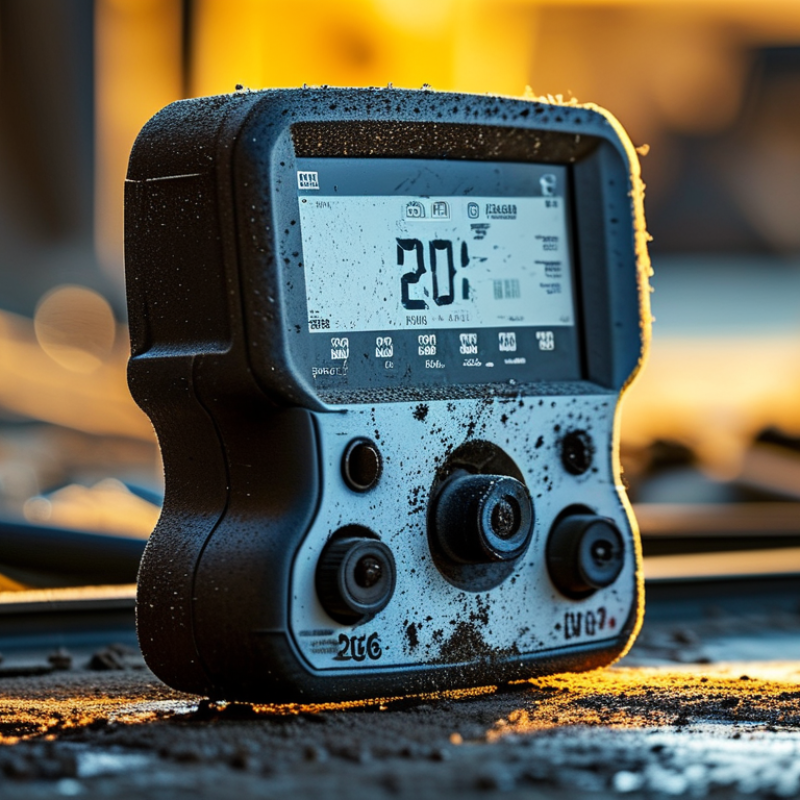
| Handheld Overall Vibration Meter | Contact accelerometer, usually magnetic or probe-mounted | Approximately 10 Hz to 1 kHz for general machine checks | RMS velocity, acceleration, displacement, crest factor, and overall severity | Fast screening of motors, pumps, fans, compressors, and gearboxes | Typically within ±5% to ±10% of reading, depending on frequency, mounting, and calibration | Limited diagnostic detail; overall values can hide imbalance, misalignment, looseness, or bearing defects |
| Portable Vibration Analyzer | Precision accelerometer with digital signal processing | Commonly 2 Hz to 10 kHz or higher, depending on configuration | Time waveform, FFT spectrum, phase, order analysis, RMS, peak, and crest factor | Root-cause analysis, predictive maintenance, balancing, and alignment verification | Often approximately ±3% to ±5% of reading within the specified operating range | Requires trained users, correct measurement locations, suitable frequency settings, and reliable machine-speed data |
| Wireless Vibration Sensor and Data Logger | Integrated MEMS or piezoelectric accelerometer with onboard storage and wireless communication | Typically 0.5 Hz to 5 kHz; many low-power systems use a narrower band | Trend data, RMS acceleration or velocity, temperature, peak values, and alarm events | Continuous condition monitoring in large facilities or hard-to-access locations | Commonly ±5% to ±10%, with accuracy influenced by battery level, mounting, bandwidth, and wireless sampling mode | Battery life, network coverage, data latency, and lower bandwidth may restrict detailed fault analysis |
| High-Frequency Bearing Vibration Meter | Piezoelectric accelerometer with envelope or high-frequency demodulation | Typically 2 kHz to 20 kHz or more for bearing-impact detection | High-frequency acceleration, envelope level, shock pulse indicators, and bearing-condition trend values | Early detection of rolling-element bearing damage and lubrication problems | Usually intended for trending; absolute accuracy is commonly around ±10% and depends strongly on mounting | Results depend on sensor placement, bearing speed, load, housing transmission, and baseline data |
| Proximity Probe System | Non-contact eddy-current displacement probe with a signal conditioner | From near DC to several kilohertz, depending on probe and driver electronics | Shaft displacement, shaft orbit, phase, gap voltage, and relative shaft vibration | Journal-bearing machines, turbines, compressors, and high-speed rotating shafts | Often approximately ±1% to ±5% of full scale when correctly installed and calibrated | Requires permanent installation, correct probe gap, conductive target material, and careful cable routing |
| Laser Doppler Vibrometer | Non-contact laser measurement of surface velocity using the Doppler effect | From low frequency to tens or hundreds of kilohertz, depending on the optical system | Surface velocity, displacement, acceleration, frequency response, and modal data | Small components, delicate structures, hot or inaccessible surfaces, and laboratory testing | Often approximately ±1% to ±5% under controlled optical and surface conditions | Higher cost, line-of-sight requirement, sensitivity to surface reflectivity, and potential interference from movement or dust |
| Human Vibration Meter | Tri-axial accelerometer with frequency weighting and exposure calculation | Usually about 0.5 Hz to 1.6 kHz, depending on hand-arm or whole-body measurement mode | Weighted RMS acceleration, vibration dose value, daily exposure, and peak or crest metrics | Hand tools, vehicle seats, platforms, and workplace exposure assessments | Typically within ±10% when calibrated and used according to the applicable measurement standard | Not designed for machine fault diagnosis; sensor orientation, mounting, and exposure duration strongly affect results |
| Structural and Modal Vibration Measurement System | Multiple synchronized accelerometers, impact hammer, or electrodynamic shaker | From below 1 Hz to several kilohertz, based on the test setup and sensors | Natural frequencies, damping, mode shapes, frequency response functions, and coherence | Bridges, buildings, vehicle bodies, aerospace structures, and product design validation | Commonly ±1% to ±3% for frequency measurement; amplitude accuracy depends on the complete test chain | More complex setup, many measurement channels, careful sensor placement, and specialized analysis software are required |