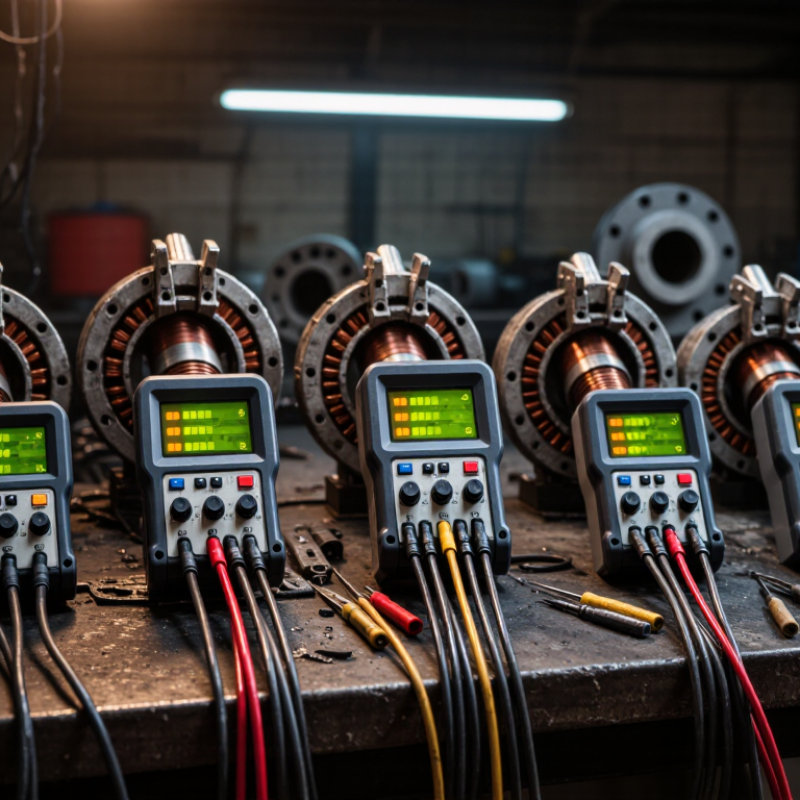
| Winding Resistance Tester | Applies a controlled direct current and measures the voltage drop across each winding. | Phase-to-phase resistance, resistance imbalance, winding continuity, and temperature-corrected resistance. | Three-phase induction motors, synchronous motors, brushless motors, and transformer-fed windings. | Incoming inspection, production testing, repair verification, and detection of loose joints or broken conductors. | Simple, repeatable, and effective for identifying high-resistance connections and phase imbalance. | Does not reliably detect insulation weakness or turn-to-turn faults that have similar DC resistance. |
| Insulation Resistance Tester | Applies a high DC test voltage between windings and ground, then measures leakage current. | Insulation resistance, polarization index, dielectric absorption ratio, and leakage current. | Low- and medium-voltage AC motors, generators, alternators, and large rewound stators. | Preventive maintenance, moisture assessment, storage checks, and post-repair insulation evaluation. | Quickly reveals contamination, moisture ingress, aging insulation, and ground leakage. | Results vary with temperature, humidity, surface cleanliness, and test duration; it is not a complete winding test. |
| High-Potential Dielectric Tester | Raises the voltage above normal operating level to verify the dielectric strength of the insulation system. | Withstand voltage, trip current, leakage current, ramp profile, and breakdown indication. | Newly manufactured stators, repaired motors, generators, and insulated winding assemblies. | Safety compliance, end-of-line quality control, repair-shop acceptance testing, and type testing. | Provides a strong pass/fail assessment of insulation withstand capability. | Can stress or damage aged insulation; test voltage and procedure must follow applicable safety standards. |
| Surge Comparison Tester | Applies fast-rising voltage pulses and compares the resulting oscillating waveforms between windings or phases. | Waveform area, peak voltage, ringing frequency, phase-to-phase deviation, and turn-to-turn fault indicators. | AC induction motors, permanent-magnet motors, servo motors, traction motors, and random-wound stators. | Production line testing, coil comparison, repair verification, and detection of turn-to-turn insulation defects. | Highly sensitive to inter-turn faults that resistance and standard insulation tests may miss. | Requires suitable pulse levels, consistent connections, and trained interpretation to avoid false results. |
| Motor Circuit Analysis Tester | Analyzes the electrical response of the complete motor circuit using low-voltage signals and frequency-based measurements. | Impedance, inductance, phase angle, resistance, capacitance, and circuit asymmetry. | Induction motors, synchronous motors, wound-rotor motors, and motors connected through long cables. | Offline maintenance, troubleshooting, baseline trending, and evaluation of rotor, stator, and connection-related abnormalities. | Supports condition trending and can identify multiple electrical fault patterns without full disassembly. | Diagnosis depends on baseline data, motor design, test setup, and correct separation of cable and motor effects. |
| Core Loss Tester | Energizes the stator core with an alternating magnetic field and measures temperature rise or power loss. | Core loss, watts per kilogram, hot-spot temperature, flux distribution, and localized heating. | Large AC motors, generators, alternators, and stator cores undergoing rewinding or refurbishment. | Repair workshops, rewind quality control, assessment of damaged laminations, and acceptance of refurbished cores. | Detects shorted laminations and excessive localized heating that electrical winding tests cannot identify. | Requires specialized excitation equipment, thermal monitoring, and careful control of test flux and duration. |
| Automatic Stator Production Tester | Combines several automated electrical tests in a programmed sequence using fixtures, switching, and digital result evaluation. | Resistance, inductance, capacitance, insulation resistance, hipot, surge response, and test-time traceability. | High-volume stators for household appliances, industrial drives, electric vehicles, pumps, and compact generators. | End-of-line manufacturing, automated assembly cells, process control, and statistical quality monitoring. | Fast, repeatable, operator-independent testing with automatic pass/fail decisions and production data logging. | Higher initial cost, fixture-specific setup, and the need for validated limits for each stator design. |