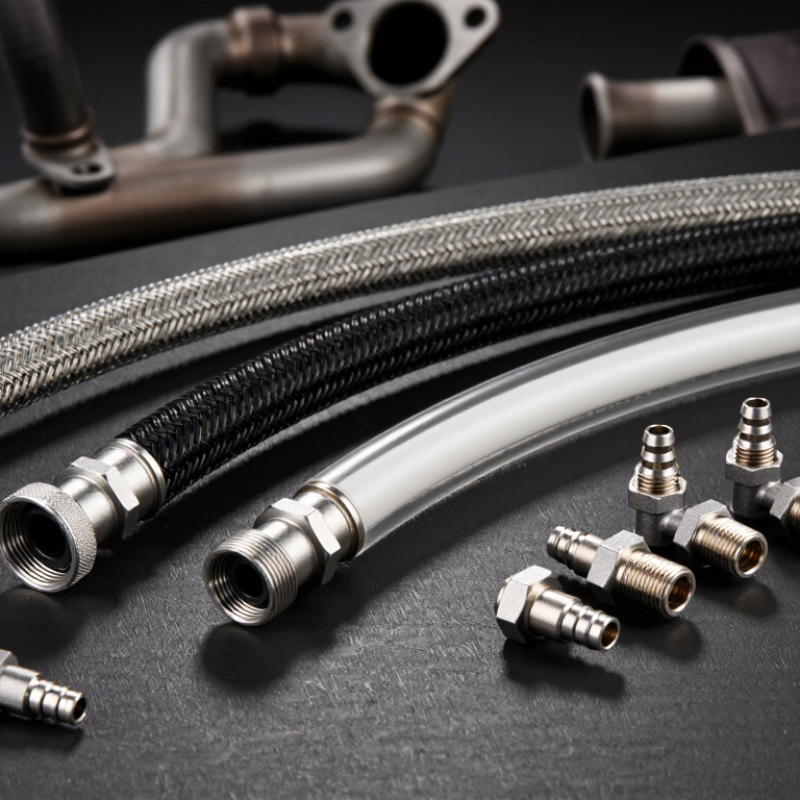
| Smooth-bore PTFE with stainless-steel braid | A smooth PTFE liner is reinforced by an external stainless-steel braid. The braid helps resist external abrasion and pressure, while the liner provides the fuel-contact surface. | Smooth bore can support fuel flow with less internal surface disruption than a convoluted liner. PTFE is used for its broad chemical resistance. | Stainless braid does not make a hose immune to corrosion, kinking, or damage. Check the hose’s published pressure and temperature limits and protect it from rubbing and sharp bends. | Fixed or gently routed fuel lines where a smooth bore and durable outer reinforcement are priorities. |
| Convoluted PTFE with braid | The PTFE liner has a corrugated or convoluted interior to improve flexibility; reinforcement may be added outside the liner. | Can route around tighter spaces more easily than many smooth-bore assemblies, depending on its construction and specified minimum bend radius. | The corrugated interior can create more flow resistance than a comparable smooth bore. Confirm the actual bend radius, flow requirements, and pressure rating for the specific assembly. | Installations where routing flexibility is more important than a smooth internal bore. |
| Conductive or static-dissipative PTFE liner | The liner is formulated to provide electrical conductivity or static dissipation. Exact electrical properties vary by hose design. | May help manage electrostatic charge in systems where charge accumulation is a concern. | Do not assume that a conductive liner alone provides a complete grounding path. Verify electrical-resistance requirements, fittings, assembly instructions, and system grounding. | Applications whose design or applicable requirements call for a conductive fuel-contact liner. |
| Non-conductive PTFE liner | A standard PTFE liner without a specified conductive or static-dissipative property. | Suitable where the hose design and system requirements do not call for a conductive liner. | Confirm the liner’s electrical characteristics and suitability for the fuel and operating conditions; do not treat all PTFE liners as electrically equivalent. | Systems where the hose manufacturer and equipment requirements specify a non-conductive liner. |
| Fuel compatibility | PTFE is generally known for broad chemical resistance, but a complete hose assembly also includes fittings, seals, and other materials. | Can be considered for many fuel-service applications, subject to the assembly’s documented compatibility. | Check compatibility with the exact fuel, additives, and blend, including ethanol-containing fuels. Verify every wetted component, not just the liner. | Any fuel system where the exact fuel formulation and all wetted materials have been checked. |
| Pressure and temperature rating | Ratings depend on the hose construction, inside diameter, reinforcement, fittings, assembly method, and operating conditions. | A documented rating makes it possible to compare assemblies against the system’s requirements. | There is no single pressure or temperature rating that applies to all PTFE fuel hoses. Use the assembly manufacturer’s data, including any derating at elevated temperature. | Every application; select only after confirming the required operating and peak conditions. |
| Diameter and flow capacity | Hose inside diameter affects available flow area. Actual flow also depends on length, fittings, bends, fuel properties, and system pressure. | Matching the inside diameter to the system can help avoid unnecessary restriction. | Do not choose by outside diameter alone. Check the specified inside diameter and system flow requirements, and account for restrictions at adapters and fittings. | Fuel supply or return lines where flow demand and pressure loss have been assessed. |
| Fittings and assembly | Ends may use different connection styles and materials; some assemblies require specific fittings and assembly procedures. | A correctly matched, professionally assembled hose can simplify installation and reduce compatibility errors. | Confirm thread, sealing face, fitting material, hose-to-fitting compatibility, and assembly instructions. Never mix components based only on appearance. | Installations requiring a secure connection to existing fuel-system ports or components. |
| Routing, abrasion, and service life | Heat, vibration, motion, abrasion, chemical exposure, and bend radius all affect hose performance in service. | Correct routing and support can reduce avoidable wear and mechanical stress. | Keep the hose away from hot surfaces and moving parts, prevent twisting and kinking, and inspect it regularly for damage, leakage, or loose fittings. | All installations, especially those exposed to vibration, heat, or frequent movement. |