| 1 | Adhesive Retrofit PDLC Film | Liquid-crystal molecules align under an electric field, allowing light transmission. Without power, the molecules scatter light and create a frosted appearance. | Applied directly to existing interior glass using a self-adhesive layer. Electrical busbars are connected to a suitable controller and transformer. | Clear when powered
Frosted when switched off | Fast renovation, limited construction work, and the ability to upgrade existing partitions or windows. | Glass must be clean, flat, and compatible with the adhesive. Edge sealing, cable routing, and visible busbars should be planned carefully. | Offices, meeting rooms, clinics, and residential renovations |
| 2 | Laminated PDLC Smart Glass | PDLC material is permanently laminated between glass layers and protected from direct handling and environmental exposure. | Installed as a factory-produced glazing unit or laminated panel during new construction or refurbishment. | Switchable privacy
Power state depends on the control system | Clean appearance, better mechanical protection, and a more integrated architectural finish than surface-applied film. | Consider glass thickness, safety glazing requirements, edge protection, wiring paths, and replacement procedures. | Hotels, hospitals, premium offices, and architectural interiors |
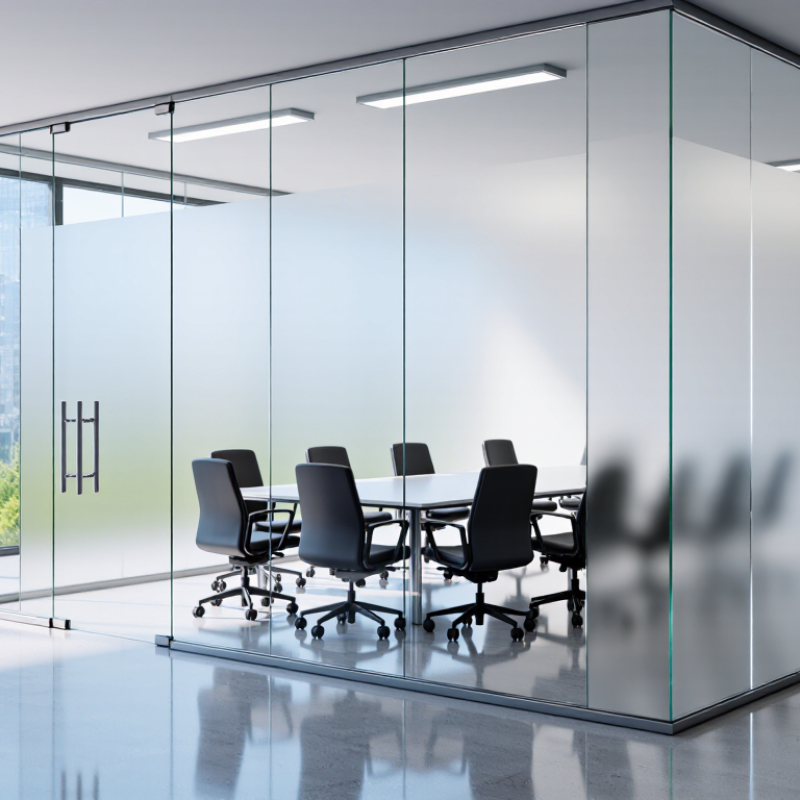
| 3 | Interior Office Partition Film | Electronic switching changes a transparent conference-room or workstation partition into a translucent privacy screen. | Usually installed on fixed tempered, laminated, or annealed interior glass partitions. | Instant visual privacy
Typically controlled by wall switch, remote, or automation system | Supports open-plan layouts while allowing private meetings, presentations, and flexible space management. | Privacy is visual rather than acoustic. Door gaps, side openings, and ceiling gaps may still allow visibility or sound transmission. | Corporate offices, coworking spaces, banks, and reception areas |
| 4 | Healthcare Privacy Film | Switchable opacity provides on-demand visual separation without requiring curtains or manually operated blinds. | Applied to consultation-room windows, examination-room partitions, observation areas, and selected doors. | Frosted on demand
Can return to a transparent state for supervision | Easy-to-clean surface, improved patient dignity, and better visibility when privacy is not required. | Specify compatible cleaning agents, sealed edges, electrical safety, hygiene procedures, and local healthcare regulations. | Hospitals, clinics, dental practices, and diagnostic centers |
| 5 | Projection-Ready PDLC Film | The opaque state acts as a rear-projection or front-projection surface, while the transparent state restores normal visibility through the glass. | Installed on glass walls, partitions, or display windows with a projector positioned according to the optical design. | Opaque for projection
Transparent for daylight visibility | Combines privacy, digital signage, presentations, and interactive visual communication in one surface. | Image quality depends on projector brightness, viewing angle, ambient light, film haze, surface uniformity, and screen size. | Showrooms, museums, education facilities, offices, and retail displays |
| 6 | Retail Display Window Film | Electronic switching changes the storefront from a clear window into a branded privacy or projection surface. | Applied to shopfront glazing or installed as laminated smart glass in display panels. | Clear or promotional screen
Can conceal displays outside operating hours | Supports dynamic advertising, seasonal campaigns, privacy, and controlled views into the store. | Assess direct sunlight, thermal loading, cleaning frequency, viewing distance, controller access, and local signage rules. | Retail stores, showrooms, shopping centers, and exhibition venues |
| 7 | Hospitality and Meeting-Room Glass | PDLC switching provides rapid privacy control for guest rooms, bathrooms, lounges, and conference facilities. | Used on interior glazing, bathroom panels, sliding doors, and meeting-room partitions. | Guest-controlled privacy
Can be integrated with room or building controls | Modern appearance, reduced reliance on curtains, and convenient control through switches, remotes, or automation platforms. | Control interfaces, fail-safe behavior, moisture exposure, cleaning requirements, and service access should be defined before installation. | Hotels, serviced apartments, restaurants, and event venues |
| 8 | Residential Smart Window Film | Switchable liquid-crystal technology provides controllable visual privacy for selected windows, doors, and interior partitions. | Typically installed on interior-facing glass where wiring and controller access can be concealed. | On-demand privacy
Commonly operated by a switch, remote, or smart-home relay | Useful for bathrooms, bedrooms, home offices, entrance sidelights, and open-plan living spaces. | PDLC is primarily a privacy technology, not a substitute for blackout blinds or solar-control glazing. Night-time privacy and lighting should be evaluated separately. | Homes, apartments, villas, and home offices |
| 9 | Educational and Training-Space Film | Transparent partitions can become opaque for examinations, group work, presentations, or temporary room division. | Installed on classroom partitions, laboratory observation panels, library rooms, and training-room glazing. | Flexible visual separation
Switching can be linked to room controls | Improves space flexibility while preserving daylight and allowing supervision when the glass is clear. | Specify impact-resistant glazing where required, protect controls from unauthorized use, and account for frequent cleaning and operation. | Schools, universities, laboratories, and training centers |
| 10 | Commercial and Architectural Façade Integration | Large-area PDLC glazing changes optical privacy across selected façade or interior zones through a low-voltage control system. | Generally implemented as custom laminated glazing or engineered panels rather than simple cut-to-size retrofit film. | Project-specific switching
May be zoned for independent control | Creates a high-impact architectural feature and can provide controlled visibility in selected areas. | Evaluate wind load, thermal stress, glass structure, electrical zoning, uniformity across large areas, maintenance access, and building-code compliance. | Commercial buildings, airports, cultural facilities, and premium developments |