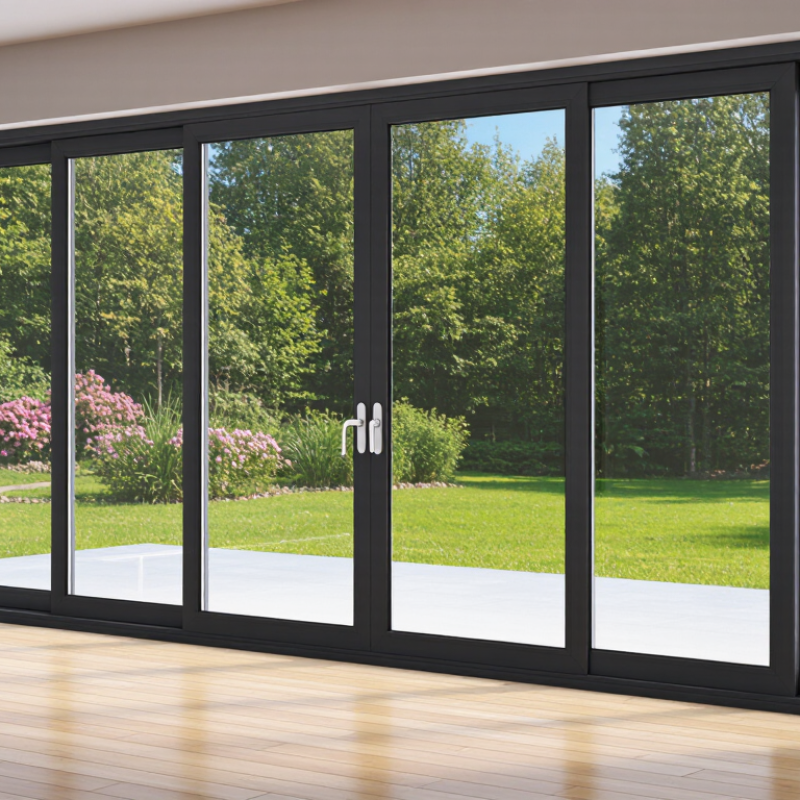
| Product Definition | A sliding door system using narrow aluminum profiles to maximize the visible glass area. | Creates a clean architectural appearance and allows more daylight into the room. | Confirm the actual visible frame width rather than relying only on the term “slim.” |
| Main Material | Aluminum alloy profiles, commonly finished with powder coating, anodizing, or liquid paint. | Aluminum is lightweight, corrosion-resistant, dimensionally stable, and suitable for large openings. | Request the alloy grade, profile thickness, surface-treatment standard, and finish warranty. |
| Common Opening Types | Two-panel, three-panel, four-panel, multi-track, pocket, and corner-opening configurations. | The configuration affects ventilation, access width, sightlines, and installation requirements. | Check whether custom panel layouts and corner connections are available. |
| Glass Options | Single, double, or laminated insulating glass, depending on the system and project requirements. | Glass selection influences thermal insulation, acoustic performance, safety, weight, and cost. | Ask for compatible glass thickness, safety-glass options, and tested performance data. |
| Thermal Performance | Thermal-break systems generally provide better insulation than non-thermal-break profiles. | Improves indoor comfort and can reduce heat transfer through the door assembly. | Request the complete door U-value or U-factor, not only the glass value. |
| Weather Resistance | Performance depends on seals, drainage design, track construction, glass installation, and correct fitting. | Reduces the risk of air leakage, water penetration, and wind-related problems. | Request air, water, and wind-load test results applicable to the intended project. |
| Operating Hardware | Rollers, tracks, handles, locks, gaskets, bumpers, anti-lift devices, and optional soft-close mechanisms. | Hardware determines operating smoothness, security, service life, and maintenance needs. | Confirm roller load capacity, replacement availability, corrosion resistance, and warranty terms. |
| Maximum Panel Size | Varies according to profile design, glass composition, panel weight, hardware capacity, and wind conditions. | Oversized panels require stronger profiles, reinforced tracks, and appropriately rated rollers. | Obtain engineering calculations and approved maximum dimensions for each configuration. |
| Security Features | Multi-point locks, laminated safety glass, anti-lift blocks, reinforced keepers, and optional restrictors. | Helps prevent forced lifting, unauthorized opening, and glass-related injuries. | Check hardware configuration, lock testing, safety-glass compliance, and local code requirements. |
| Surface Finishes | Common options include white, gray, black, metallic, anodized, wood-look, and customized colors. | The finish affects appearance, UV resistance, scratch resistance, and long-term maintenance. | Request color samples and confirmation of the applicable coating or anodizing standard. |
| Installation Conditions | Requires accurate opening measurements, a level sill, suitable structural support, and correct drainage detailing. | Poor installation can reduce weather performance and cause difficult or uneven operation. | Ask for shop drawings, installation instructions, sill details, and site-support requirements. |
| Typical Applications | Residential balconies, patios, terraces, villas, apartments, hospitality areas, offices, and retail spaces. | Suitable where wide views, natural light, and connection between indoor and outdoor areas are priorities. | Verify that the selected system meets the project’s climate, building-code, and usage requirements. |
| Maintenance Requirements | Regular cleaning of tracks, inspection of seals, adjustment of rollers, and lubrication where recommended. | Routine care helps maintain smooth movement, drainage, sealing, and hardware performance. | Confirm cleaning methods, service intervals, spare-part support, and after-sales response. |
| Key Selection Criteria | Profile design, visible frame width, glass specification, thermal performance, weather testing, hardware quality, customization, and technical support. | A slim appearance alone does not guarantee structural strength, energy efficiency, or long-term reliability. | Compare complete tested systems and project-specific quotations instead of comparing frame prices alone. |