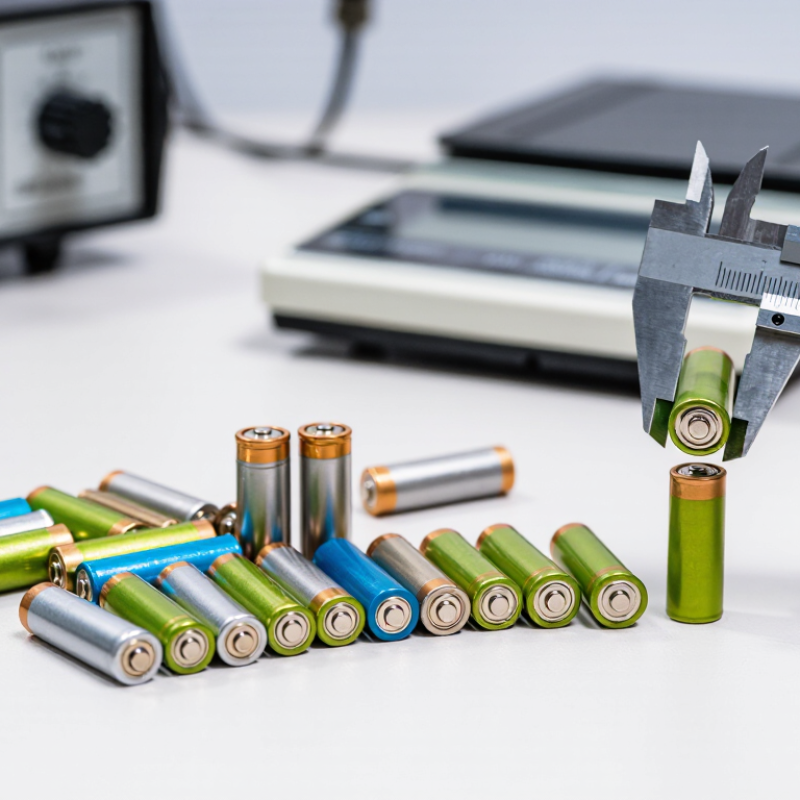
| Cell Format | 18 mm diameter × approximately 65 mm length | Determines mechanical fit, holder compatibility, pack dimensions, and enclosure design. | Confirm the exact cell drawing, including terminal design, insulation ring, protection circuit, and dimensional tolerances. |
| Nominal Voltage | 3.6 V or 3.7 V, depending on the cell specification | Affects battery-pack voltage calculations, charger selection, motor operation, and electronic-system compatibility. | Use cells with the same nominal voltage and chemistry throughout one battery pack. |
| Maximum Charge Voltage | Usually 4.20 V for conventional lithium-ion 18650 cells | An incorrect charging voltage can cause overheating, capacity loss, venting, or fire. | Match the charger and battery-management system to the cell manufacturer's specified charge limit. |
| Capacity | Approximately 1,500–3,500 mAh for commonly available 18650 cells | Higher capacity generally provides longer runtime, but may reduce maximum discharge capability. | Choose capacity according to runtime requirements, current demand, operating temperature, and allowable pack size. |
| Energy per Cell | Approximately 5.4–12.6 Wh, calculated from nominal voltage × rated capacity | Supports accurate runtime, shipping, and battery-pack energy calculations. | Calculate total pack energy from the actual tested capacity, not only the printed nominal value. |
| Continuous Discharge Current | Approximately 2–35 A, depending on chemistry, design, temperature, and test conditions | Determines whether the cell can safely power tools, mobility equipment, lighting, electronics, or high-load motors. | Select a verified continuous-current rating with a safety margin above the application's sustained load. |
| Pulse Discharge Current | Application-specific; often higher than the continuous rating for a short, controlled duration | Short acceleration or startup loads can cause voltage sag and excessive heat if pulse limits are misunderstood. | Do not use a pulse rating as a substitute for the continuous-discharge specification. |
| Cell Chemistry | Common lithium-ion chemistries include NMC, NCA, and LCO; chemistry-specific alternatives may also exist | Chemistry affects voltage, energy density, thermal behavior, service life, and discharge performance. | Prioritize high-energy cells for long runtime and high-power cells for heavy current demand, while following the approved system design. |
| Cycle Life | Often approximately 300–1,000 cycles under defined test conditions | Affects total ownership cost, replacement frequency, warranty planning, and sustainability. | Compare cycle-life data only when charge rate, discharge rate, depth of discharge, temperature, and end-of-life criteria are comparable. |
| Internal Resistance | Typically measured in milliohms; the value varies with temperature, state of charge, age, and test method | Lower resistance generally means less voltage sag and heat under load. | Request the test method and measurement conditions; compare cells from the same production batch whenever possible. |
| Operating Temperature | Many cells specify charging near 0–45°C and discharging near -20–60°C; exact limits vary | International products may face hot warehouses, cold transport routes, or outdoor operation. | Use thermal monitoring and protection; never charge a cell outside its specified charging-temperature range. |
| Weight | Approximately 40–50 g per cell for many standard 18650 designs | Influences shipping weight, portable-product design, pack energy density, and handling costs. | Verify actual measured weight because capacity, construction, and protective components can change the result. |
| Protected or Unprotected Design | Unprotected bare cells are common for battery packs; protected versions add an electronic protection circuit | Protection affects length, diameter, current capability, safety behavior, and device compatibility. | Use protected cells only when the product design supports them; battery packs normally require a properly designed BMS. |
| State of Charge for Transport | Lithium-ion cells are commonly prepared for transport at a low state of charge, often not exceeding 30% where applicable | State of charge influences transport safety, documentation, carrier acceptance, and shipping cost. | Confirm the current transport rules, carrier requirements, packaging method, and applicable UN 38.3 test status before shipment. |
| Compliance and Test Documentation | Relevant documentation may include UN 38.3 test evidence, safety data, product specifications, and applicable regional requirements | Documentation supports customs clearance, carrier approval, product liability management, and market access. | Request current, traceable documents for the exact cell model and production configuration. |
| Batch Consistency and Traceability | Capacity, voltage, resistance, and production-date records should be available for each supplied batch | Consistent cells are essential for safe series and parallel battery-pack assembly. | Use cells from matched batches and require incoming inspection, capacity testing, and resistance screening. |
| Best Application Match | High-energy: approximately 2,800–3,500 mAh; high-power: commonly approximately 1,500–2,500 mAh | The highest capacity cell is not always the best choice for high-current or high-temperature applications. | Choose the best balance of capacity, current, cycle life, thermal performance, compliance, and total delivered cost. |