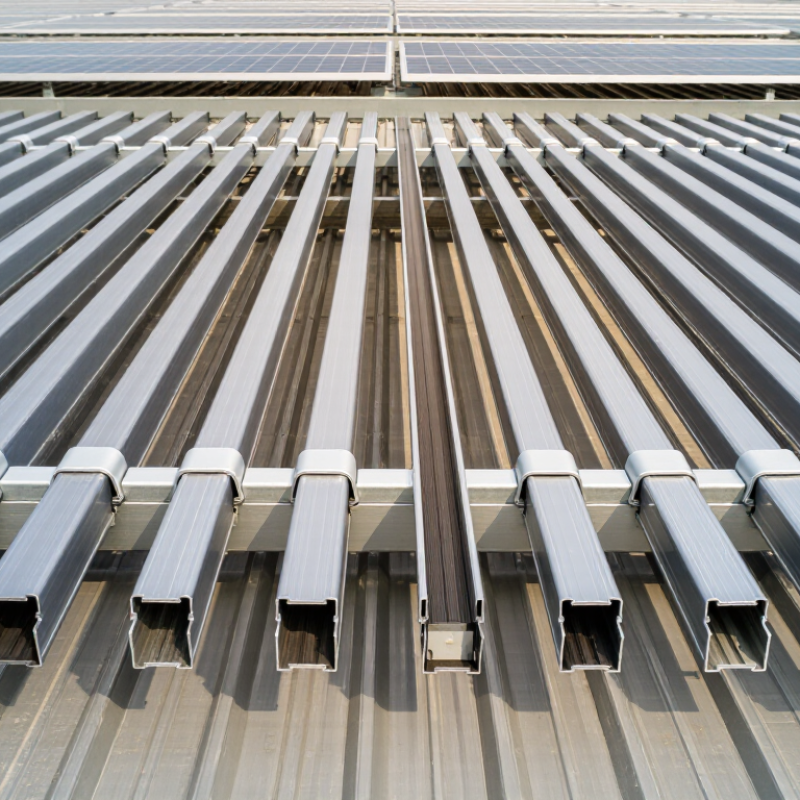
| What a solar rail is | An elongated structural member in a photovoltaic mounting system. Rails provide attachment points for modules and connect to roof or ground-mount supports. | Confirm the rail is designed for the intended mounting system, module layout, support spacing, and installation method. |
| How rails support panels | Module clamps or other approved attachments secure the panel frame to the rails. The rails transfer loads through brackets, feet, or other supports to the building or mounting structure. | Check that clamps and fasteners are compatible with the module frame and rail profile, and follow the system installation instructions. |
| Common rail material | Extruded aluminum alloys are commonly used for solar rails. Alloy and temper affect strength and mechanical properties; 6005-series alloys are used in some structural extrusions. | Request the exact alloy and temper, technical datasheet, and applicable material documentation rather than relying on a general “aluminum” description. |
| Surface finish | Rails may be supplied with a mill finish or an anodized surface. Finish selection and performance depend on the product and exposure conditions. | Ask for the finish specification and assess the installation environment, especially where salt, moisture, or industrial pollutants may be present. |
| Structural loads | Rails and their connections must be selected for project-specific actions, including dead load, wind, and, where relevant, snow or seismic effects. Required capacity depends on the site and system geometry. | Use project-specific engineering calculations and local building codes. Do not treat a rail’s standalone capacity as the capacity of the complete installed system. |
| Profile and span | Rail cross-sections, wall thicknesses, and support spacing vary by product and application. These factors influence stiffness, deflection, and connection design. | Compare profile drawings and engineering data for the proposed span and load case; dimensions alone do not establish structural suitability. |
| Roof or structure interface | Rails connect to the supporting structure through system-specific components, such as roof attachments or mounting brackets. The roof connection is part of the load path. | Verify attachment suitability for the roof material, structural substrate, waterproofing details, and local installation requirements. |
| Corrosion and material pairing | Corrosion performance depends on the environment, finish, drainage, and contact with other materials. Dissimilar-metal contact can require attention to galvanic corrosion risk. | Check fastener and connector materials, isolation requirements, and the system supplier’s guidance for the intended exposure conditions. |
| Standards and assessment | Relevant references depend on the market and system. Examples include EN 1999 for the design of aluminum structures, AS/NZS 1170 for structural design actions, and UL 2703 for applicable photovoltaic mounting and grounding/bonding system evaluations. | Confirm which standards and editions apply to the project, and request documentation for the complete mounting configuration—not just the rail component. |
| Manufacturing quality | Extruded profiles are commonly produced to defined cross-section and dimensional tolerances. Product consistency depends on process controls and inspection practices. | Request drawings, tolerances, inspection records, traceability information, and samples when evaluating suppliers for repeat orders. |
| Global sourcing and logistics | Rail lengths, packaging, accessories, and cut-to-length options vary by supplier and destination. Transport requirements can affect packaging and shipment planning. | Confirm available lengths, order quantities, lead times, packaging, export documentation, and local availability of compatible connectors and fasteners. |