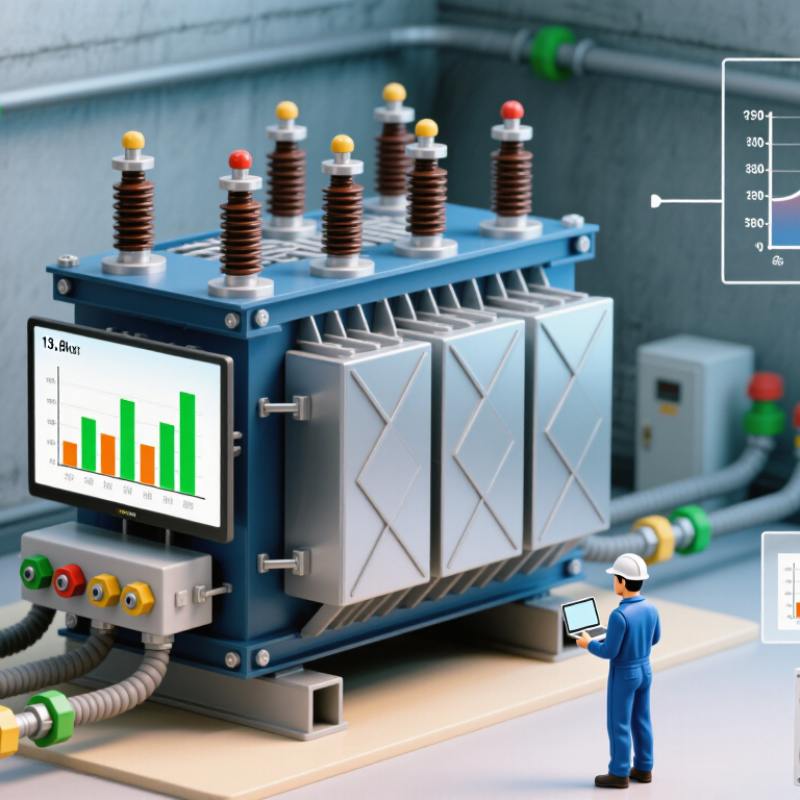
| 1 | Confirm Voltage Class and Ratio | Primary voltage: 13.8 kV
Common equipment class: 15 kV distribution class
Typical secondary options: 480 V, 4.16 kV, 2.4 kV, or another project-specific voltage
System frequency is commonly 60 Hz in North America. | Confirm the rated primary voltage, maximum system voltage, secondary voltage, phase arrangement, connection symbol, tap range, and impedance on the nameplate and approved drawings. | The transformer ratio must match the system design. Incorrect tap selection can cause excessive secondary voltage, motor damage, or poor voltage regulation. |
| 2 | Check Insulation and Dielectric Strength | For many 15 kV-class applications, a primary basic insulation level (BIL) of 95 kV is commonly specified. Typical power-frequency withstand values are defined by the applicable standard and transformer construction. | Request certified dielectric-test results, impulse-test requirements, clearances, creepage distances, insulation material details, and the specified BIL for both high-voltage and low-voltage windings. | Insulation coordination should consider lightning surges, switching surges, altitude, contamination, and the grounding method of the electrical system. |
| 3 | Select the Correct Cooling System | Liquid-immersed units commonly use ONAN cooling: Oil Natural, Air Natural. Larger units may add ONAF cooling: Oil Natural, Air Forced. Dry-type units may use AN or AF cooling. | Compare the continuous rating, self-cooled rating, forced-air rating, ambient temperature, altitude correction, enclosure ventilation, fan controls, and noise requirements. | Blocked ventilation can reduce transformer life and increase fire risk. Fans, thermostats, alarms, and control power should be tested during commissioning. |
| 4 | Evaluate Thermal Performance and Loading | Typical liquid-immersed transformer designs use a 65°C average winding temperature rise or another value required by the applicable standard. Dry-type temperature-rise ratings vary by insulation system and design. | Review the temperature-rise test, ambient-temperature assumptions, overload capability, load profile, harmonic content, and expected short-circuit duty. Consider a K-factor or derating requirement for nonlinear loads. | Frequent overloading accelerates insulation aging. Harmonic currents can create additional winding and tank heating even when the measured average load appears acceptable. |
| 5 | Specify Protection and Monitoring | Common protection provisions include primary overcurrent protection, surge arresters, pressure-relief devices, liquid-level indication, temperature indication, and ground-fault protection. Conservator-type liquid units may also use gas-actuated protection. | Confirm alarm and trip settings, relay coordination, current-transformer ratios, control voltage, remote contacts, trip-circuit supervision, and compatibility with the facility protection system. | Protection settings must coordinate with upstream and downstream devices so that faults are cleared quickly without unnecessary loss of service. |
| 6 | Review Grounding, Enclosure, and Installation Safety | Specify the neutral grounding method, tank grounding points, cable or bus entry, enclosure rating, access control, internal barriers, arc-flash requirements, and required working clearances. | Check the grounding conductor size, bonding points, cable bending space, pad or foundation loading, lifting provisions, ventilation clearances, weather exposure, and indoor or outdoor installation conditions. | The tank, enclosure, cable shields, neutral, and system grounding network must be bonded according to the approved electrical design. Installation and maintenance require qualified personnel. |
| 7 | Demand Testing, Documentation, and Compliance | Typical factory documentation includes a nameplate, wiring diagram, routine test report, ratio and polarity results, winding-resistance results, insulation-resistance results, leak test results for liquid units, and applicable compliance certificates. | Confirm compliance with the project standard, local electrical code, environmental requirements, transportation limits, warranty terms, spare-parts list, maintenance schedule, and commissioning procedure. | Do not energize until installation inspection, torque verification, insulation testing, phase identification, grounding checks, protection testing, and oil or enclosure inspection are complete. |