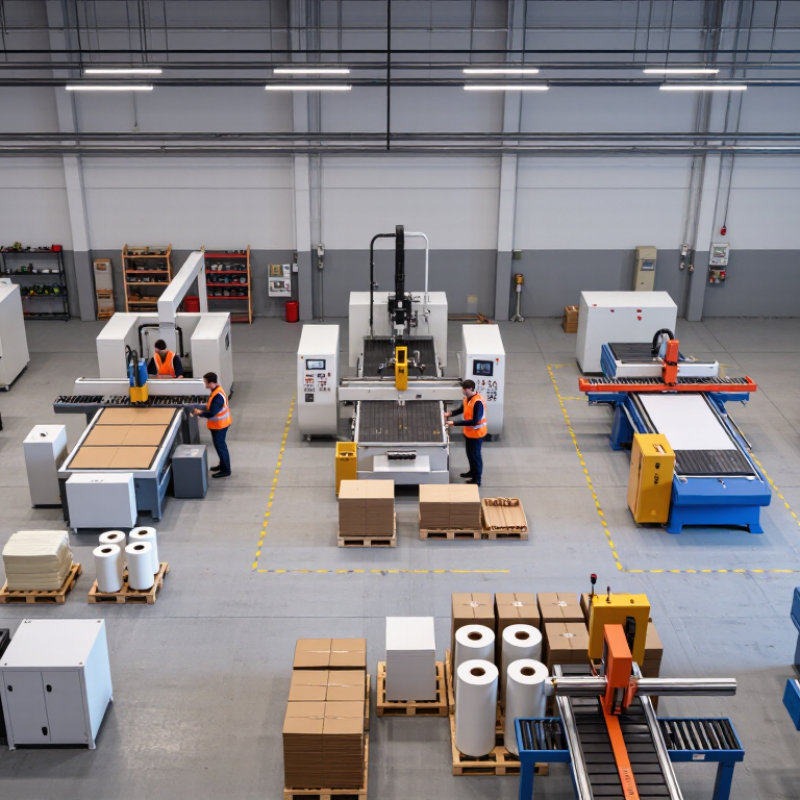
| 1 | Flatbed Digital Cutting Machine | Short runs, prototypes, samples, packaging, signage and customized products | Computer-controlled tangential knife, oscillating knife, creasing wheel or pen tool | Corrugated board Foam Rubber Gaskets Textiles Leather | Up to approximately 50 mm, depending on tool and material | 600 × 900 mm to 2,000 × 3,000 mm | Approximately ±0.1 to ±0.3 mm | Approximately 20–60 m/min tool speed | Creates cut and crease patterns digitally; does not normally require a physical die | Excellent for variable designs and low tooling cost; throughput is usually lower than rotary or platen production systems |
| 2 | CNC Oscillating-Knife Cutter | Thick, soft and layered materials used in industrial fabrication | High-frequency reciprocating blade with optional routing, creasing or drilling tools | Foam Carpet Insulation Felt Gasket sheet Composite board | Approximately 1–100 mm, depending on material density | 1,500 × 3,000 mm to 2,500 × 8,000 mm | Approximately ±0.2 to ±0.5 mm | Approximately 10–40 m/min cutting speed | Produces digital profiles without steel-rule dies; suitable for trial parts and small batches | Strong choice for thick materials; blade selection, compression control and dust management affect results |
| 3 | CO₂ Laser Cutting Machine | Sealed edges, intricate shapes, non-contact cutting and fine engraving | Focused infrared laser beam that melts, vaporizes or chars the material | Acrylic Wood Paper Fabric Leather Rubber | Approximately 0.1–25 mm, depending on material and laser power | 600 × 900 mm to 2,000 × 3,000 mm | Approximately ±0.05 to ±0.15 mm | Approximately 300–1,500 mm/s travel speed | Cuts digital die outlines and can engrave registration marks; physical dies are not normally required | Provides clean detail and low mechanical force; requires ventilation and may discolor or thermally affect some materials |
| 4 | Flatbed Die-Cutting Press | Medium- to high-volume packaging, labels, gaskets and shaped sheet products | A reciprocating platen applies force through a prepared steel-rule or solid cutting die | Paperboard Corrugated sheet Foam Felt Leather Thin plastics | Approximately 0.2–10 mm, depending on press force and die design | 400 × 600 mm to 1,600 × 2,500 mm | Approximately ±0.1 to ±0.3 mm | Approximately 1,500–8,000 sheets or strokes per hour | Uses interchangeable steel-rule or solid dies for cutting, creasing, embossing and perforating | High repeatability and fast cycle times; tooling cost and changeover time should be included in total cost calculations |
| 5 | Rotary Die-Cutting Machine | Continuous web production of labels, seals, medical components and flexible packaging | A cylindrical engraved or flexible rotary die cuts material as it moves through the machine | Labels Adhesive films Paper web Thin foil Flexible laminates | Approximately 0.05–3 mm | Web widths of approximately 100–1,600 mm | Approximately ±0.05 to ±0.2 mm | Approximately 20–150 m/min web speed | Uses rotary dies for high-speed continuous cutting, kiss-cutting, creasing, perforation and waste stripping | Best for long runs and consistent repeat work; cylinder tooling and setup are less economical for frequent design changes |
| 6 | Hydraulic Traveling-Head Press | Leather goods, footwear components, seals, foam parts and layered sheet cutting | A hydraulic-powered cutting head travels across the worktable and presses a cutting die into the material | Leather Rubber Foam EVA Synthetic materials | Approximately 1–100 mm, depending on material and layer count | 1,000 × 1,500 mm to 2,000 × 3,000 mm | Approximately ±0.2 to ±0.5 mm | Approximately 15–40 cutting cycles per minute | Uses replaceable profile dies and can cut multiple layers in one operation | Offers broad material coverage and strong cutting force; energy use, die height and operator loading affect productivity |
| 7 | Waterjet Cutting Machine | Hard, heat-sensitive or multi-material parts requiring cold cutting | High-pressure water, with abrasive particles added when cutting hard materials | Metal Stone Glass Composites Rubber Plastic | Approximately 1–150 mm, depending on material and pump capacity | 1,000 × 2,000 mm to 2,000 × 6,000 mm | Approximately ±0.05 to ±0.2 mm | Approximately 50–600 mm/min cutting speed | Produces digital profiles without physical dies; useful for prototypes, replacement parts and low-volume production | Creates a minimal heat-affected zone; water treatment, abrasive disposal, noise and operating cost require planning |