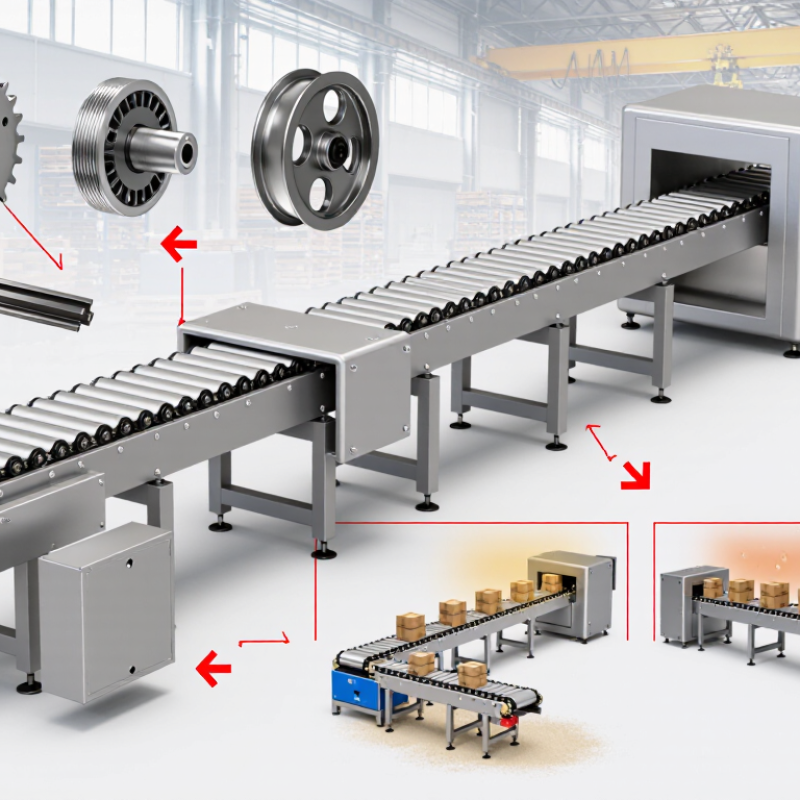
| Load and Capacity Engineering | Capacity must be calculated from product weight, pitch, speed, accumulation, incline, and duty cycle rather than selected from a standard catalog size. | A documented calculation showing chain pull, allowable working load, motor torque, safety factor, and maximum accumulated product load. | Request the conveyor calculation sheet and compare it with actual product weight, spacing, speed, and operating hours. | Critical |
| Chain and Sprocket Selection | The chain, sprockets, guides, and wear strips must be matched as one system; material selection depends on load, temperature, moisture, chemicals, and sanitation requirements. | Traceable chain specifications, sprocket material details, wear-strip material, rated working load, and replacement-part references. | Check material certificates, chain identification, sprocket tooth profile, and compatibility between chain and guide components. | Critical |
| Speed Control | Variable-speed operation is normally required when the process includes accumulation, indexing, product transfer, or changing production rates. | A defined speed range, drive sizing data, variable-frequency-drive compatibility, and documented acceleration and deceleration settings. | Review the control philosophy and perform a factory or site test at minimum, nominal, and maximum operating speeds. | High |
| Frame and Structural Integrity | The frame should be designed for operating load, impact, thermal movement, support spacing, and installation conditions, not only static self-weight. | General arrangement drawings, frame material and thickness, support-load data, deflection assumptions, and weld-quality requirements. | Review structural drawings and inspect welds, levelness, support spacing, and frame deflection during commissioning. | Critical |
| Safety Compliance | The system should address guarding, emergency stops, accessible nip points, lockout procedures, warning labels, and electrical safety requirements. | A documented risk assessment and compliance package referencing applicable requirements such as ASME B20.1, ISO 12100, ISO 13850, and IEC 60204-1 where applicable. | Request the risk assessment, safety-circuit drawings, emergency-stop test records, and applicable conformity documentation. | Critical |
| Sanitary and Corrosion Resistance | Food, pharmaceutical, chemical, and outdoor applications require materials, finishes, drainage, and cleaning methods suited to the environment. | Specified stainless-steel grade, surface-finish information, drainable design, compatible lubricants, and cleaning or washdown limitations. | Confirm material certificates, surface-finish records, chemical-compatibility data, and the recommended cleaning procedure. | High |
| Lubrication and Wear Management | Wear parts should have a defined service interval based on load, speed, contamination, temperature, and operating hours. | Lubrication points, lubricant specifications, chain-elongation limits, wear-strip replacement criteria, and preventive-maintenance schedules. | Review the maintenance manual and confirm that wear indicators and replacement procedures are practical for site personnel. | High |
| Noise and Vibration Control | Noise and vibration should be evaluated during normal operation, especially at transfers, sprockets, curves, and high-speed sections. | Noise-control design features, alignment tolerances, chain-tension requirements, and optional factory noise or vibration measurements. | Conduct an acceptance test under normal production load and record abnormal noise, vibration, and tracking behavior. | Medium |
| Controls and Integration | Industrial conveyors should support clear control states, interlocks, fault reporting, and communication with the plant control system. | I/O list, electrical schematics, PLC or drive interface details, safety-circuit architecture, alarms, and communication protocol information. | Test start permissives, downstream and upstream interlocks, fault recovery, emergency stops, and communication signals. | Critical |
| Factory Acceptance Testing | A repeatable factory acceptance test should verify dimensions, speed, load behavior, safety functions, controls, and product handling before shipment. | A signed FAT procedure with measurable acceptance criteria, test records, punch-list control, and change-management records. | Attend the FAT remotely or on site and require closure of all critical punch-list items before delivery. | High |
| Installation and Commissioning | Installation quality affects chain tracking, sprocket alignment, product transfer, noise, and service life. | Installation drawings, leveling and alignment tolerances, anchoring details, startup checklist, and trained commissioning support. | Use a site commissioning checklist covering alignment, chain tension, guarding, controls, emergency stops, and loaded operation. | High |
| Spare Parts Availability | Critical wear and drive components should be identifiable and available for the expected service period. | Parts list with item numbers, recommended start-up spares, lead times, interchangeability information, and end-of-life notification practices. | Obtain written lead-time commitments for chain, sprockets, bearings, wear strips, motors, sensors, and safety components. | High |
| Documentation Quality | Complete technical documentation should be delivered in the operating language before final handover. | Approved drawings, manuals, wiring diagrams, bills of materials, certificates, maintenance schedules, and software backups where applicable. | Use a document register and withhold final acceptance until required revisions and as-built documents are complete. | High |
| Quality Management | A controlled quality system should manage design changes, supplier controls, inspection records, nonconformities, and corrective actions. | Current quality-management certification or equivalent documented procedures, inspection plans, traceability records, and corrective-action reports. | Review the quality certificate scope, audit selected records, and verify that the certificate applies to the manufacturing location. | High |
| Lifecycle Cost | Total cost should include energy, lubrication, wear parts, downtime risk, maintenance labor, spare parts, and expected operating life. | A total-cost-of-ownership estimate with assumptions for duty cycle, maintenance intervals, consumables, service response, and replacement components. | Compare at least three technically equivalent proposals using the same production, labor, energy, and maintenance assumptions. | Critical |