| Single-Girder Full Gantry Crane | One main bridge girder supported by two rigid end carriages and four or more legs. The hoist trolley runs beneath or along the lower flange of the girder. | Up to approximately 20 t | 8–35 m | 6–18 m | Powered wheels travel on ground rails or embedded runway tracks. | General manufacturing, workshops, maintenance yards, and light-to-medium outdoor handling. | Lower steel weight and investment cost; suitable for moderate loads. Less suitable for very high capacities, long spans, or intensive heavy-duty cycles. |
| Double-Girder Full Gantry Crane | Two parallel main girders connected to rigid legs and end carriages. A top-running trolley or open winch system travels on rails mounted above the bridge girders. | 10–500 t or more, depending on design duty | 15–40 m | 9–30 m | Motorized end carriages run on parallel ground rails. | Steel yards, shipyards, precast concrete plants, heavy fabrication, and outdoor assembly. | High load capacity, improved stiffness, greater hook height, and better control of deflection. Requires more steel, stronger foundations, and higher installation cost. |
| Semi-Gantry Crane | One side of the bridge is supported by legs running on a floor rail, while the opposite side runs on an elevated runway beam attached to a building column or support structure. | 1–50 t | 8–30 m | 6–20 m | Combined ground-level and elevated runway travel. | Facilities with limited outdoor space, workshops beside buildings, loading areas, and production extensions. | Uses existing building structure on one side and saves floor space. Requires adequate building-column strength and precise alignment between runways. |
| Rubber-Tyred Gantry Crane | Steel bridge, legs, end carriages, lifting trolley, and rubber tires form a self-contained mobile gantry system. Power may be supplied by a cable reel, battery system, or onboard engine-generator set. | 10–100 t; specialized models may be higher | 15–35 m | 8–25 m | Steerable rubber tires allow longitudinal travel and, on suitable designs, limited transfer between lanes. | Container yards, precast production, ship components, heavy equipment assembly, and temporary work sites. | Flexible movement without permanent rails. Requires a level, load-bearing surface, tire maintenance, steering control, and strict wind-safety procedures. |
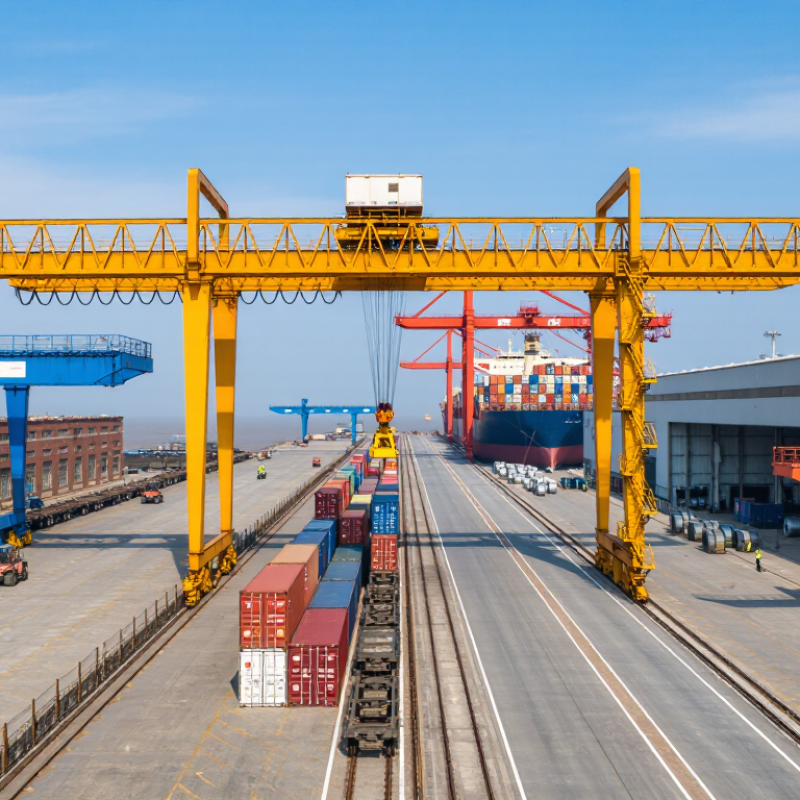
| Rail-Mounted Gantry Crane | A rigid bridge and leg frame is supported by bogies or end carriages that run on fixed parallel rails. The lifting trolley generally travels across the bridge span. | 20–100 t; higher capacities are available for specialized duties | 20–45 m | 10–30 m | Motorized wheels travel on dedicated rails, normally with guided and synchronized drives. | Container handling, intermodal terminals, large storage yards, and repetitive heavy outdoor lifting. | Accurate positioning, high utilization, and efficient repetitive operation. Needs rail foundations, drainage, alignment checks, and a dedicated operating lane. |
| Single-Leg or Cantilever Gantry Crane | The bridge is supported by a leg frame on one side and an elevated building runway, column, or cantilever support on the other side. The bridge may extend beyond one or both support lines. | 1–20 t | 8–30 m | 5–18 m | One end runs on a ground rail; the other runs on an elevated runway or support beam. | Material transfer along building edges, outdoor loading zones, and production lines requiring side access. | Good use of restricted floor space and convenient access from one side. Load distribution and cantilever deflection require detailed structural verification. |
| Container Gantry Crane | Usually a double-girder bridge with tall rigid legs, a spreader-equipped trolley, long travel beams, and container-clearance geometry. The structure may be rail-mounted or rubber-tyred. | 30–65 t under spreader; greater loads may require special lifting gear | 20–45 m | 12–30 m, depending on stacking requirements | Rail-mounted travel or rubber-tire travel along container blocks and transfer lanes. | Container terminals, inland freight yards, rail-transfer facilities, and high-density storage blocks. | Efficient stacking and precise container handling. Requires spreader compatibility, anti-sway control, lane planning, wind protection, and carefully designed pavement or rails. |
| Heavy-Duty Double-Girder Gantry Crane with Auxiliary Hoist | Two deep main girders carry a primary trolley and an independent auxiliary hoist. The legs, end carriages, brakes, buffers, and power systems are designed for high duty cycles and large impact loads. | 50–500 t or more, subject to engineering design | 15–40 m | 10–30 m | Powered rail travel with synchronized drives and heavy-duty wheel assemblies. | Heavy machinery assembly, power-generation components, shipbuilding, steel handling, and large structural fabrication. | Supports tandem lifting, fine positioning, and demanding service classes. Has the highest structural, foundation, electrical, inspection, and maintenance requirements. |