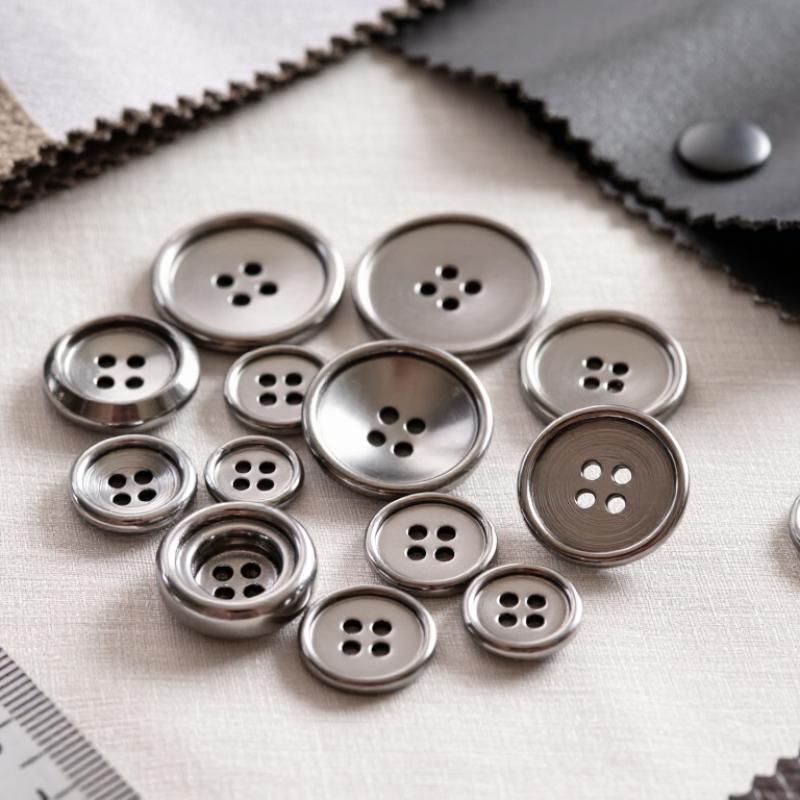
| Definition | Stainless steel button | A fastening or decorative button made from corrosion-resistant steel containing at least approximately 10.5% chromium. The chromium forms a passive surface layer that helps protect the metal from corrosion. | Garments, uniforms, coats, bags, footwear, upholstery, accessories, and decorative products. | Suitable when durability, a metallic appearance, and resistance to moisture are required. |
| Material Grade | 304 stainless steel | Common austenitic stainless steel with good corrosion resistance, formability, and weldability. It is generally non-magnetic in the annealed condition, although forming can introduce slight magnetism. | Fashion garments, coats, shirts, bags, uniforms, and general indoor or outdoor apparel. | Best general-purpose option for most clothing and accessory applications. |
| Material Grade | 316 stainless steel | Contains molybdenum, which improves resistance to chlorides and salt-related corrosion compared with 304 stainless steel. It is generally non-magnetic in the annealed condition. | Marine clothing, coastal outdoor products, swimwear accessories, medical garments, and products exposed to perspiration or salt air. | Choose for higher corrosion resistance in marine, coastal, or chemically demanding environments. |
| Material Grade | 430 stainless steel | Ferritic stainless steel with good resistance to atmospheric corrosion and a naturally magnetic structure. It is usually less corrosion-resistant than 304 and 316. | Decorative buttons, indoor garments, light-duty uniforms, bags, and applications where magnetic response is useful. | Suitable for cost-sensitive indoor use and designs that require a magnetic stainless steel grade. |
| Corrosion Exposure | Indoor and normal daily wear | Usually exposed to air, skin contact, occasional washing, and normal humidity. Corrosion requirements are moderate. | Shirts, jackets, trousers, handbags, footwear, and everyday accessories. | 304 is normally sufficient; 430 may be suitable for indoor, cost-sensitive products. |
| Corrosion Exposure | High humidity, perspiration, or frequent washing | Repeated contact with water, detergents, perspiration, and humidity can increase staining or surface corrosion if the grade or finish is unsuitable. | Workwear, sportswear, uniforms, children's clothing, and washable bags. | Use 304 with a suitable protective finish; consider 316 for severe exposure. |
| Corrosion Exposure | Salt air, seawater, or chloride exposure | Chloride ions can cause localized corrosion, especially pitting and crevice corrosion, on less-resistant stainless steel grades. | Marine apparel, coastal outdoor products, sailing clothing, and seaside accessories. | 316 is the preferred choice; avoid relying on 430 for prolonged chloride exposure. |
| Magnetism | Non-magnetic or low-magnetic requirement | Austenitic grades such as 304 and 316 are generally non-magnetic when annealed, but cold working, stamping, or forming may create slight magnetism. | Decorative apparel, accessories, garments used near sensitive instruments, and products requiring a low-magnetic response. | Select annealed 304 or 316 and confirm the finished button's magnetic behavior by testing. |
| Magnetism | Magnetic requirement | Ferritic 430 stainless steel is naturally magnetic. Magnetic response depends on the button's final composition and manufacturing process. | Magnetic closures, practical workwear components, and designs requiring magnetic attraction. | Use 430 when magnetic performance is required and the environment is not highly corrosive. |
| Surface Finish | Polished or mirror finish | Reflective, bright appearance that emphasizes the metallic character of the button. Fingerprints and scratches may be more visible. | Fashion coats, formalwear, handbags, footwear, and decorative products. | Choose for a bright premium appearance; include careful packaging to reduce scratching. |
| Surface Finish | Brushed or satin finish | Fine directional texture with lower reflectivity. It can reduce the visibility of minor fingerprints and surface marks. | Workwear, uniforms, casual jackets, bags, furniture textiles, and modern minimalist designs. | A practical choice for frequent-use products and understated styling. |
| Surface Finish | Bead-blasted or matte finish | Uniform low-gloss appearance created by fine surface texturing. It offers a contemporary look but may require careful cleaning to prevent residue buildup. | Outdoor apparel, industrial-style clothing, bags, accessories, and contemporary fashion. | Select when glare reduction and a modern matte appearance are important. |
| Button Construction | One-piece metal button | Made from a single metal body with no separate decorative shell. It offers a simple structure and a solid visual appearance. | Heavy jackets, workwear, uniforms, denim garments, and durable accessories. | Best for robust designs where strength and simple maintenance are priorities. |
| Button Construction | Two-piece or multi-piece button | Combines a visible face with a separate shank, back, or attachment component. It allows more decorative shapes and styling options. | Fashion coats, formalwear, bags, footwear, and decorative garments. | Choose when appearance and design flexibility are more important than the simplest construction. |
| Attachment Method | Sew-through button | Has two or four holes through the button face. It is attached with thread and is easy to replace or repair. | Shirts, knitwear, uniforms, children's clothing, coats, and craft products. | Suitable for products requiring easy sewing, replacement, and maintenance. |
| Attachment Method | Shank button | Has a loop or shank on the back instead of visible holes on the front. It creates a clean decorative face and provides space beneath the button. | Coats, blazers, formalwear, handbags, upholstery, and decorative accessories. | Choose for a cleaner front appearance and thicker fabrics. |
| Attachment Method | Snap or press-stud component | Uses a male-and-female fastening system that opens and closes by pressing the components together. Installation requires compatible parts and suitable setting equipment. | Babywear, sportswear, workwear, jackets, bags, and functional closures. | Use when quick opening and closing is more important than traditional button styling. |
| Size Selection | Small button: approximately 8–15 mm diameter | Lightweight and visually subtle. It is generally suitable for lighter fabrics and smaller garment areas. | Shirts, blouses, cuffs, children's garments, light accessories, and small pockets. | Select according to fabric thickness, buttonhole size, and required visual scale. |
| Size Selection | Medium button: approximately 16–25 mm diameter | Balances visibility, usability, and fastening strength for many standard garments. | Jackets, cardigans, uniforms, medium-weight shirts, and bags. | A versatile range for general apparel and accessory applications. |
| Size Selection | Large button: approximately 26 mm diameter or larger | Creates a strong decorative effect and may require reinforced fabric, larger buttonholes, and stronger attachment thread. | Overcoats, heavy jackets, capes, upholstery, statement fashion, and large bags. | Choose for heavy fabrics or visual emphasis; verify weight and attachment strength. |
| Care and Quality Check | Finish, edges, and attachment strength | Check for smooth edges, uniform plating or surface texture, secure shanks or holes, consistent dimensions, and absence of sharp burrs. | All apparel, accessory, and upholstery applications. | Request samples and test abrasion, washing, pull strength, and color or finish stability before production. |
| Final Selection Rule | Match grade, finish, construction, and size to the end use | Material grade controls corrosion resistance, the finish controls appearance and surface behavior, construction controls attachment, and size controls usability and visual balance. | Any product using stainless steel buttons. | For most applications, begin with 304; upgrade to 316 for chloride exposure and select 430 when magnetic response or cost efficiency is prioritized. |